Glossary
The academic writing glossary
Academic writing runs on terms nobody ever defines for you — patchwriting, hedging, a similarity score, IMRaD. Each entry here gives you the definition, why it matters while you are writing, and the neighboring term it gets confused with.
36 TERMS
Every term, A to Z
Abstract
An abstract condenses a paper into a standalone passage of roughly 150–300 words covering the problem, the method, the findings, and why they matter. It has to make sense to someone who never reads the rest, because it is what appears in databases and search results and does most of the work of finding readers.
Academic integrity
Academic integrity covers the commitments that make scholarly claims trustworthy: reporting honestly what you did, crediting whoever got there first, and being transparent about the help you had — from a colleague, an editor, or a tool. Your institution codifies this in a policy, and that policy, not general custom, governs your work.
Academic register
Scholarly writing is expected to hold a particular tone — precise, reserved about the writer’s feelings, cautious about claims, free of contractions, slang, and rhetorical questions. That tone is academic register. It is not a synonym for difficulty: clear sentences are fully academic, and needless abstraction is not a virtue.
AI detector
An AI detector estimates, from statistical properties of a text such as how predictable each word is, the probability that a passage was machine-generated. The output is a likelihood, not evidence. Detectors produce false positives, and they flag writers whose first language is not English disproportionately often.
Bibliography
A bibliography lists, alphabetically at the end of a paper, every source you consulted — whether or not each one is cited in the text. Chicago and several humanities fields use the word that way. APA and MLA reserve their lists for works actually cited, which makes those lists narrower than a true bibliography.
BibTeX
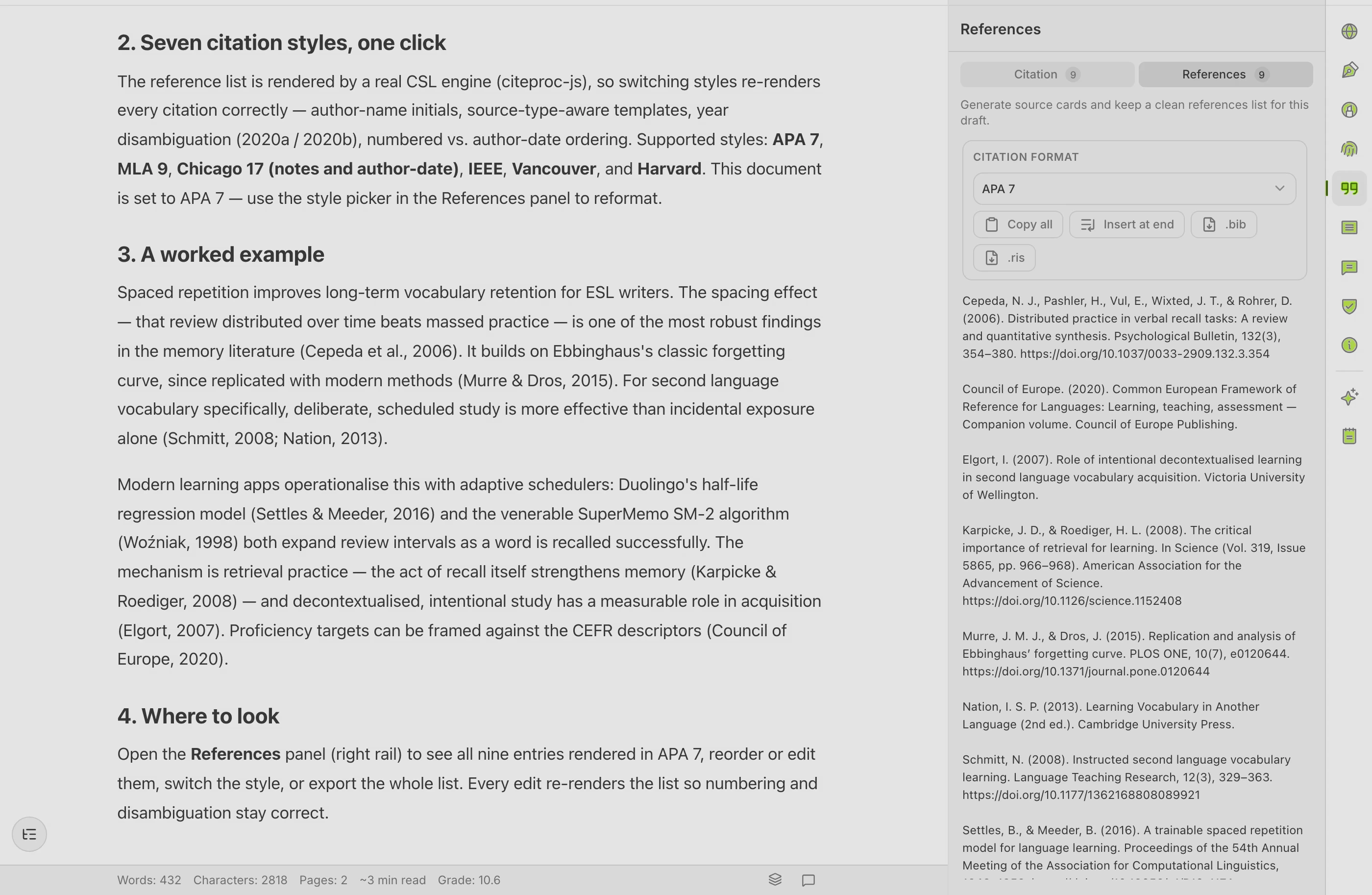
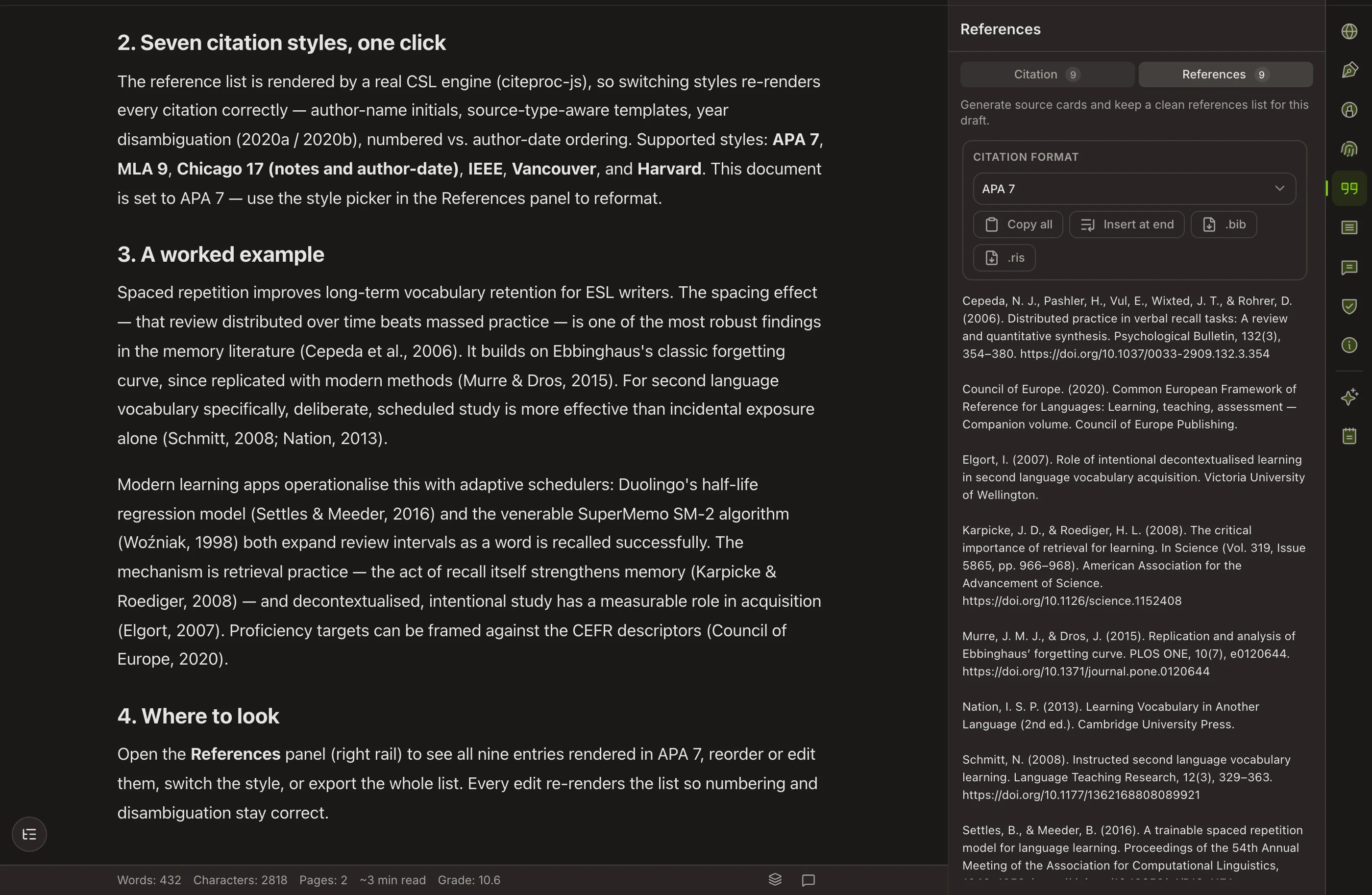
BibTeX stores bibliographic records as plain text, one entry per source, each tagged with a type such as @article or @book and a unique citation key. A LaTeX document pulls from the .bib file and builds the reference list automatically, so switching styles means editing one line rather than every entry.
Citation style
Every citation style — APA, MLA, Chicago, IEEE, Vancouver, Harvard — is a published rulebook governing how you signal a source in the text and format it in the reference list: punctuation, author order, italics, date placement. Your journal, department, or instructor decides which one applies; it is not usually a free choice.
Common knowledge
Some facts your readers will accept without a source: undisputed dates, standard definitions, and findings that appear unattributed throughout the literature of your field. That is common knowledge, and it needs no citation. The boundary moves with audience — what passes in a specialist journal may still need a source in an undergraduate essay.
DOI
Publishers assign a DOI — a Digital Object Identifier — to an article, dataset, or preprint as a permanent alphanumeric handle that resolves to the work’s current location. Unlike a journal URL, it survives a site redesign or a change of publisher, which is why most citation styles now require it when one exists.
Et al.
“Et al.” abbreviates the Latin et alii, meaning “and others.” It stands in for co-authors you have chosen not to name in an in-text citation once a source passes a set number of authors. The period belongs on “al.” only — “et” is a complete word, not an abbreviation.
Hedging
Hedging matches the strength of a claim to the strength of its evidence through qualifying language — may, suggests, appears, in most cases. It is precision rather than timidity: correlational data supports “is associated with,” and writing “causes” instead states something the study did not actually show.
Hypothesis
A hypothesis predicts a specific relationship between variables in terms precise enough that data could contradict it. Falsifiability separates it from a hunch; being written before the analysis separates it from a conclusion. Exploratory and interpretive studies often have none, and inventing one afterward misrepresents how the work was done.
Ibid.
Short for the Latin ibidem, “in the same place,” ibid. replaces a footnote that would otherwise repeat the source cited immediately above it, with a page number added when the page differs. Chicago now prefers a shortened citation instead, and author–date styles such as APA never use it at all.
Impact factor
A journal’s impact factor averages the citations its articles from the two preceding years received during one year. The figure describes a journal, not a paper. Citation counts inside any journal are heavily skewed toward a few articles, so a high impact factor tells you little about the specific study in front of you.
IMRaD
IMRaD names the four-part structure of most empirical papers: Introduction, Methods, Results, and Discussion. Each part answers one question — why the study was done, how, what was found, and what it means — and content that belongs in one section is treated as a fault when it turns up in another.
In-text citation
Every borrowed idea in a paper carries an in-text citation: a brief marker — usually an author name plus a year, page, or number — that points to the full entry in your reference list. It attributes the source at the exact spot the borrowing happens, rather than lumping credit at the end.
Literature review
A literature review synthesizes existing scholarship on a topic into an argued account of what is known, what is contested, and what remains unexamined. It is organized by theme or debate rather than by article, and it ends by locating your own question inside the gap it has just described.
Meta-analysis
A meta-analysis statistically combines the results of separate studies measuring the same effect, weighting each by its precision, to produce a pooled estimate with a confidence interval. It usually sits inside a systematic review, and it is only as sound as the studies pooled — combining biased trials yields a precise wrong answer.
Nominalization
Nominalization turns a verb or adjective into a noun — analyze becomes analysis, apply becomes application — and then needs a weak verb to carry the sentence. A little is unavoidable in academic prose; stacked three deep it hides who did what, and sentences grow longer while saying less.
Open access
Open access means a published work is free to read online without a subscription, and often carries a license permitting reuse. Gold open access places the article on the publisher’s site, usually funded by a fee the author or funder pays; green open access deposits an accepted manuscript in a repository at no charge to anyone.
Paraphrasing
Paraphrasing restates a source’s point in your own sentence structure and vocabulary, at roughly the same length, with the citation kept. Done properly it requires understanding the idea well enough to rebuild it from nothing — which is why the reliable method is to close the source before you write the sentence.
Passive voice
The passive voice puts the thing acted on in the subject position — “the samples were incubated” — and lets you omit the actor entirely. It earns its place in a methods section, where the procedure matters more than who performed it, and costs you clarity anywhere the agent is actually the point.
Patchwriting
Patchwriting sits halfway between quoting and paraphrasing: you keep the source’s sentence skeleton and swap in synonyms, so the phrasing belongs to neither the author nor to you. Even with a citation attached, most institutions treat it as a form of plagiarism, because the language was never actually rewritten.
Peer review
In peer review, an editor sends a submitted manuscript to researchers working in the same field, who assess its methods, evidence, and contribution and recommend rejection, revision, or acceptance. The process filters and improves work; it does not verify raw data or guarantee that a published finding will hold up.
Plagiarism
Plagiarism is presenting someone else’s words, ideas, structure, data, or images as your own — by omitting attribution, by attributing so loosely that the borrowing is hidden, or by reproducing phrasing while implying it is yours. The act defines it, not the outcome: unattributed text is plagiarism whether or not anyone ever notices.
Preprint
Researchers post preprints — complete manuscripts — to public servers such as arXiv, bioRxiv, or SSRN before, or instead of, journal peer review. A preprint is citable, timestamped, and usually carries its own DOI, but no reviewer has scrutinized it, so its claims deserve weighing rather than assuming.
Primary source
Direct evidence produced by a participant or an instrument at the time of the event or study counts as a primary source: original data, an interview transcript, a manuscript, a statute, the first report of an experiment. You analyze it yourself rather than relying on someone else’s account of it.
Readability
Readability describes how much effort a reader spends decoding your sentences rather than thinking about your argument. Formulas such as Flesch–Kincaid approximate it from sentence and word length, which makes them a rough signal only — technical vocabulary is not a defect, and a short sentence can still be entirely unclear.
Research question
A research question states, in one interrogative sentence, what a study exists to find out — narrow enough that you can say what evidence would answer it and what would not. Vague questions produce unfocused papers; a workable one names the population, the variables or texts, and the relationship being examined.
Secondary source
A secondary source interprets, summarizes, or argues about evidence it did not itself generate: a review article, a textbook chapter, a critical monograph. It is genuinely useful for orientation and for locating debates, but citing it as though it were the underlying evidence misrepresents where your support actually comes from.
Self-plagiarism
Self-plagiarism means reusing your own previously submitted or published work as if it were new, without disclosing the earlier version. Submitting one essay to two courses, or recycling a methods section into a second paper with no note and no citation, both count. The offense is the undisclosed double credit, not the repetition itself.
Signposting
Signposting is the language that tells readers where they are and where they are going: section previews, transitions that name the logical move, and sentences that state what has just been established. Done well it is nearly invisible, and its absence is what supervisors mean when they write “hard to follow.”
Systematic review
A systematic review answers a defined question by searching the literature according to a protocol registered in advance, screening every hit against stated inclusion criteria, and appraising the studies that survive. The method is documented in enough detail that another team could repeat it and reach the same set of included studies.
Thesis statement
One or two sentences near the end of your introduction carry the arguable claim the whole paper defends: that is the thesis statement. Because the claim is contestable, a reader could in principle disagree with it — which is precisely what separates a thesis from a description of your topic.
Turnitin similarity score
Turnitin reports a similarity score: the percentage of a submission that matches text in its comparison databases. The number measures overlap, not dishonesty — a correctly quoted and fully cited passage raises it exactly as much as an uncited one. Only reading the matched sources tells you what the figure means.
Works Cited
MLA calls its end-of-paper source list the Works Cited page, and it holds only the sources you actually cited. Every in-text citation must have a matching entry, and every entry must be pointed to by at least one citation — the two lists lock together with nothing left over.
Terms are the easy part
the paper is the work
Copyeditor keeps drafting, citations, paraphrase and export in one document — so the writing is the only thing you are managing.