Skip to content

Free tool

Sentence starters organized by what you are trying to do

A searchable list of academic sentence starters, grouped by paper section and by the rhetorical move you are trying to make.

Establishing the gap

  • Despite considerable work on X, little attention has been paid to Y.
  • Existing accounts of X tend to assume Y, an assumption that has not been tested directly.
  • What remains unclear is whether X holds under Y conditions.
  • These studies converge on X, but they diverge sharply on Y.

Stating your contribution

  • This paper addresses that gap by X.
  • We contribute to this literature in three ways.
  • The present study extends X by introducing Y.
  • Our aim is more modest: to establish whether X is observable at all.

Describing method

  • Participants were recruited through X between Y and Z.
  • We operationalized X as Y, following the approach used in earlier work on Z.
  • Data were analyzed using X; the full analysis script is available at Y.
  • To guard against X, we pre-registered the analysis plan before collection began.

Reporting results

  • The pattern in Figure 1 is consistent across all three conditions.
  • X increased under Y, though the effect was smaller than expected.
  • No reliable difference emerged between X and Y.
  • Table 2 summarizes the estimates; the text focuses on the two that bear on our question.

Hedging a claim

  • These results suggest that X, although the design does not permit a causal claim.
  • One plausible reading is that X; another, which we cannot rule out, is Y.
  • The evidence is consistent with X without establishing it.
  • This interpretation holds only if Y, which future work should test directly.

Acknowledging limitations

  • Three limitations qualify these conclusions.
  • Our sample was drawn from a single institution, which limits generalization to X.
  • Because X was measured by self-report, Y cannot be excluded.
  • We treat this as a first estimate rather than a settled figure.

Closing

  • Taken together, these findings point toward X.
  • The practical implication is narrow but concrete: X.
  • What this work does not settle is Y, and that is where we would go next.

Runs entirely in your browser. Nothing you paste is uploaded, stored, or sent anywhere.

How it works

This is a reference list rather than a calculator. Phrases are organized in two dimensions: by section — introduction, literature review, methods, results, discussion, conclusion — and by move, such as naming a gap, hedging a claim, conceding a point, comparing findings, or signposting what comes next.

The search box filters the list as you type, matching against both the phrase text and the label on its group, so typing “limitation” brings back the phrases for stating one wherever they sit. Each phrase leaves a blank where your content goes; nothing here is a complete sentence, because a complete sentence would be someone else’s.

Filtering and search run in your browser over a list that ships with the page. There is no lookup service behind it, so it works offline once the page has loaded.

Using standard phrasing is not plagiarism. Formulations like “these findings suggest that” and “little is known about” are shared conventions of the genre, carrying no author’s original expression — what must be yours is every claim you attach to them.

Why it matters for academic writing

Most drafting time is lost at the start of sentences, and that cost falls hardest on writers working in a second language. Having the conventional opener for a move you have already decided to make lets you spend the effort on the argument instead of on the framing.
Questions about the academic phrase bank

Is anything I type into the search box sent anywhere?

No. The phrase list is part of the page and the filtering runs in your browser, so nothing you type leaves your device.

Is using these phrases plagiarism?

No. These are conventional structures of academic English, not anyone’s original expression, in the same way that “Dear Editor” is not borrowed from a particular letter. The substance you place inside them has to be your own.

Will my writing sound formulaic?

Only if you use the same starter repeatedly. Vary the openers within a section, and treat a phrase as a starting point you adapt to your sentence rather than a slot you fill.

Can I use these in a thesis as well as a journal article?

Yes. The moves are the same across genres — a thesis chapter still has to state a gap and hedge a claim. Only the register shifts, and theses generally allow slightly fuller phrasing than a word-limited article.

These are the small tools
Copyeditor is the workspace

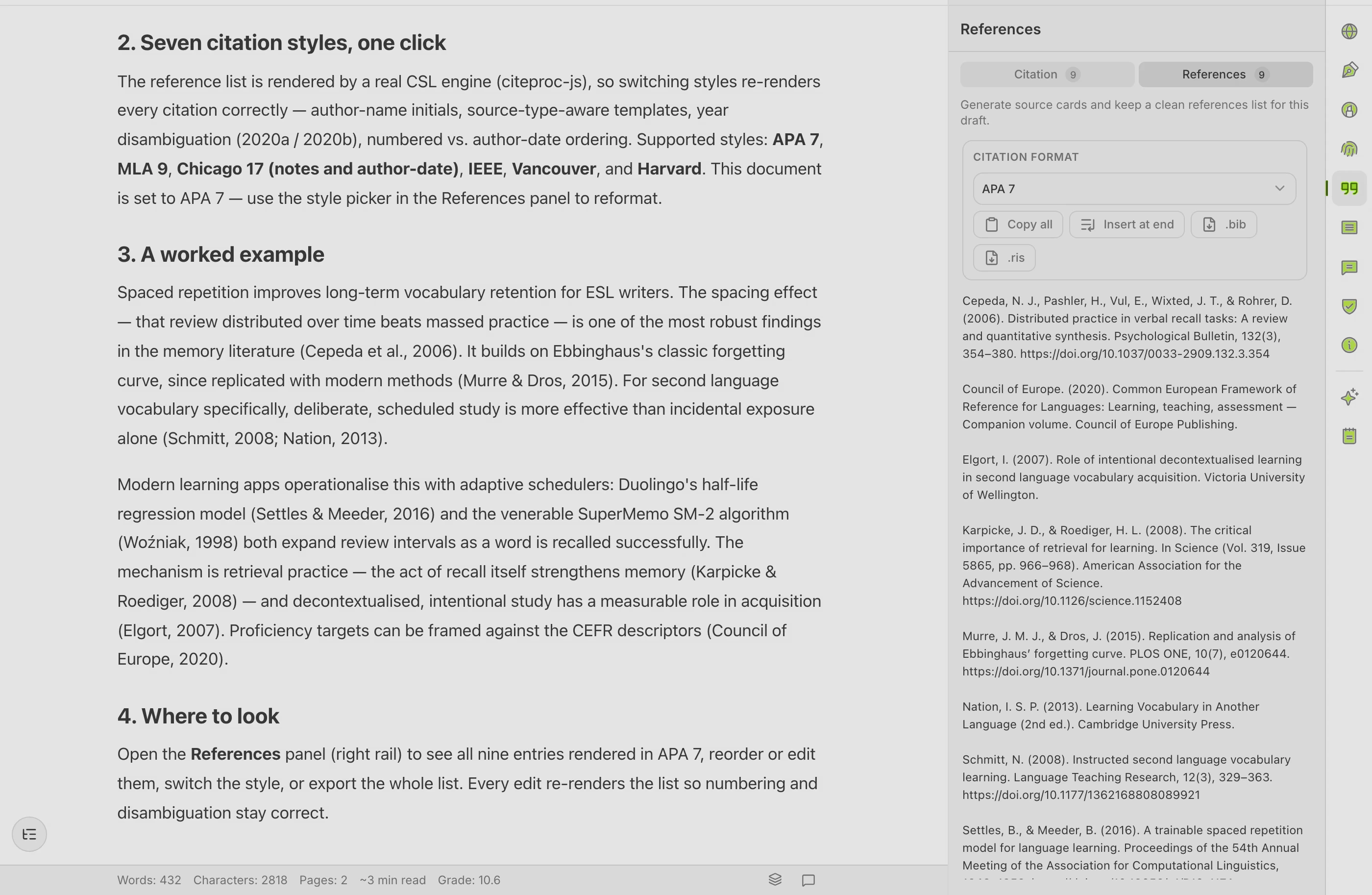
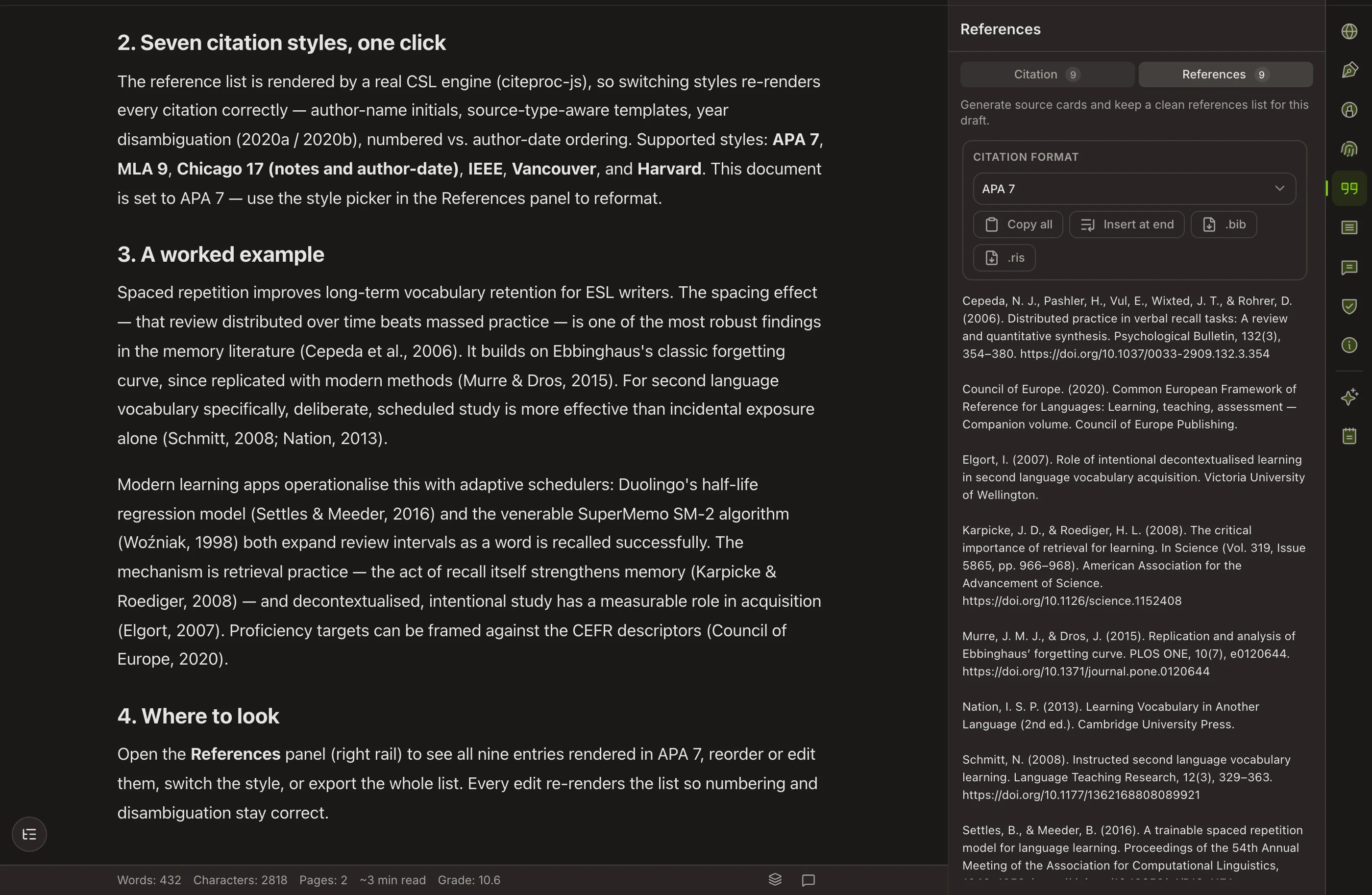
Structured drafting, citations that build their own bibliography, academic paraphrase and export — in one document. In beta; apply and we’ll reach out as spots open.

Apply for beta

*Beta opens this season — starting with students and researchers.

The Copyeditor writing workspace