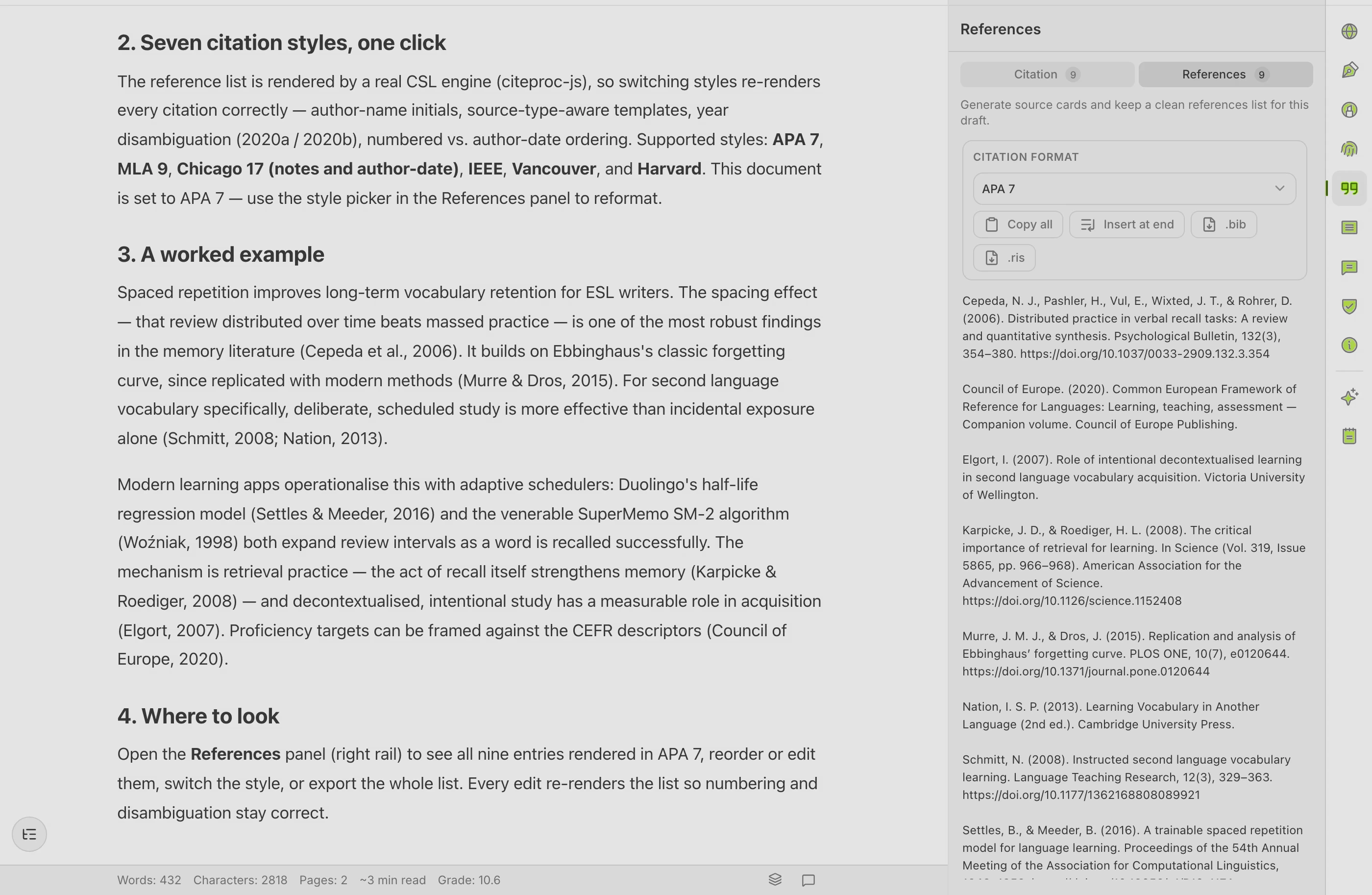
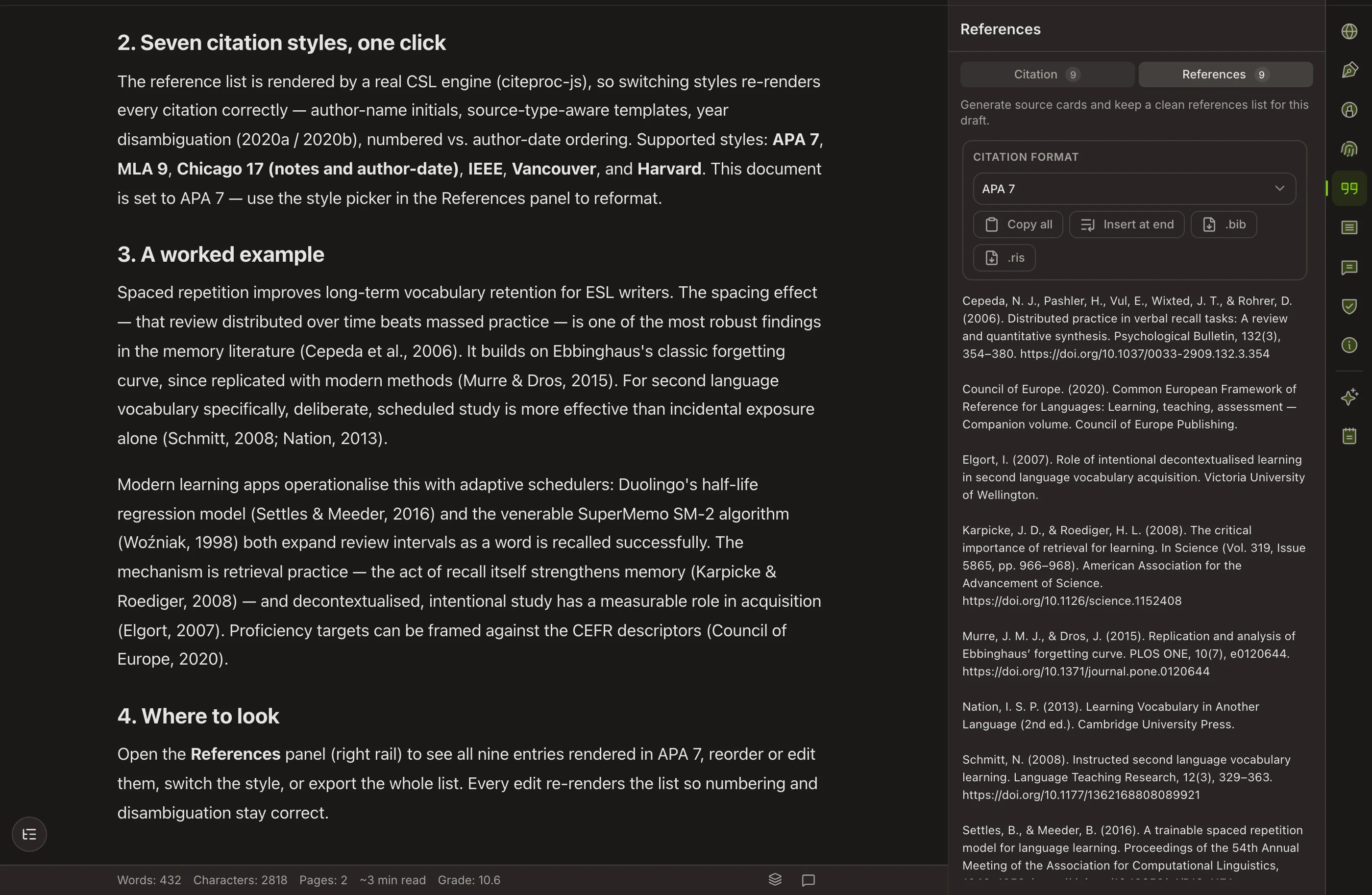
How it works
Paste your list with one reference per line — or with references separated by blank lines, which the tool also accepts. Each entry is treated as a single block of text, and the leading characters up to the first period or opening parenthesis are used as the sort key, which for most styles is the author field.
Sorting uses your browser’s locale-aware comparison, so accented characters such as Ö and Ø fall where a reader expects rather than at the end of the alphabet. Leading articles are left alone, since styles differ on whether “The” is ignored in a title-led entry — if yours ignores it, check those few entries by hand.
Duplicate detection is approximate. Entries are compared after lowercasing, stripping punctuation, and collapsing whitespace, and near-identical pairs are flagged rather than deleted. Two versions of the same source with different page ranges or a DOI on one and not the other will be shown side by side for you to decide.
This is a formatting utility, not a citation generator: it reorders what you give it and never edits a reference, changes a style, or looks anything up. All processing happens in your browser.
Why it matters for academic writing
Reference lists get assembled from several drafts, several co-authors, and several sessions, and they arrive out of order with quiet duplicates in them. Sorting and deduplicating before submission catches the mismatches that a reviewer would otherwise catch for you.