Skip to content

Free tool

Measure how hard your writing is to read

Computes Flesch Reading Ease and Flesch–Kincaid grade level for your text, along with average sentence length and the sentences that score worst.

Runs entirely in your browser. Nothing you paste is uploaded, stored, or sent anywhere.

How it works

Both formulas take the same three inputs: total words, total sentences, and total syllables. Flesch Reading Ease is 206.835 minus 1.015 times the average words per sentence, minus 84.6 times the average syllables per word — higher scores mean easier reading. Flesch–Kincaid grade level uses the same two ratios with different constants and returns a US school grade instead of a 0–100 score.

Syllables are estimated, not looked up. The tool counts vowel groups in each word, applies the usual adjustments for silent endings, and handles common suffixes. That works well across ordinary prose and less well on technical vocabulary and proper nouns, so treat the score as a close approximation rather than an exact value.

Alongside the scores you get your longest sentences ranked, because sentence length is the input you can most easily change. Shortening three sentences usually moves the score more than swapping a dozen words.

The whole calculation runs in your browser on the text in the box. Nothing is uploaded, and the numbers update as you edit.

Why it matters for academic writing

Academic prose is naturally harder to read than general writing, and a low reading-ease score is not by itself a fault. What the score is good for is comparison: if your discussion section is markedly harder than your introduction, the difference is usually long sentences and stacked noun phrases rather than deeper ideas. Grant summaries, lay abstracts, and public-facing writing genuinely do need to score easier.
Questions about the readability checker

Does anything I paste get uploaded?

No. The tool runs entirely in your browser; nothing you paste leaves your device and nothing is stored.

What score should academic writing aim for?

There is no official standard, and published research routinely scores in the difficult range because the vocabulary is long. As a rule of thumb, aim for consistency across your own sections and for easier scores in abstracts and lay summaries.

Why is the syllable count sometimes wrong?

Syllables are estimated from letter patterns rather than looked up in a dictionary, so unusual technical terms, acronyms, and names can be miscounted. Over a few hundred words the errors mostly cancel out.

Can I improve the score without dumbing down the content?

Usually yes. Splitting long sentences and unpacking noun strings lowers both inputs to the formula without removing any idea, and neither change requires simpler concepts.

These are the small tools
Copyeditor is the workspace

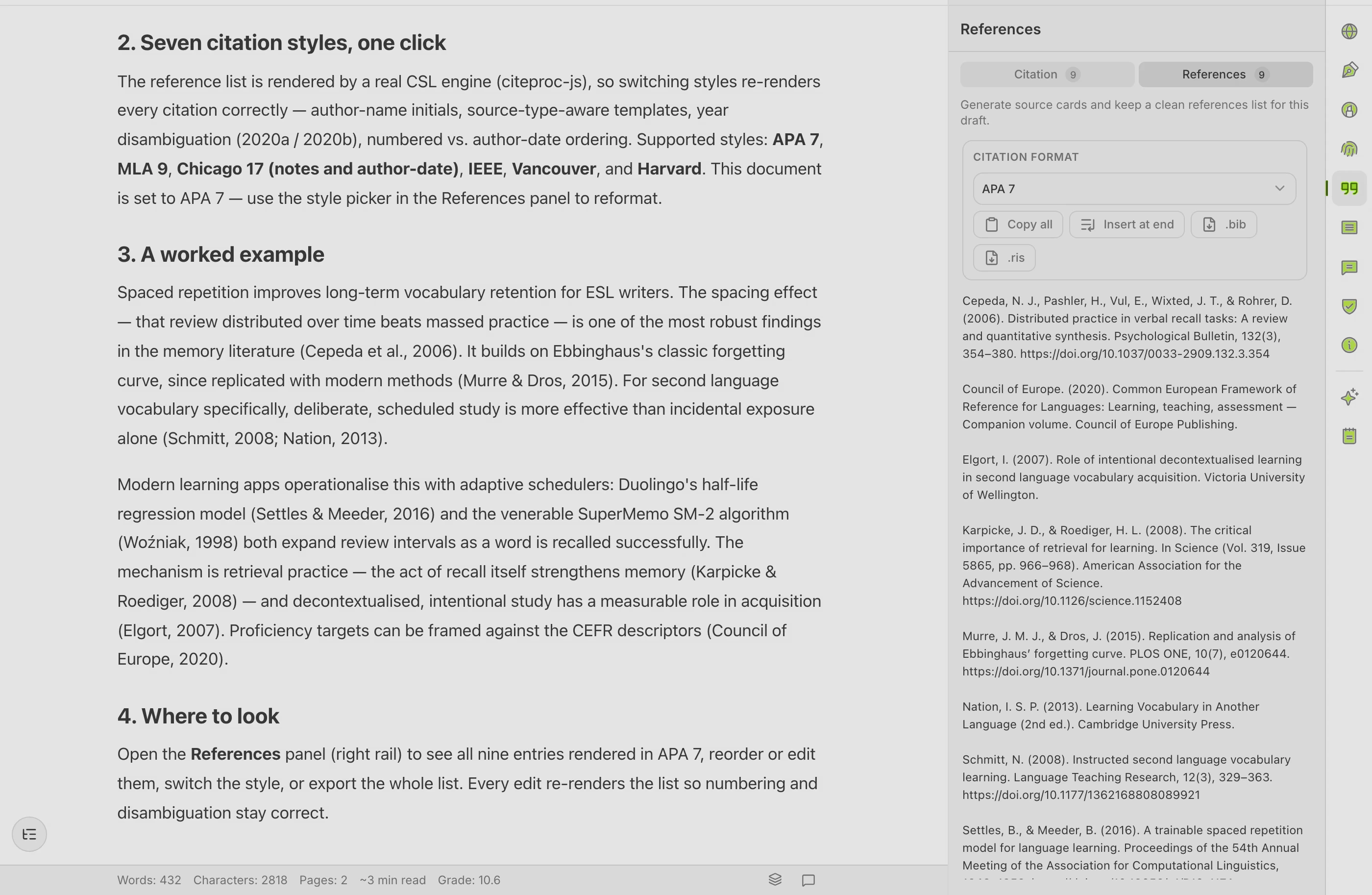
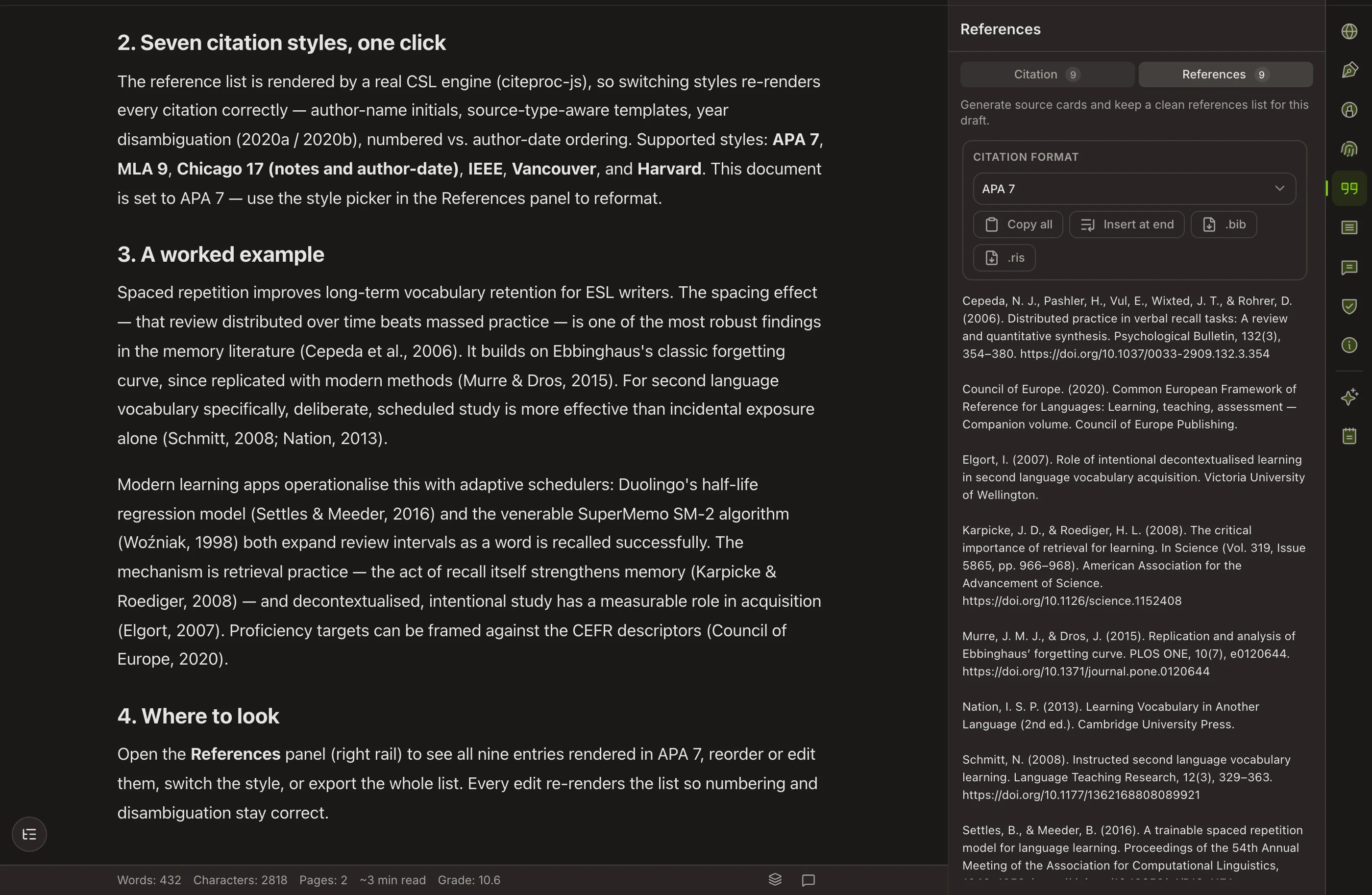
Structured drafting, citations that build their own bibliography, academic paraphrase and export — in one document. In beta; apply and we’ll reach out as spots open.

Apply for beta

*Beta opens this season — starting with students and researchers.

The Copyeditor writing workspace