Skip to content

Free tool

Count syllables, polysyllabic words, and structural density

Counts syllables across words and sentences, highlighting polysyllabic vocabulary and rhythmic sentence weight.

Runs entirely in your browser. Nothing you paste is uploaded, stored, or sent anywhere.

How it works

Syllable count is the core linguistic metric behind readability formulas (such as Flesch-Kincaid, Gunning Fog, and SMOG). A high concentration of polysyllabic words (words with 3 or more syllables) increases cognitive load for the reader.

The tool scans vowel groups, adjusts for silent trailing vowels and common prefixes/suffixes, and calculates total syllables, average syllables per word, and polysyllabic word percentage.

It highlights the most syllable-dense words in your draft so you can evaluate whether simpler vocabulary would improve clarity without sacrificing conceptual depth.

The calculations run in real time entirely within your browser.

Why it matters for academic writing

While technical terminology is necessary, unnecessary multi-syllable jargon clutters prose. Monitoring syllable density helps you maintain scholarly precision while keeping sentence rhythm energetic.
Questions about the syllable counter

What counts as a polysyllabic word?

In linguistic and readability metrics, a polysyllabic word is any word with three or more syllables (e.g., “methodology”, “significant”, “implementation”).

What is a typical syllables-per-word ratio for academic writing?

Academic writing typically averages 1.6 to 1.9 syllables per word due to Latinate roots and technical terms, compared to 1.3 to 1.4 for general journalistic prose.

How accurate is the syllable estimation algorithm?

The rule-based vowel grouping algorithm achieves ~96% accuracy on standard English vocabulary, providing a dependable metric across paragraphs and whole sections.

Is my text private?

Yes. Everything is processed locally on your device with zero data collection.

Embed this syllable counter on your academic blog or website

Free for universities, writing centers, and academic blogs. Copy and paste the HTML snippet below:

These are the small tools
Copyeditor is the workspace

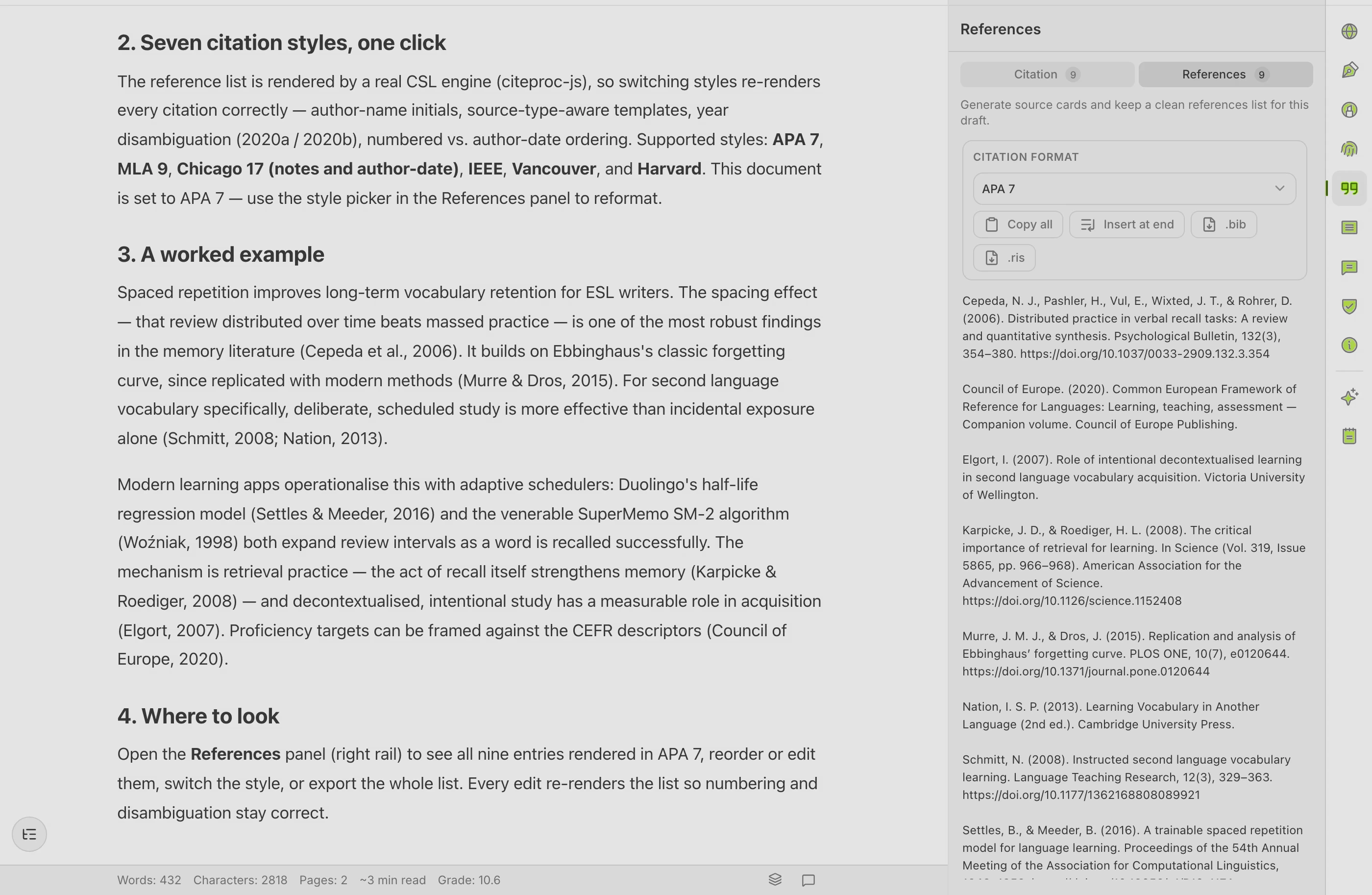
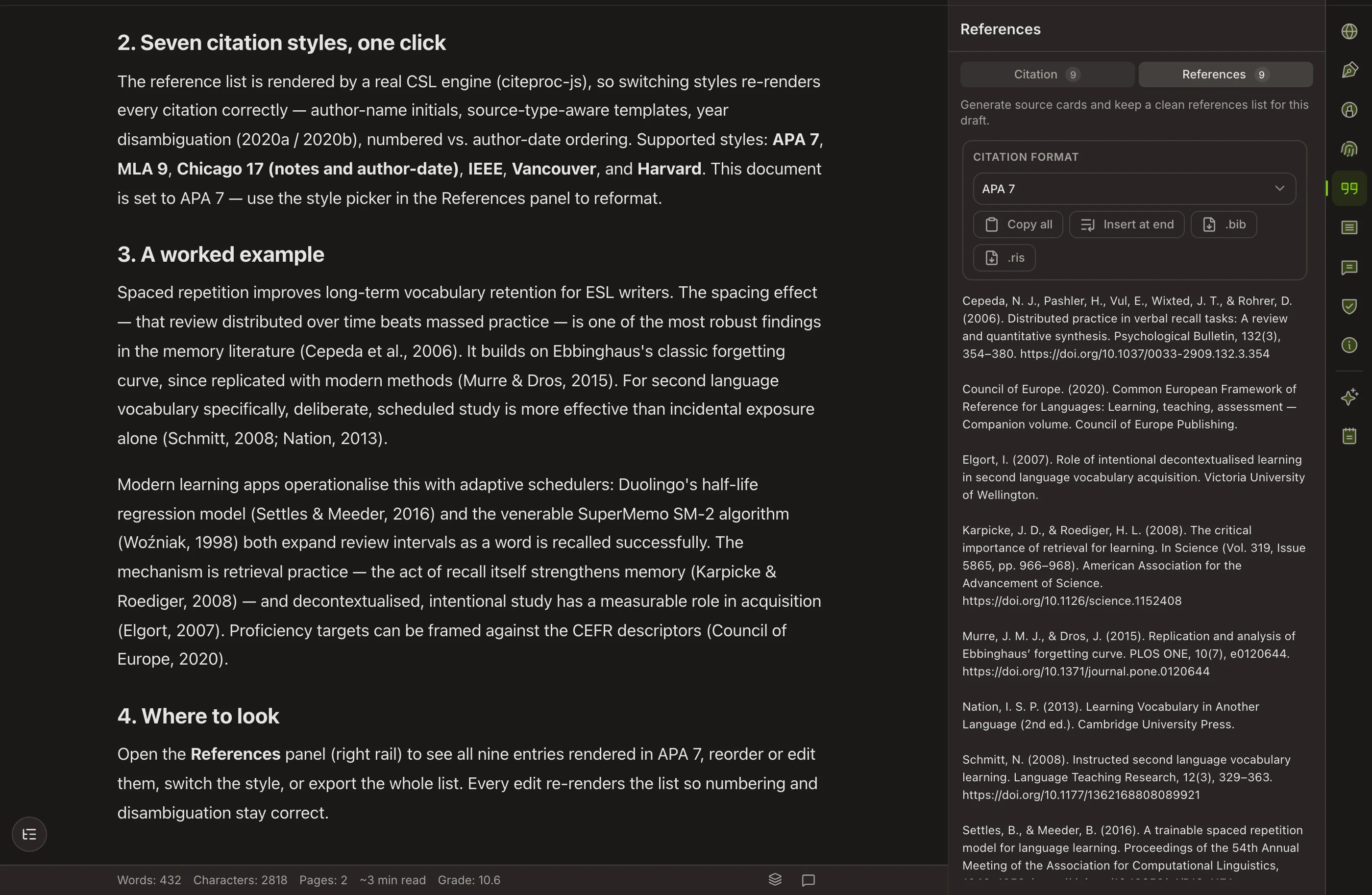
Structured drafting, citations that build their own bibliography, academic paraphrase and export — in one document. In beta; apply and we’ll reach out as spots open.

Apply for beta

*Beta opens this season — starting with students and researchers.

The Copyeditor writing workspace