Citation guides
Citation formats, one page per source type
Six styles, twelve source types, seventy-two pages — each one carrying the reference pattern, a filled-in example, both in-text forms, and the exceptions that catch people out. No sign-up, no paywall.
BY STYLE
Start with your style
Each style hub explains the system it belongs to, the rules that apply to every entry, and links to all twelve source types.
APA citation guide
APA puts the year next to the author because in the social and behavioral sciences the age of a finding matters almost as much as who produced it.
MLA citation guide
MLA identifies a source by author and page, because a humanities reader usually wants to find the exact sentence you are discussing rather than judge how recent it is.
Chicago citation guide
Chicago has two citation systems, and this page covers the one most humanities departments mean when they say “Chicago”: notes–bibliography.
Harvard citation guide
Harvard is not one style.
IEEE citation guide
IEEE is a numeric style: a source gets a bracketed number the first time you cite it, and it keeps that number for the rest of the paper.
Vancouver citation guide
Vancouver is the numeric system of medicine and the health sciences.
BY SOURCE TYPE
Or start with what you are citing
Pick the row for your source, then the column for your style.
| Source type | APA | MLA | Chicago | Harvard | IEEE | Vancouver |
|---|---|---|---|---|---|---|
| journal article | APA | MLA | Chicago | Harvard | IEEE | Vancouver |
| book | APA | MLA | Chicago | Harvard | IEEE | Vancouver |
| chapter in an edited book | APA | MLA | Chicago | Harvard | IEEE | Vancouver |
| website | APA | MLA | Chicago | Harvard | IEEE | Vancouver |
| thesis or dissertation | APA | MLA | Chicago | Harvard | IEEE | Vancouver |
| conference paper | APA | MLA | Chicago | Harvard | IEEE | Vancouver |
| report | APA | MLA | Chicago | Harvard | IEEE | Vancouver |
| newspaper article | APA | MLA | Chicago | Harvard | IEEE | Vancouver |
| YouTube video | APA | MLA | Chicago | Harvard | IEEE | Vancouver |
| podcast episode | APA | MLA | Chicago | Harvard | IEEE | Vancouver |
| interview | APA | MLA | Chicago | Harvard | IEEE | Vancouver |
| dataset | APA | MLA | Chicago | Harvard | IEEE | Vancouver |
Questions about citation styles
Which citation style should I use?
Your department or target journal decides, and their guidance overrides everything else. As a rough map: APA in psychology, education and the social sciences; MLA in literature and the humanities; Chicago in history; IEEE in engineering and computer science; Vancouver in medicine and nursing; and some form of Harvard across many UK and Australian institutions.
What is the difference between a bibliography and a reference list?
A reference list contains only the sources you cited. A bibliography can also include background reading you consulted but never cited. MLA calls its list Works Cited, APA and IEEE call theirs References, and Chicago calls its full list a Bibliography.
Can I switch citation styles after I have finished writing?
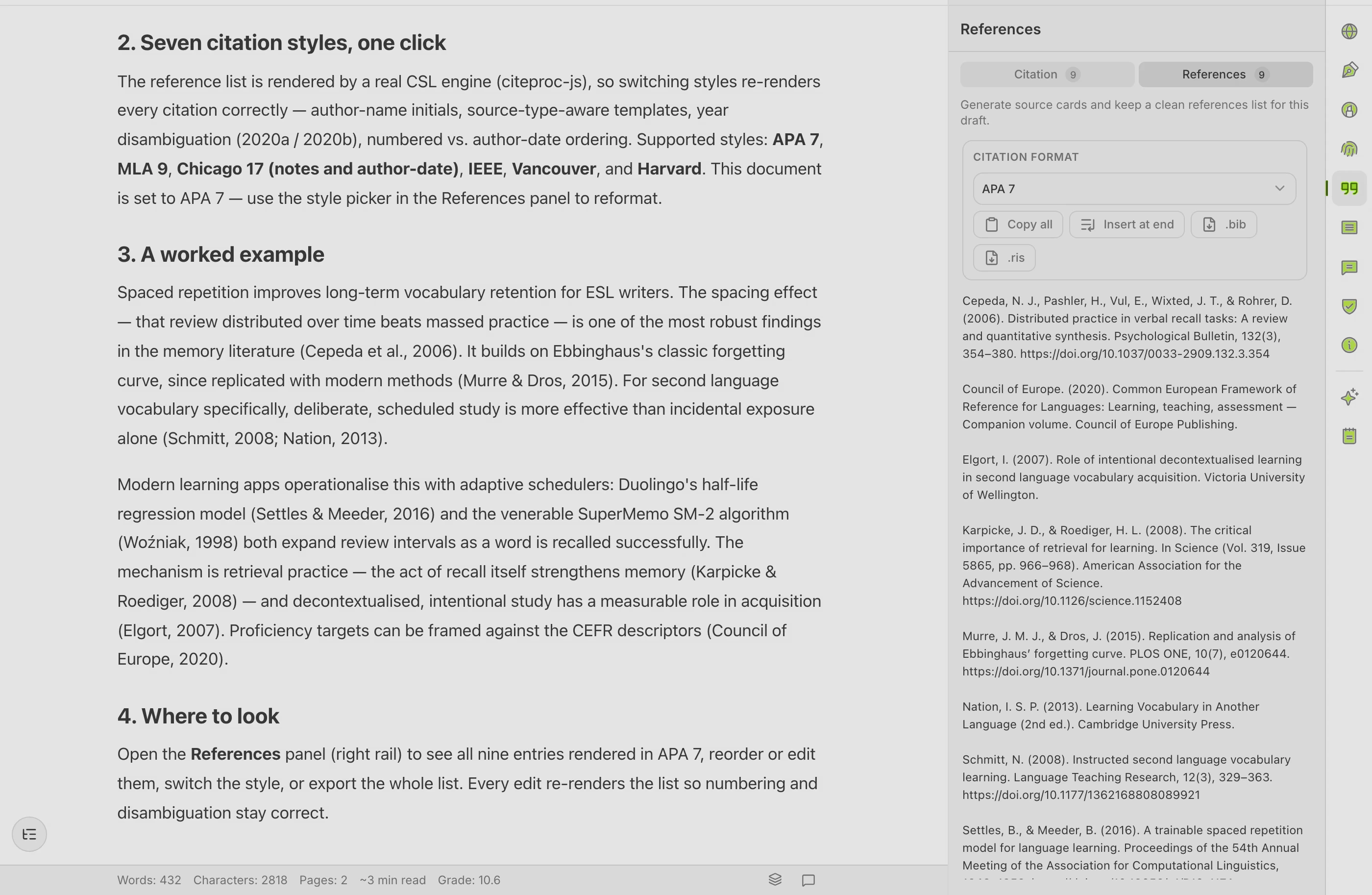
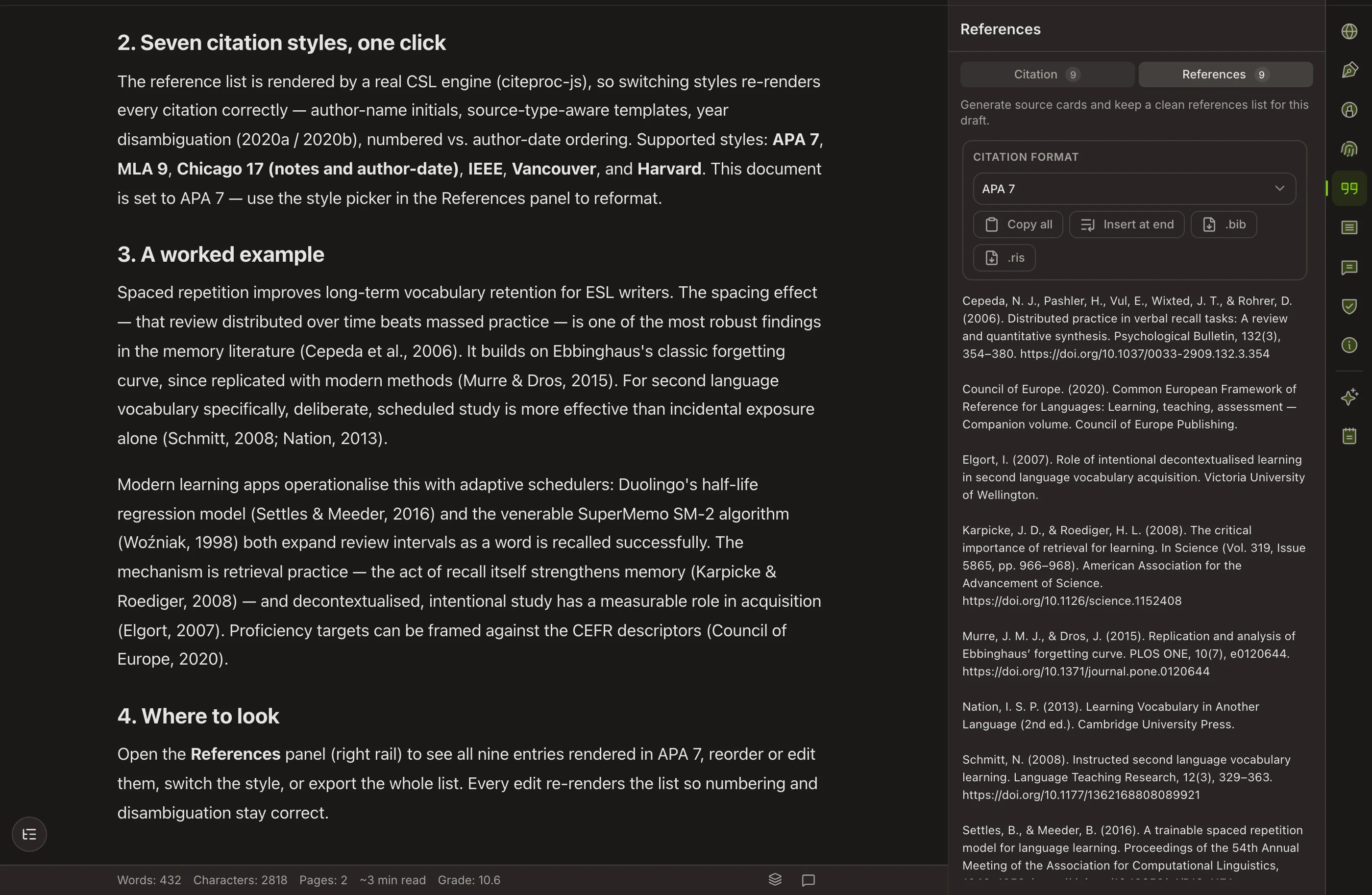
In Copyeditor, yes — sources are stored as structured data rather than frozen text, so changing the active style reformats every in-text citation and the whole reference list at once. If you are formatting by hand, switching late means retyping every entry, which is why it is worth confirming the style before you start.
Which styles does Copyeditor format automatically?
APA, MLA, Chicago and IEEE, each with a real, tested formatter. Harvard and Vancouver guides are on this site because writers need them, but Copyeditor does not format those two automatically today. We list only what actually works.
Do these guides replace the official style manual?
No. Each guide names the manual that governs it, and where a journal or department publishes its own house rules, those rules win. Use these pages to get an entry right quickly, then check anything unusual against the manual.
Cite once.
The bibliography takes care of itself.
Copyeditor stores sources as structured data and formats them in APA, MLA, Chicago or IEEE — switch styles and the whole document follows.