numeric
IEEE style: how to cite anything
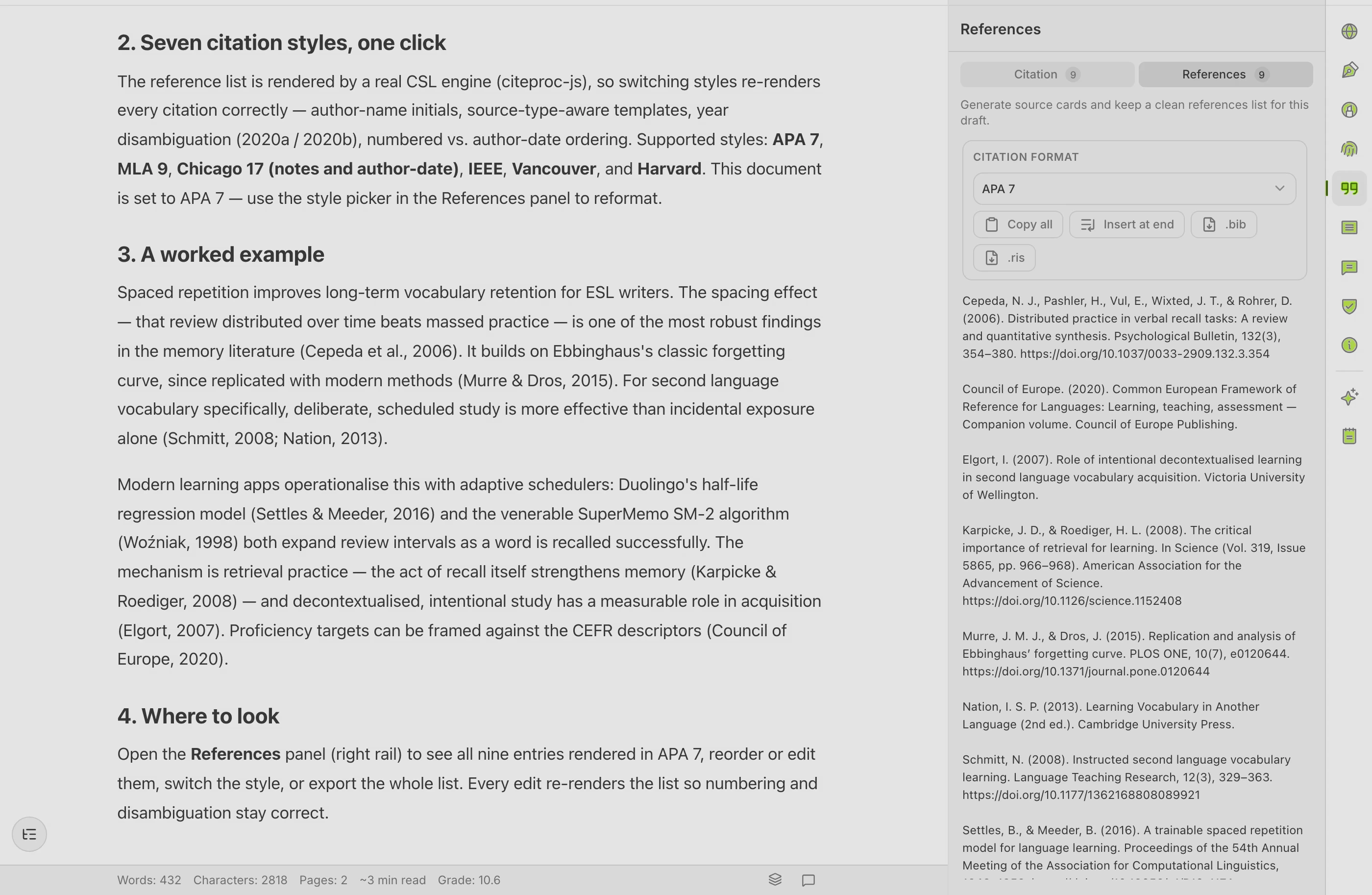
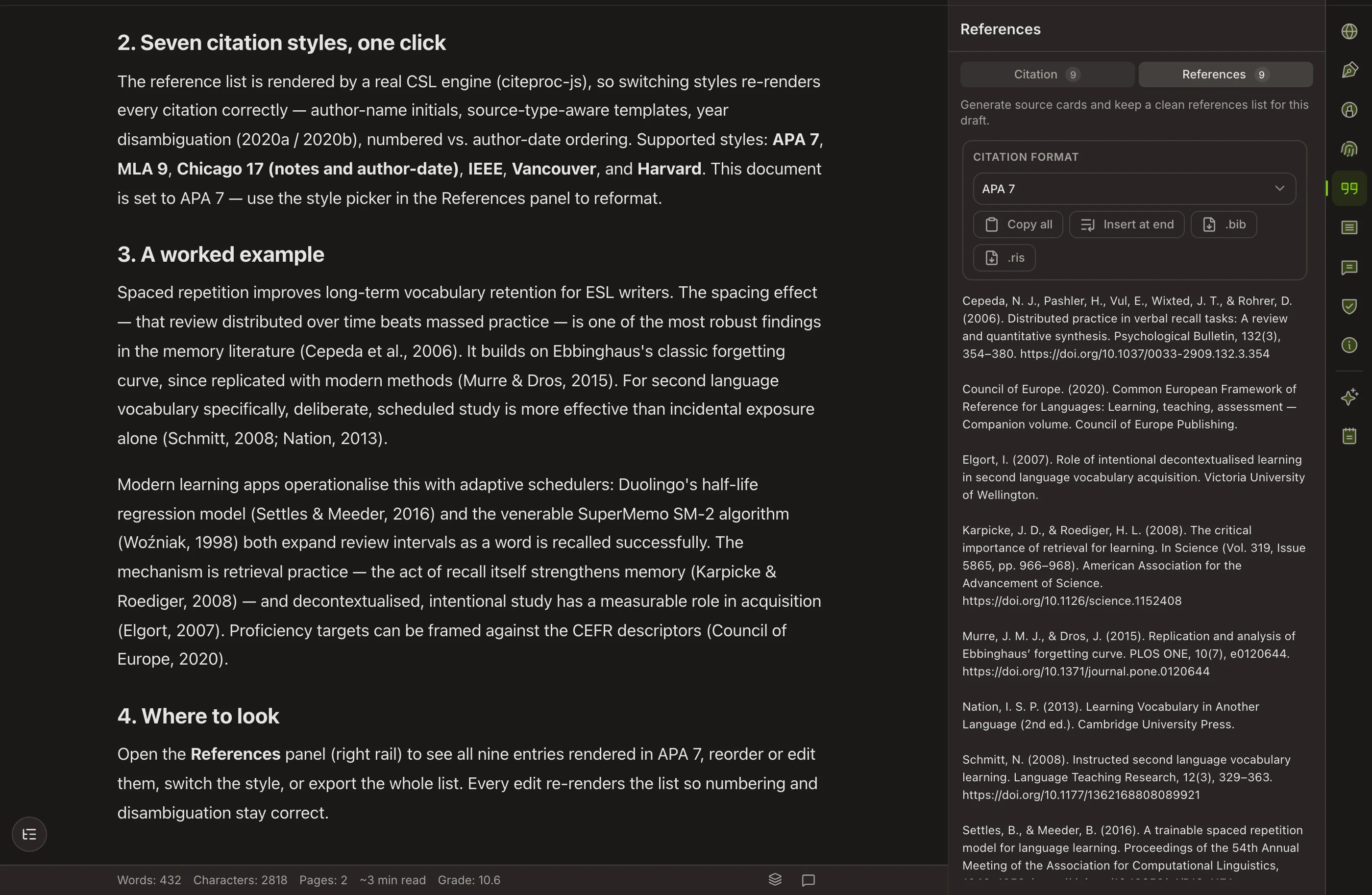
IEEE is a numeric style: a source gets a bracketed number the first time you cite it, and it keeps that number for the rest of the paper. The reference list is ordered by that number — by order of first appearance, never alphabetically — so it reads as a log of the argument rather than an index of names. Author initials come before surnames, article titles sit in quotation marks, and journal names are italicized and abbreviated to IEEE’s own short forms. It is the house style of IEEE journals and conferences, and the default in most engineering departments.
- Citation system
- numeric
- Reference list is called
- References
- Common in
- Electrical and electronic engineering, Computer science and software engineering, Robotics, control, and systems engineering, Telecommunications and signal processing, Applied physics and materials science
- Authority
- IEEE Reference Guide
- Formatted automatically by Copyeditor
- Yes — cite once and the bibliography builds itself.
THE RULES THAT CARRY
What IEEE expects of every entry
- Number by first appearance
- The first source you cite is [1], the second is [2], and so on down the paper. Move a paragraph and every number after it shifts, which is why IEEE lists are the ones most often out of sequence. Check the numbering last, after the text is final.
- Square brackets, on the baseline
- The marker is [4] — not a superscript, not (4), and not a raised bracket. It sits inside the sentence with a space before it, and terminal punctuation comes after it: “…converges in nine iterations [4].”
- Initials before surnames
- Every name is written “R. M. Delacroix”: spaced initials with periods, then the surname. The last author in a list is preceded by “and”. List up to six authors; with more than six, give the first author only, followed by “et al.”
- Quotation marks for parts, italics for wholes
- Articles, chapters, conference papers, theses, and reports take quotation marks and sentence capitalization. Books, journals, proceedings volumes, newspapers, and datasets take italics and headline capitalization. The typography alone tells a reader what kind of object they are looking for.
- Abbreviate periodicals, departments, and publishers
- Journal and conference names follow IEEE’s list of periodical title abbreviations — “IEEE Trans. Power Electron.”, not the full name. Universities and departments are abbreviated the same way: “Dept. Elect. Comput. Eng., Univ. of Toronto”.
- Abbreviated month with the year
- A journal entry closes with an abbreviated month and the year — Jan., Feb., Sept., Dec. Only May, June, and July are written in full. Newspapers and web sources need the day as well; a journal issue never does.
- Locators live in the bracket
- Pages, chapters, sections, and figures go with the in-text number rather than in the entry: [2, pp. 210–214], [2, ch. 4], [2, Fig. 3]. The reference entry for a whole book carries no page range at all.
BY SOURCE TYPE
Every IEEE format, one page each
Each page carries the pattern, a worked entry, both in-text forms, and the exceptions that apply to that source.
Journal article
[#] A. B. Author, C. D. Author, and E. F. Author, “Title of the article,” Abbrev. Journal Title, vol. #, no. #, pp. ##–##, Mon. Year, doi: 10.xxxx/xxxxx.
Book
[#] A. B. Author, Title of the Book, #th ed. City, State, Country: Publisher, Year.
Chapter in an edited book
[#] A. B. Author, “Title of the chapter,” in Title of the Book, C. D. Editor, Ed. City, State, Country: Publisher, Year, pp. ##–##.
Website
[#] A. B. Author. “Title of the page.” Name of the Site. Accessed: Mon. DD, YYYY. [Online]. Available: https://…
Thesis or dissertation
[#] A. B. Author, “Title of the thesis,” Ph.D. dissertation, Dept. …, Univ. …, City, State, Country, Year.
Conference paper
[#] A. B. Author and C. D. Author, “Title of the paper,” in Proc. Abbrev. Conf. Name (ACRONYM), City, Country, Year, pp. ##–##, doi: 10.xxxx/xxxxx.
Report
[#] A. B. Author, “Title of the report,” Issuing Organization, City, State, Country, Rep. XXX-##, Mon. Year.
Newspaper article
[#] A. B. Author, “Headline of the article,” Newspaper Name, p. ##, Mon. DD, YYYY.
YouTube video
[#] Creator or Channel Name, Title of the video. (Year, Mon. DD). Accessed: Mon. DD, YYYY. [Online Video]. Available: https://…
Podcast episode
[#] A. B. Host, “Title of the episode,” Name of the Podcast, Episode ##. (Year, Mon. DD). Accessed: Mon. DD, YYYY. [Online Audio]. Available: https://…
Interview
[#] A. B. Interviewee, private communication, Mon. Year.
Dataset
[#] A. B. Author and C. D. Author, Title of the Dataset, version #.#. Repository, Year. Accessed: Mon. DD, YYYY. [Dataset]. Available: https://doi.org/10.xxxx/xxxxx
Where IEEE entries usually go wrong
- Alphabetizing the reference list. IEEE orders by number, which means by order of first appearance. An alphabetical IEEE list is wrong even when every entry is perfectly punctuated.
- Putting the surname first. “Delacroix, R. M.” is an APA habit; IEEE wants “R. M. Delacroix”, with the comma only between names.
- Writing “in Ref. [4]” or “in reference [4]”. In running text the bare bracket is enough: “in [4]”. “Reference [4] shows…” is used only to open a sentence, because a sentence cannot begin with a bracket.
- Superscripting the number or wrapping it in parentheses. Superscripts belong to Vancouver-style journals; IEEE keeps the bracket on the line.
- Spelling journal names out in full. IEEE expects the abbreviation: “IEEE Sens. J.”, “Proc. IEEE”, “IEEE Trans. Ind. Electron.”
- Leaving a page range in a whole-book entry. If you want to point at pages, the bracket is where they go.
- Renumbering by hand after a structural edit and missing one. Read the numbers straight down the finished paper and check that none repeats, skips, or appears in the list without appearing in the text.
Questions about IEEE
Does the IEEE reference list go in alphabetical order?
No. It goes in numeric order, and the numbers are assigned by order of first appearance in the text. The first source you cite is [1] no matter whose name it carries. This is the difference most often missed by writers arriving from APA or Harvard, and it is the first thing a reviewer notices.
How do I cite several sources at once in IEEE?
Separate numbers with commas — [1], [4], [7] — and use an en dash for a run of three or more consecutive numbers: [3]–[6]. Two consecutive sources are written [3], [4] rather than [3]–[4]. Keep the numbers in ascending order inside the group.
How many authors does IEEE list before “et al.”?
Up to six authors are listed in full. With seven or more, IEEE gives the first author followed by “et al.” — only the first, not the first six. Note that the threshold is the same as Vancouver’s but the cut is different: Vancouver lists six names and then adds “et al.”, IEEE drops back to one.
What if I cite the same source more than once?
Reuse its original number every time. IEEE never assigns a second number to a source already in the list, and it does not use “ibid.” or “op. cit.” If you need a different page on a later mention, change only the locator: [4, p. 88] and then [4, p. 214].
Is IEEE the same as Vancouver?
Both are numeric and both number by order of first appearance, but the entries look different. IEEE puts initials before surnames, quotes article titles, italicizes abbreviated journal names, and uses vol./no./pp. with an abbreviated month. Vancouver writes “Halpern SD” with no periods, abbreviates journals per the NLM catalog without italics, and compresses the tail into “2024;33(4):241-9”. Engineering journals want IEEE; medical journals want Vancouver.
Other citation styles
Departments change their minds. Here is the rest of the set.
APA citation guide
Author–date. Used in Psychology, Education, Nursing and the health sciences.
MLA citation guide
Author–page. Used in Literature and literary studies, Languages and linguistics, Composition and rhetoric.
Chicago citation guide
Notes–bibliography. Used in History, Art history and visual culture, Literature and literary studies.
Harvard citation guide
Author–date. Used in Business and management, Economics, Nursing and allied health.
Vancouver citation guide
Numeric. Used in Medicine and clinical research, Nursing and allied health, Public health and epidemiology.
Stop reformatting
your reference list by hand
Cite as you write and let the bibliography build itself in APA, MLA, Chicago or IEEE. Copyeditor is in beta — apply and we’ll reach out as spots open.