Skip to content

Free tool

Check your writing for informal tone, slang, and conversational phrasing

Highlights conversational colloquialisms, contractions, vague idioms, and informal phrasing to ensure rigorous scholarly tone.

Runs entirely in your browser. Nothing you paste is uploaded, stored, or sent anywhere.

How it works

Academic register requires objective, precise, and emotionally neutral prose. This tool evaluates your draft across four stylistic dimensions: informal phrasal verbs (“get rid of”, “look into”), conversational idioms (“a lot of”, “in a nutshell”), colloquial contractions (“don’t”, “can’t”), and conversational first-person hedges (“I think that”, “as you know”).

Each flagged expression is paired with established formal equivalents used in peer-reviewed literature: “examine” instead of “look into”, “eliminate” instead of “get rid of”, and “substantially” instead of “a lot”.

The tool computes an overall Formality Index based on the ratio of informal markers to total sentences.

The evaluation is strictly client-side and immediate, preserving the privacy of your unpublished drafts.

Why it matters for academic writing

Maintaining an appropriate academic register is critical for peer review, dissertation defense, and grant proposals. Conversational or emotive phrasing undermines scientific authority and weakens empirical claims.
Questions about the academic tone checker

Are contractions ever allowed in academic papers?

Standard academic style manuals (APA, Chicago, MLA, IEEE) strongly recommend expanding all contractions (e.g., “do not” instead of “don’t”, “cannot” instead of “can’t”) in formal prose.

Is it wrong to use phrasal verbs in research writing?

Phrasal verbs (e.g., “set up”, “put off”, “find out”) are characteristic of spoken English. Single Latinate verbs (e.g., “establish”, “postpone”, “determine”) provide clearer precision in scholarly writing.

Can I use first-person pronouns (I, we) in academic writing?

Most modern disciplines accept “we” for collaborative research actions (“we measured”), but conversational self-referential hedges (“I feel that”, “in my opinion”) should be avoided.

Is my text sent to a remote server?

No. The stylistic scanning happens entirely on your local device with JavaScript.

Embed this academic tone checker on your academic blog or website

Free for universities, writing centers, and academic blogs. Copy and paste the HTML snippet below:

These are the small tools
Copyeditor is the workspace

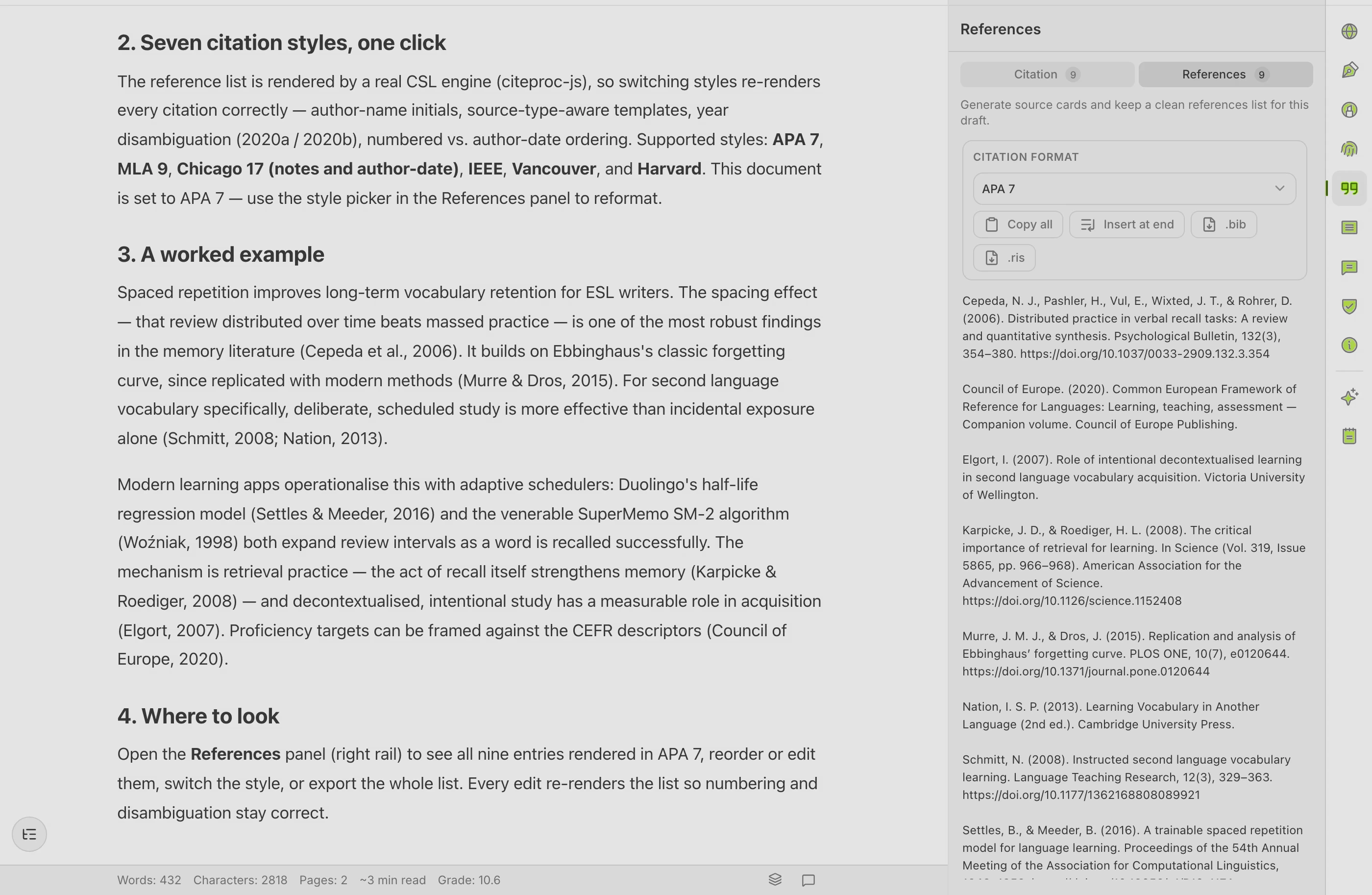
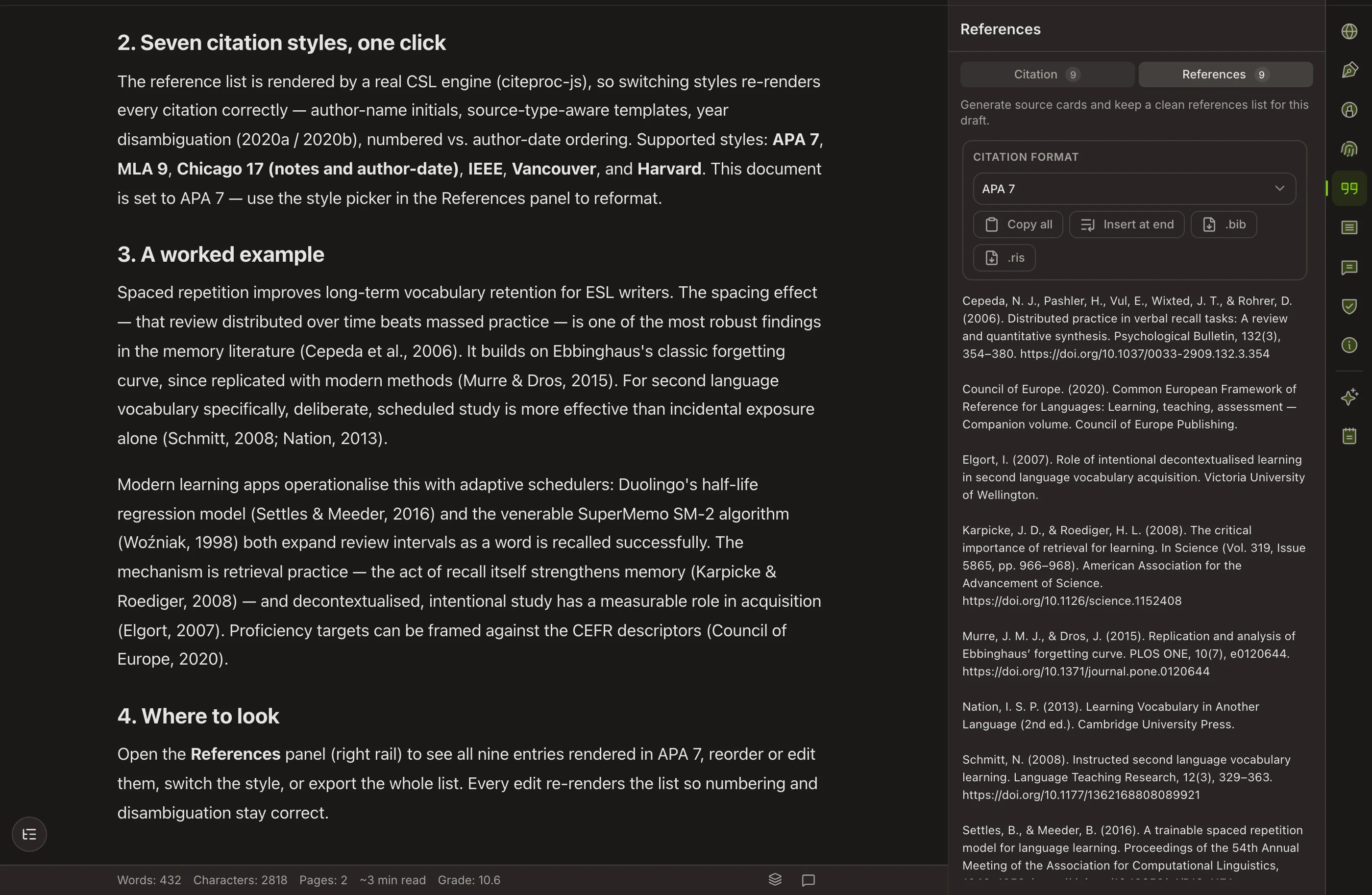
Structured drafting, citations that build their own bibliography, academic paraphrase and export — in one document. In beta; apply and we’ll reach out as spots open.

Apply for beta

*Beta opens this season — starting with students and researchers.

The Copyeditor writing workspace