Writing guides
Guides for every stage of an academic paper
Academic writing is a set of learnable moves, not a talent. These guides cover the moves — how a literature review is organized, what a discussion section is actually for, when hedging helps and when it hides your claim.
10 GUIDES
Structuring a paper
Building a literature review that argues instead of lists
Organize by theme, say what the sources mean together, and end on the gap your study addresses.
Read guide →Compressing a whole paper into 250 useful words
Four moves — background, method, result, implication — with the result sentence doing most of the work.
Read guide →Describing your method so another researcher could repeat it
Enough detail to reproduce the study, plus a reason for every design decision you made.
Read guide →Turning results into an argument about what they mean
Answer the question first, interpret against the literature, bound the claims, then say what follows.
Read guide →Reporting findings so the text and the tables each do their own job
Data in the tables, pattern in the prose, every planned result reported — including the null ones.
Read guide →From the wide field to your specific question, in about a page
Establish the territory, name the gap, state the question — and stop before it becomes a review.
Read guide →Closing a paper without writing a second abstract
Answer the opening question, name the contribution, and say what it changes.
Read guide →Making the case that your study is worth doing and can be done
A specific question, a method that visibly fits it, and evidence that you can finish the work.
Read guide →The four-part shape behind most empirical papers
Introduction, Methods, Results, Discussion — what each part owns, and when the format stops helping.
Read guide →Turning a topic into a claim someone could argue with
One arguable sentence that tells the reader what the paper will defend, and why.
Read guide →5 GUIDES
Getting words down
Restating a source in your own words, properly
Paraphrase by working from your own notes, changing the structure rather than the vocabulary, and checking the result against the source for accuracy.
Read guide →Condensing a paper without distorting it
Read in the right order, capture the claim the paper actually makes, and keep your summary proportional to where the paper spends its weight.
Read guide →Catching the errors your eyes skip over
Proofreading your own text works when you deliberately break familiarity — with time, a different medium, your ear, and one error type per pass.
Read guide →When the page stays blank, change the task
Treat block as a diagnosis, not a mood: find the missing decision or the impossible standard behind it, then shrink the task until starting is trivial.
Read guide →Speed comes from separating drafting and editing
The fastest writers are not faster typists — they stop mixing composition with correction, and they decide the structure before they start producing prose.
Read guide →5 GUIDES
Academic language
What academic writing actually sounds like
Register in academic prose comes from precision and appropriate caution, not from long words — inflated vocabulary usually signals imprecision rather than authority.
Read guide →Matching the strength of a claim to its evidence
A hedge states how confident you are. Used well it makes a claim more defensible; stacked without thought it makes a sentence say nothing at all.
Read guide →When the passive is the right choice — and when it is not
Voice is a choice about what the sentence should be about. The passive is correct whenever the actor is irrelevant, and wrong whenever it conceals who did something.
Read guide →Giving the reader a map they can follow
Signposting tells a reader where they are, where they are going, and why one paragraph follows another — using relationships, not decorative connectives.
Read guide →Writing sentences that land the first time
Four levers do most of the work in second-language academic prose: shorter sentences, verbs instead of abstract nouns, a workable article strategy, and fixed preposition pairs.
Read guide →2 GUIDES
Integrity and authorship
Keeping the line between your words and theirs
Avoiding plagiarism is mostly a matter of process: mark every borrowed phrase at the moment you capture it, and cite while drafting rather than afterwards.
Read guide →Where the line sits between assistance and authorship
The answer depends on your institution’s rules and on whether the tool helped you express your own reasoning or produced claims you never made.
Read guide →2 GUIDES
Getting published
Writing a revision letter that gets your paper accepted
Answer every comment, show where each change landed, and disagree with reasons rather than irritation.
Read guide →The one page an editor reads before deciding to send your paper out
One page: what the paper reports, why it belongs in this journal, and the declarations required.
Read guide →About these guides
Where should I start if I am writing my first research paper?
Start with the shape of the document rather than the sentences. Read the IMRaD guide to understand why papers are built the way they are, then work through the introduction and methodology guides in the order you will actually write them — which, for most people, is not front to back.
Are these guides tied to a particular citation style?
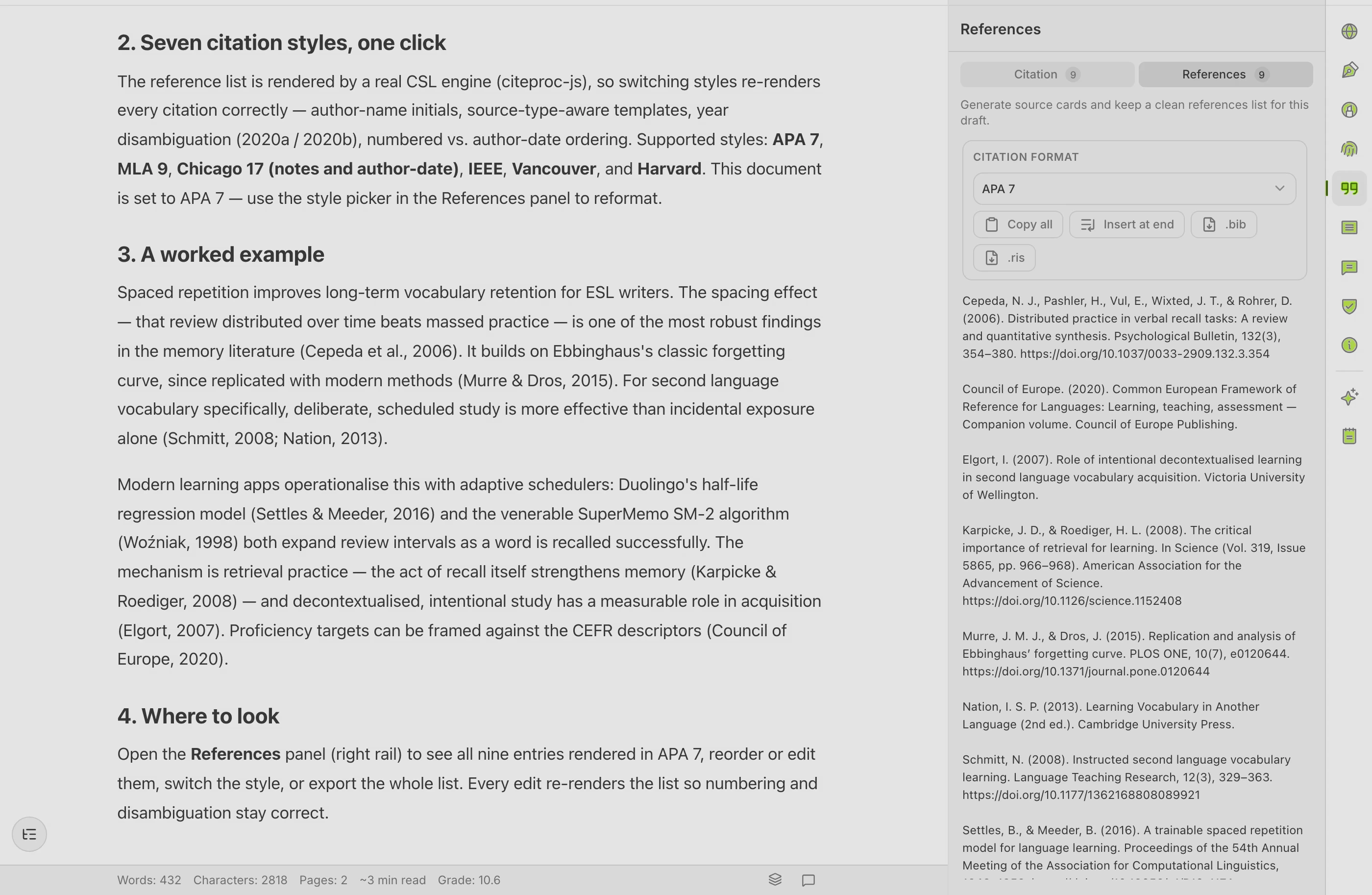
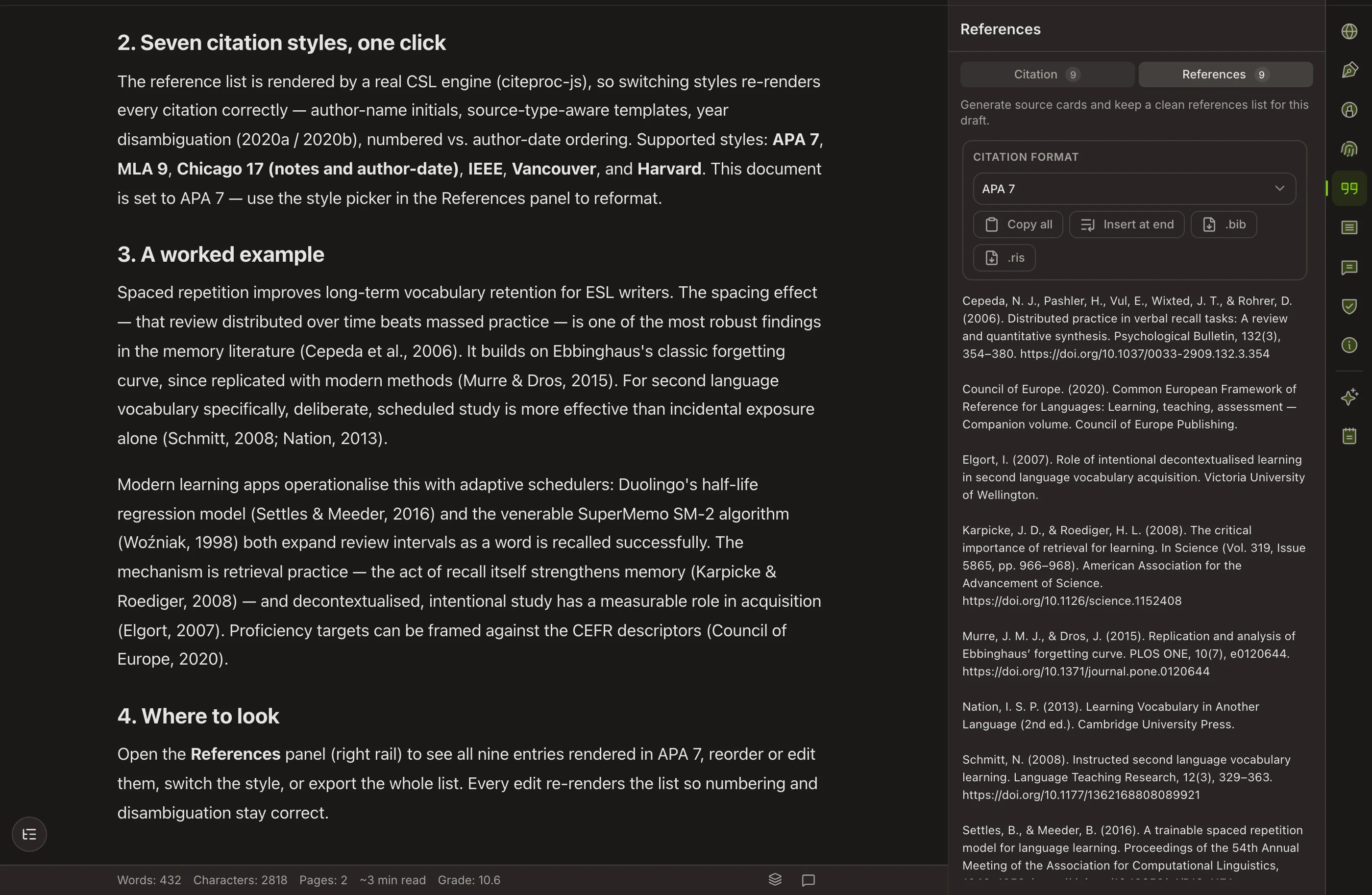
No. They cover the writing itself. Formatting questions live in the citation guides, which cover APA, MLA, Chicago, Harvard, IEEE and Vancouver across twelve source types.
Do I need a Copyeditor account to read these?
No. Every guide is open, with no sign-up and no paywall. Copyeditor is a writing workspace you can apply to use, but the guides stand on their own.
Knowing the moves
is half of it
The other half is a workspace that keeps drafting, citations and your reference list in one document. Copyeditor is in beta — apply and we’ll reach out as spots open.