Skip to content

Getting words down

Restating a source in your own words, properly

Paraphrase by working from your own notes, changing the structure rather than the vocabulary, and checking the result against the source for accuracy.

To paraphrase, read the passage until you can explain it without looking, close the source, write the idea in your own sentence structure, then reopen the original and check your version for accuracy rather than similarity. Cite it either way. Swapping synonyms while keeping the author’s sentence shape is still plagiarism.

THE PROCESS

Step by step

Read the whole passage, not the sentence you want

Read the full paragraph the sentence sits in, and the one before it. A sentence lifted out of context usually loses a condition the author attached to it. You cannot restate an idea faithfully until you know what question it was answering.

Close the source and write a note

Look away from the text and write one or two sentences saying what the author claimed, in whatever plain language comes out. If you cannot do that, you have not understood the passage yet — reread it instead of starting to reword.

Draft from the note, not from the original

Write your paragraph working only from the note. Because the note is already in your phrasing and your ordering, the draft comes out in your voice by default instead of shadowing the author clause by clause.

Change the structure, not just the words

Start the sentence from a different element — the finding rather than the researchers, the condition rather than the outcome. Combine two of the author’s sentences, or split one. If your version maps one-to-one onto the original, it is not a paraphrase yet.

Reopen the source and check for accuracy

Compare meaning, not vocabulary. Watch the qualifiers especially: an “appears to contribute to” that became “causes” is a factual error, and you have now attributed it to someone else in print.

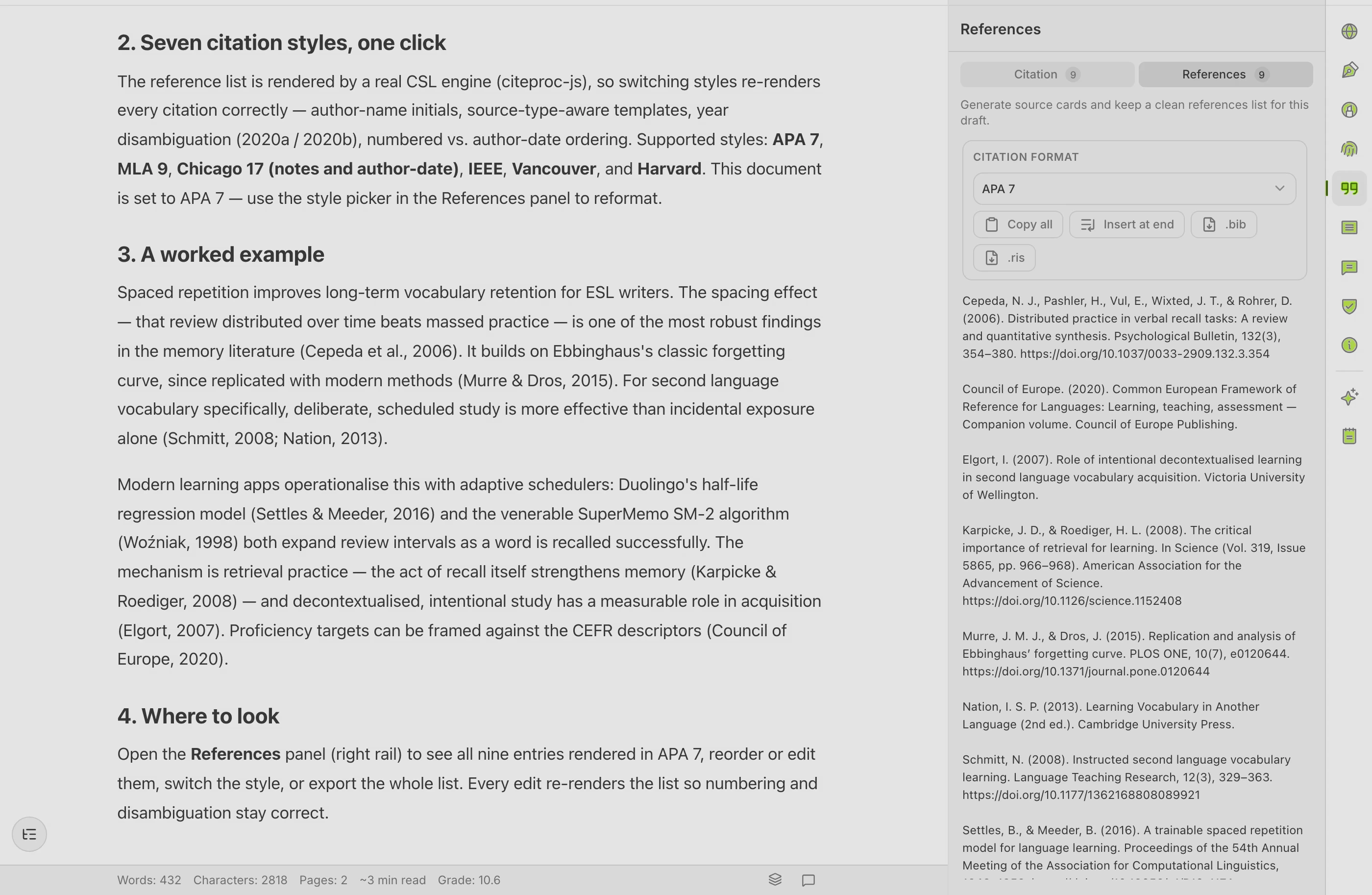
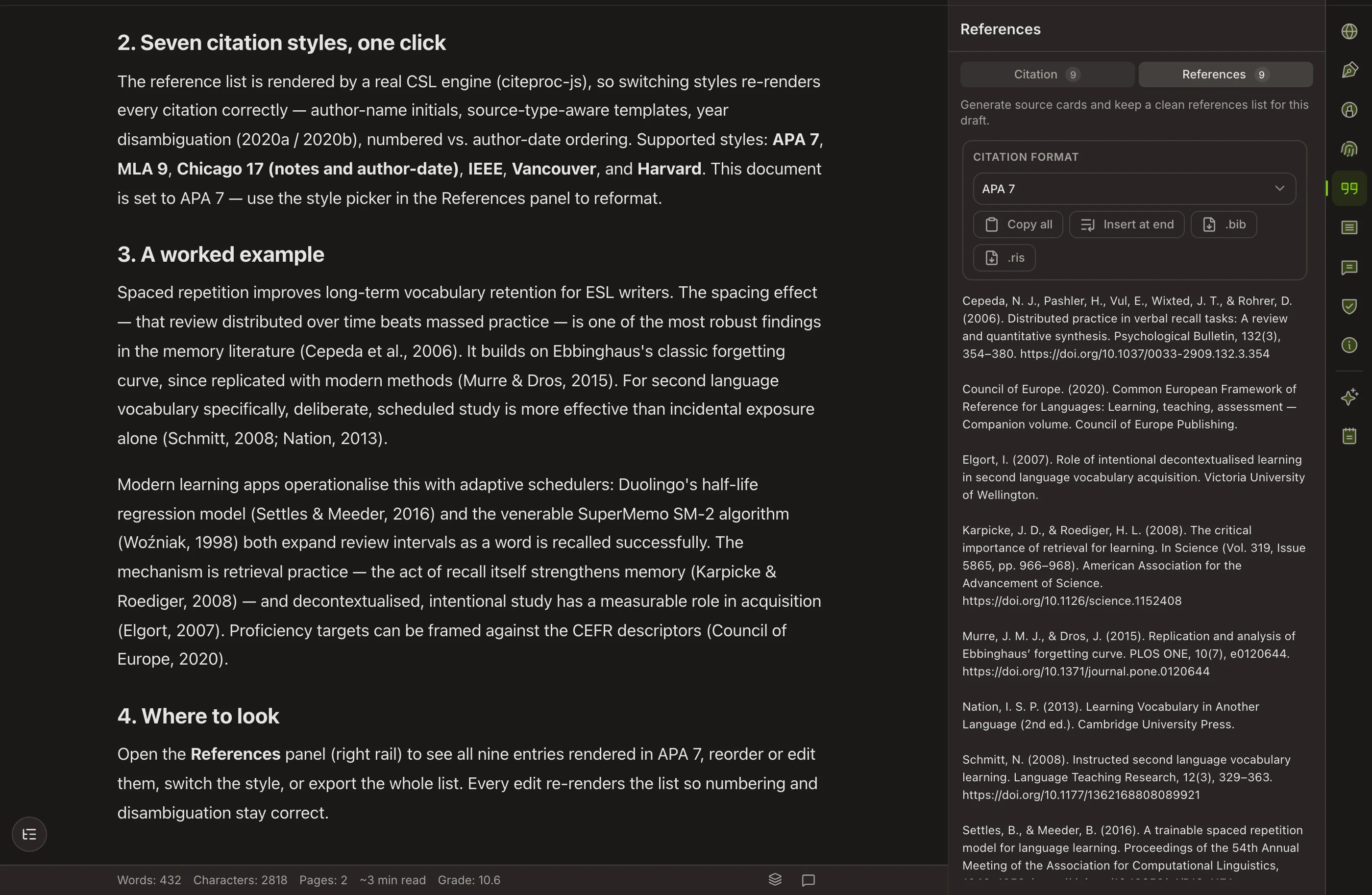
Attach the citation in the same breath

Add the in-text citation as you write the sentence, not in a cleanup pass later. Unattributed paraphrases in a draft are the single most common route to an accidental integrity problem, because by the third revision you no longer remember which sentences came from where.

Ask whether it should have been a quotation

Some passages resist paraphrase: a definition, a legal formulation, a phrase whose exact wording is the point. If your paraphrase is longer and vaguer than the original, quote it instead and keep your commentary as the contribution.

Why synonym swapping is still plagiarism

The rule most writers half-remember is that a paraphrase must use different words. That is not the rule. A paraphrase must be your own expression of an idea, and expression includes the order of the clauses, the choice of what becomes the subject, and where the emphasis falls. Replace every word in a sentence but keep its architecture and you have produced a translation of someone else’s sentence, not your own.

Take an original like this: “Rising sea surface temperatures have been implicated in the increasing frequency of coral bleaching events across the Indo-Pacific.” The synonym-swap version — “Climbing ocean surface temperatures have been blamed for the growing frequency of coral bleaching incidents throughout the Indo-Pacific” — is the same sentence wearing a hat. Most assessors would read it as copied, and they would be right.

A genuine paraphrase restructures. “Corals across the Indo-Pacific bleach more often as the surface ocean warms, a link several studies have drawn (Author, 2019).” The subject changed from temperatures to corals, the passive construction is gone, and the hedge that the original carried in “have been implicated” now sits in “a link several studies have drawn.” Same claim, your sentence.

Work from notes, never from the open source

The mechanical cause of accidental plagiarism is having the source visible while you write. Your working memory takes the path of least resistance and reaches for the phrasing already on screen. Writers who close the PDF before drafting produce more distinct prose without trying harder — the constraint does the work.

Build the habit at the note-taking stage. When you read, write notes in full sentences of your own, and put anything you copy verbatim in quotation marks with a page number the moment you paste it. Notes that mix your wording and the author’s with no marker between them are a trap you set for yourself weeks before the draft.

This also makes the writing faster. A note that already says the thing in your voice is a sentence you have half-written; a highlighted passage is a sentence you still have to rewrite from scratch, under time pressure, with the original staring at you.

  • Quotation marks plus a page number on anything copied word for word, at the moment of copying.
  • Notes written in full sentences, not fragments — fragments get pasted straight into drafts.
  • A short line under each note saying why the source matters to your argument.

Fidelity is the part people skip

A paraphrase can be perfectly original in wording and still be wrong, because rewording is where certainty quietly inflates. Authors write “was associated with,” “may explain,” “in this sample”; paraphrasers write “led to,” “explains,” and drop the sample entirely. The result reads more confident and cites a source that never said it.

Check every paraphrase against three things in the original: the strength of the verb, the scope of the population, and any condition attached to the claim. “Participants who completed the full program reported fewer symptoms at six months” should not become “the program reduces symptoms.” Two qualifiers vanished and a correlation became a cause.

If you find yourself unable to keep the qualifiers without the sentence turning clumsy, that is a signal about your own argument, not about the sentence. You may be leaning on a source to carry more weight than it can.

Checking a paraphrase you wrote yesterday

Read your version and the original side by side and ask one question: could someone reconstruct the original sentence from mine? If the answer is yes, the structure is still borrowed. Rewriting the paraphrase from your own version — without looking at the source at all — usually breaks the last of the resemblance.

A second check: does your paragraph contain a sentence that is doing no work except restating the source? Strong academic paragraphs use the paraphrase and then do something with it — compare it to another study, apply it to your case, name its limit. If the paraphrase is the whole paragraph, the paragraph is not yet yours.

Finally, confirm the citation is still attached after revision. Sentences get split and merged during editing, and a citation that ends up on the wrong half of a split sentence points a reader at a claim the source never made.
FAILURE MODES

What goes wrong, and what to do instead

Swapping synonyms while keeping the source’s sentence structure, which is still plagiarism.

Rebuild the sentence from a different subject, and merge or split clauses so your version cannot be mapped onto the original one part at a time.

Paraphrasing with the source open on the other half of the screen, then wondering why the phrasing feels borrowed.

Close the source. Write from a note you made in your own words, and only reopen the original to check accuracy afterwards.

Dropping the author’s hedge, so a tentative association becomes a stated cause in your paper.

Copy the strength of the claim before you copy anything else: “was associated with” stays associated with, and the sample stays named.

Assuming a paraphrase does not need a citation because the words are now yours.

Cite every borrowed idea regardless of wording. The citation credits the thinking, not the vocabulary.

Stitching a paragraph out of paraphrases from four sources with no sentence of your own between them.

After each paraphrase, write a line that does something with it — contrast, qualify, apply. That line is your contribution.

Paraphrasing a technical definition until it is no longer accurate, just to avoid quoting.

Quote definitions and formulations whose exact wording carries the meaning, and spend your own words on what follows from them.

Questions writers ask about this

Do I need to cite a paraphrase?

Yes. Citation credits the idea, not the phrasing. A paraphrase with no citation presents someone else’s thinking as yours, which is the definition of plagiarism regardless of how thoroughly you rewrote the sentence.

How different does a paraphrase have to be?

Different enough that a reader could not reconstruct the original sentence from yours. That usually means a new subject, a different clause order, and often a different number of sentences — not a pass with a thesaurus.

What is the difference between paraphrasing and summarizing?

A paraphrase restates one passage at roughly its original length. A summary compresses a longer stretch — a section, a whole article — and keeps only what matters at that scale. Both need citations.

Is patchwriting plagiarism?

Patchwriting — keeping the source’s structure and changing scattered words — is treated as plagiarism at most institutions, even when it is unintentional. It is usually a sign of writing too close to a source you have not fully digested.

Can I paraphrase my own earlier work?

Reusing your own published or submitted text without acknowledgement is self-plagiarism at many institutions. Check your policy, and cite your earlier work the way you would cite anyone else’s.

One workspace
for the whole paper

Draft with structure, cite as you write, and keep a verifiable record of how the document came together. Copyeditor is in beta — apply and we’ll reach out as spots open.

Apply for beta

*Beta opens this season — starting with students and researchers.

The Copyeditor writing workspace