Template
A research paper outline you can fill in section by section
You are writing an empirical paper for a journal or a graduate course and you want the structure settled before you draft a paragraph.
- Typical length
- Roughly 4,000–8,000 words for a journal article, but the range is wide and field-specific. Read the author guidelines before you outline.
- Usual tense
- Present tense for established knowledge and for what the paper itself does; past tense for what you did and what you found.
- First person
- Common and accepted in most fields today (“we measured”), though some journals still prefer impersonal constructions. Copy the register of recent issues.
- Citation style
- APA in psychology and education, IEEE in engineering and computing, Chicago or MLA in the humanities, and house styles almost everywhere else.
- Display items
- Many journals cap figures and tables at roughly five to seven. Confirm the limit before you build ten.
- Check with your department
- Word limits, whether background stands as its own section, and whether a preregistration or data-availability statement is expected.
THE SKELETON
Section by section
Each block gives you the heading, what it has to accomplish, and the questions that fill it.
1 · about 3–5% of the total
Title and Abstract
The title says what you studied and, where the field allows it, what you found. The abstract compresses the whole paper into one paragraph a reader can judge in half a minute.
- Which two or three terms would a reader type into a database to find this paper?
- If you could report one result and nothing else, which one would it be?
- Can you name your design, sample, and setting in a single clause?
- Does the abstract promise anything the paper does not deliver?
2 · about 10–15% of the total
Introduction
Move from the broad problem to your specific question in a few paragraphs, and land on the gap your study fills. The last sentence should make the rest of the paper feel necessary.
- What does the field currently treat as settled on this topic?
- Which specific thing does nobody yet know, and how do you know it is unknown?
- What is your research question, written as an actual question?
- Why does answering it matter to someone who is not you?
3 · about 15–20% of the total
Background and Theoretical Framing
Give the reader the concepts and prior findings they need before the methods make sense. In many journals this folds into the introduction rather than standing alone.
- Which three or four studies does your work sit directly on top of?
- Where do those studies disagree with one another?
- Which terms must you define before the methods section is readable?
- What does your framework predict that a competing framework does not?
4 · about 15–20% of the total
Methods
Describe what you did in enough detail that a competent stranger could repeat it. This is the section reviewers read most skeptically.
- What would another researcher need in order to run this study again?
- How were participants, samples, or texts selected, and how many were there?
- Which analyses did you plan in advance, and which did you decide on after seeing the data?
- Where did the ethics approval or data-use permission come from?
5 · about 15–20% of the total
Results
Report what you found without interpreting it. Every result you present here should be one you return to in the discussion.
- Stated plainly, what is the answer to your research question?
- Which numbers belong in the prose and which belong in a table or figure?
- Did anything come out the opposite of what you expected?
- Are you reporting results you never mention again?
6 · about 20–25% of the total
Discussion
Explain what the results mean, how they sit against prior work, and how far the claim can be pushed. This is where the paper earns or loses its argument.
- What is the most defensible reading of your main result?
- Which earlier finding does yours confirm, extend, or contradict?
- What would a skeptical reviewer object to first, and what is your answer?
- Which limitation genuinely constrains the claim, as opposed to being a ritual disclaimer?
7 · about 5% of the total
Conclusion
Close with the contribution in a form a reader can carry away. Introduce nothing new here.
- If a reader remembers one sentence from this paper, which sentence should it be?
- What is the study someone should run next?
- Are you claiming more here than the results section supports?
8
References and Supplementary Material
Every in-text citation appears here and nothing else does. Material that supports the study but interrupts the argument moves into an appendix or an online supplement.
- Does every citation in the text have an entry, and every entry a citation?
- Which style and which edition does the target journal require?
- What belongs in the supplement — instruments, code, full data tables?
SENTENCE STARTERS
Phrasing you can adapt
Lift these and change the specifics. Academic phrasing is a shared convention, not something each writer has to reinvent.
Although X has been studied extensively, little is known about …
Existing accounts of X have concentrated on Y, leaving Z largely unexamined.
To date, no study has tested whether …
These findings are difficult to reconcile with …
Table 2 shows that …
Participants in the X condition reported higher …
Contrary to expectation, …
The pattern held after controlling for …
These results suggest, but do not establish, that …
One plausible reading of this pattern is that …
Because the sample was drawn from a single site, the estimate may not extend to …
This interpretation rests on the assumption that …
Questions about the research paper outline
Should I write the sections in order?
Most people do not. Methods and results are the easiest to write because they describe what already happened, so drafting those first gives you something solid to argue from. The introduction usually gets rewritten last, once you know what the paper actually claims.
How detailed should an outline be before I start drafting?
Detailed enough that each section has a one-sentence claim under its heading. If you cannot state what a section argues, drafting it will not clarify the matter — it will just produce paragraphs.
Do I need a separate literature review section?
It depends on the field. Psychology and medical papers often fold prior work into the introduction, while education, management, and many social science journals expect a separate section. Look at three recent papers in your target venue and follow them.
Where do hypotheses go?
At the end of the introduction or the end of the background section, immediately after the reasoning that motivates them. A hypothesis that appears without the argument behind it reads as arbitrary.
How many references does a research paper need?
There is no correct number, and reviewers notice padding faster than they notice thinness. Cite what your argument depends on, plus the recent work a reader would expect you to have read.
Related templates
Literature Review Outline
You are writing a standalone review — for a course, a thesis chapter, or a review journal — and you have far more sources than shape.
Abstract Template
You have a finished paper and 250 words to make an editor, a reviewer, and a search engine understand it.
Methodology Section Template
You ran a study and now have to describe it so precisely that a reviewer can evaluate it and a stranger could repeat it.
Discussion Section Template
Your results are written up and you now have to say what they mean without claiming more than the data will carry.
An outline is a start
Plan mode is the rest
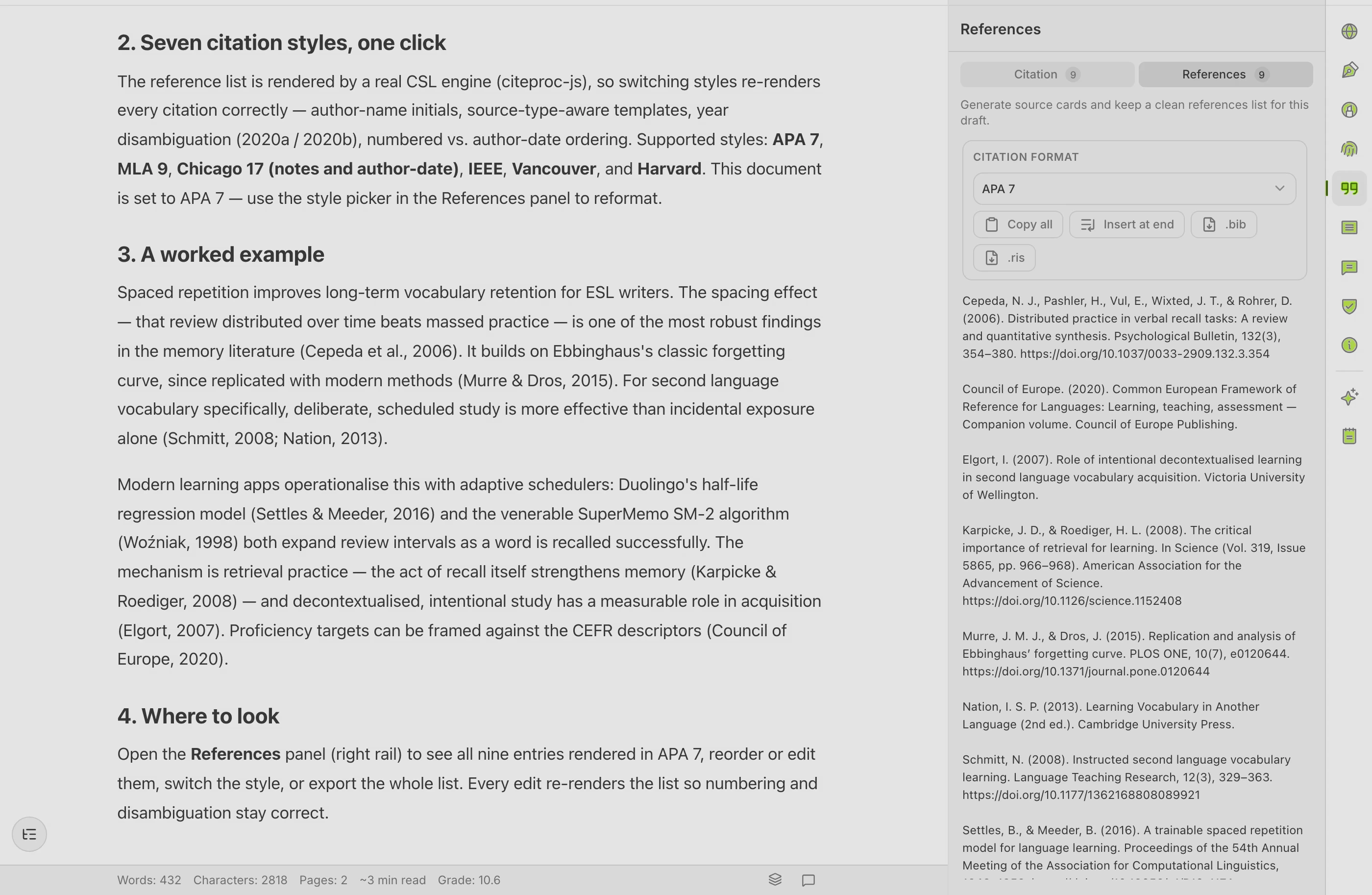
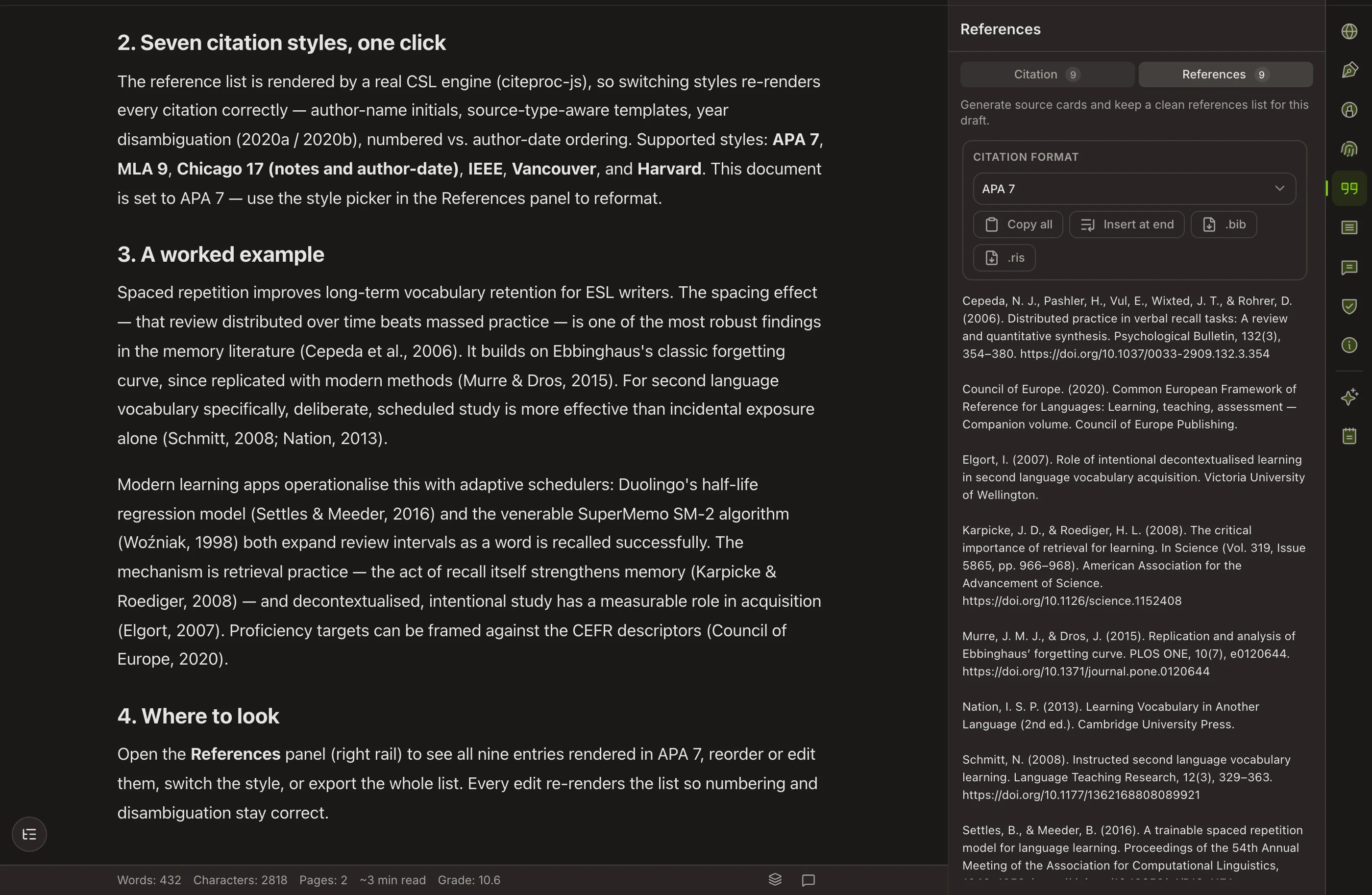
Copyeditor’s Plan mode turns a structure like this into sections you produce one at a time, with citations landing in the bibliography as you go.