Skip to content

Integrity and authorship

Keeping the line between your words and theirs

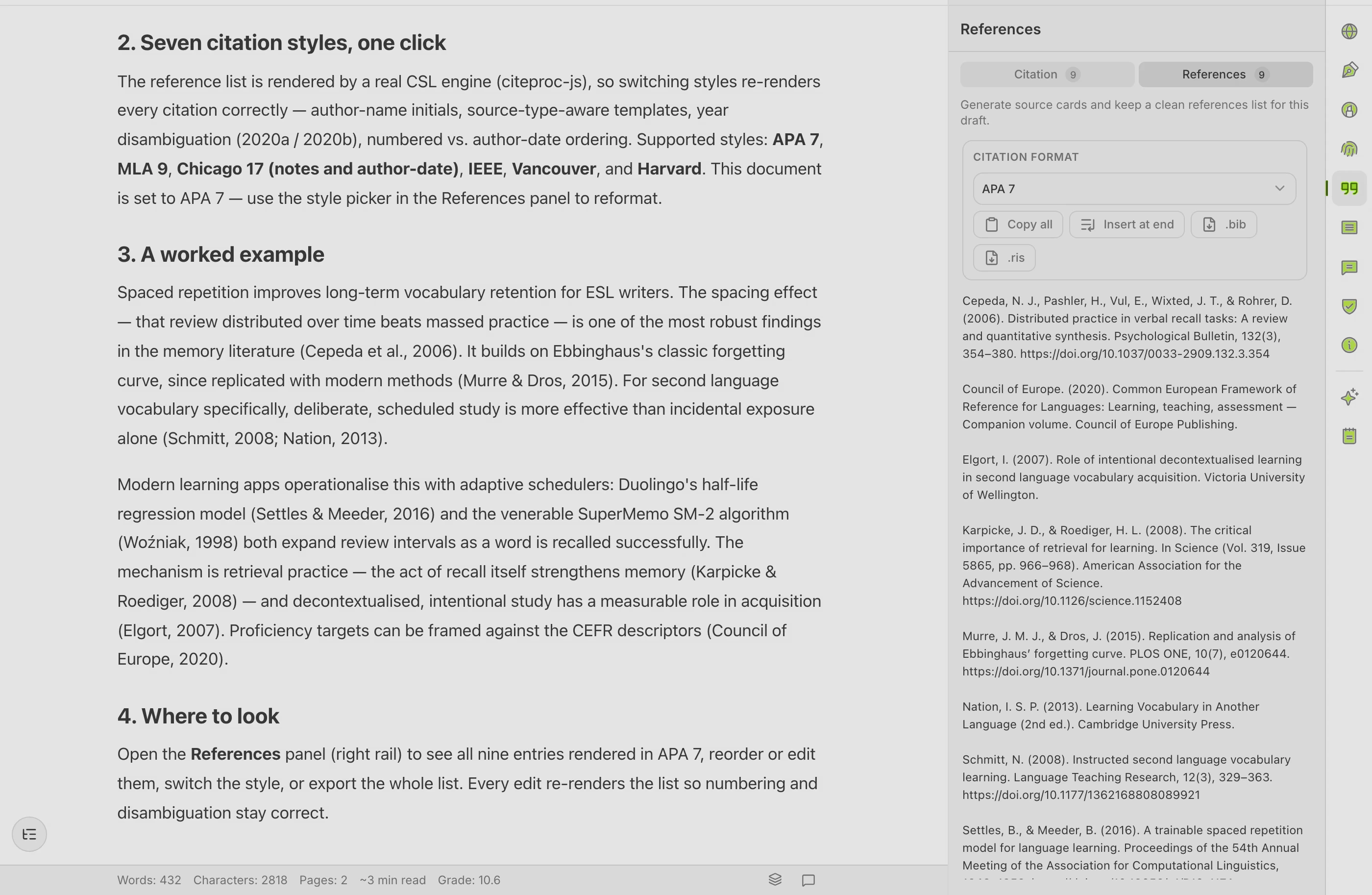
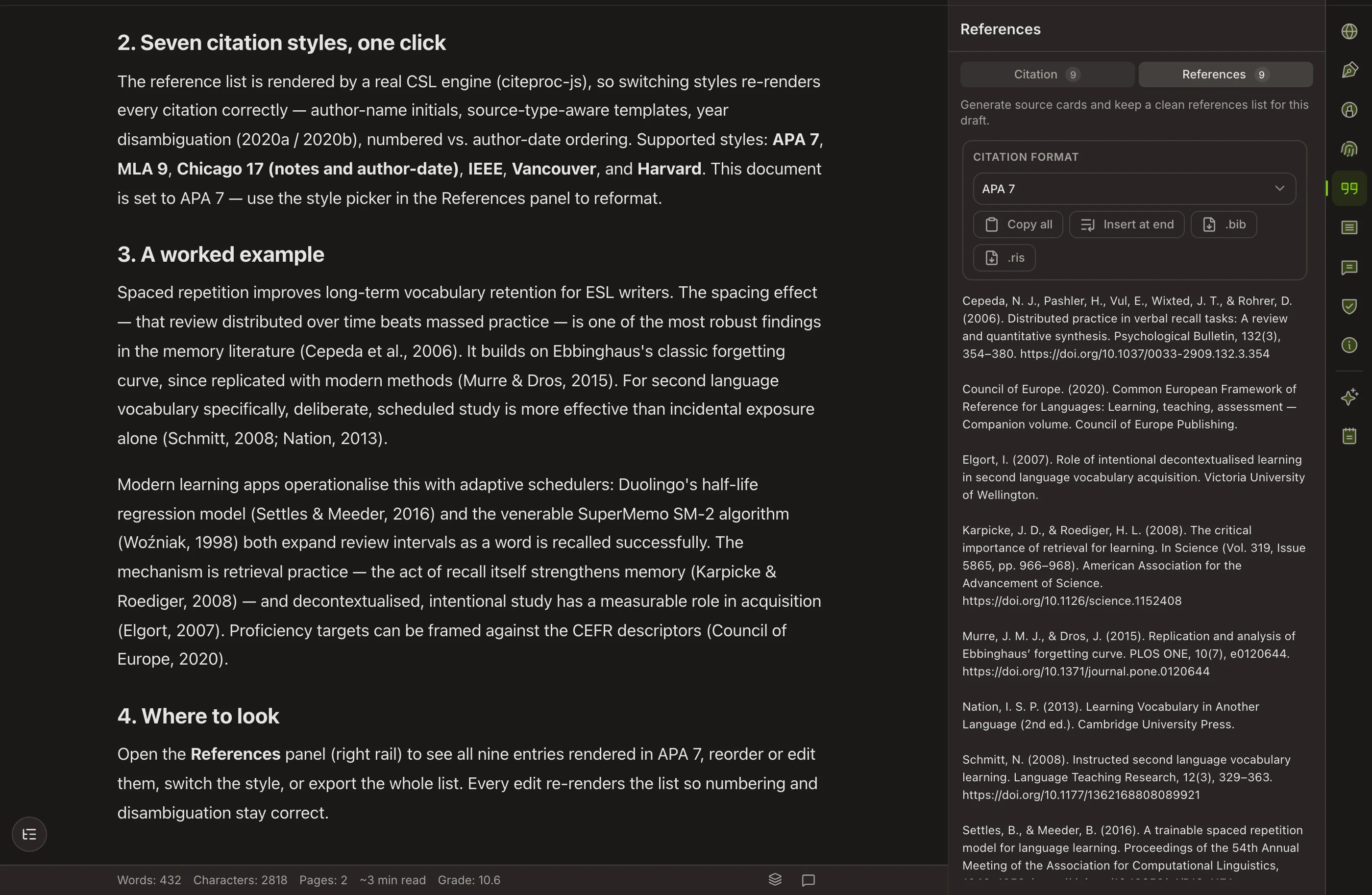
Avoiding plagiarism is mostly a matter of process: mark every borrowed phrase at the moment you capture it, and cite while drafting rather than afterwards.

Avoid plagiarism by keeping the boundary between your words and a source’s visible at every stage. Mark direct quotations with quotation marks and a page number the moment you copy them, write notes in your own sentences, cite while drafting rather than at the end, and treat structure — not just wording — as something that must be yours.

THE PROCESS

Step by step

Mark quotations at the moment of capture

Anything you copy verbatim into notes gets quotation marks and a page number immediately, before you do anything else. Weeks later you will not be able to tell your phrasing from the author’s, and this is where most accidental plagiarism starts.

Write notes as sentences of your own

Instead of highlighting, write what the passage claims in your own words, with the source closed. Highlighted text gets pasted into drafts; a sentence you wrote yourself is already yours and already understood.

Keep the full reference with every note

Attach author, year, title, and page to each note as you make it. Reconstructing sources afterwards is slow, error-prone, and the point at which citations get attached to the wrong claims.

Cite while you draft, never afterwards

Put the citation in as you write the sentence, even as a rough bracketed marker. A cleanup pass at the end depends on remembering which sentences came from where, and by the third revision you will not.

Paraphrase from your notes, not from the source

Draft with the original closed. Working from a note you already phrased yourself is what stops your version shadowing the author’s sentence structure, which is the form of plagiarism writers most often commit without meaning to.

Check your policy on grey areas before you need to

Reusing your own earlier submitted work, citing a source you found quoted in another paper, and what counts as common knowledge in your discipline all vary by institution. Read your regulations once, early, rather than guessing at three in the morning.

Audit citations after every revision

Splitting and merging sentences moves citations away from the claims they support. After each round of edits, check that every claim needing attribution still has it, and that every reference in the list appears in the text.

Where plagiarism actually happens

The deliberate cases — buying an essay, copying a chapter — are rare and easy to describe. The common cases are procedural. A phrase gets pasted into notes without quotation marks and resurfaces in a draft. A paraphrase stays too close to the original because the PDF was open. A citation gets orphaned when a paragraph is restructured. None of these involve an intention to deceive, and all of them are treated as plagiarism.

This matters because it tells you where to spend effort. Reading a definition of plagiarism does not protect you; changing how you take notes does. Writers who never have this problem are almost always writers with a habit that separates borrowed material from their own at the point of capture.

It also explains why the risk peaks under time pressure. Every shortcut people take when a deadline is close — highlighting instead of note-taking, drafting with sources open, citing at the end — is a shortcut that removes one of the boundaries. The process is a defense, and it is the first thing that gets dropped.

Patchwriting, the most common accidental form

Patchwriting means keeping a source’s sentence structure while substituting words here and there. Most institutions treat it as plagiarism, and most writers who do it believe they are paraphrasing. It usually signals that the writer has not yet understood the passage well enough to restate it, so they stay close to the safety of the original.

The diagnostic is straightforward: put your sentence beside the original and ask whether a reader could reconstruct the source from yours. If the clauses line up in the same order, with the same emphasis, it is patchwriting no matter how many words differ. Adding a citation does not fix it — a citation covers the idea, but the expression is still borrowed, and that needs quotation marks.

The fix is upstream of the sentence. Close the source, explain the passage aloud or in a note, and draft from that. If you cannot explain it without looking, the passage is not yet yours to paraphrase and you should either reread it or quote it directly.

Common knowledge, self-plagiarism, and other grey areas

Common knowledge — facts so widely known in your field that they need no source — is real but narrower than writers hope, and it is discipline-relative. That the boiling point of water at sea level is 100 °C needs no citation; the prevalence of a condition in a particular population does, even if you have read it many times. When unsure, cite. An unnecessary citation is a minor stylistic issue; a missing one is not.

Self-plagiarism is the reuse of your own previously submitted or published text without acknowledgement. Institutions vary, and some are strict about reusing even a methods section between your own papers. This surprises people, so check your regulations and your journal’s policy rather than assuming your own work is free to reuse.

Secondary citation — citing a source you have only encountered quoted in another work — is the third grey area. Most style guides allow it with an explicit “as cited in” formulation, and most supervisors would rather you found the original. The real risk is that the intermediate author’s summary was inaccurate and you have now inherited their error under your own name.

  • Common knowledge is field-specific and narrower than it feels. When unsure, cite.
  • Reusing your own submitted text usually requires acknowledgement — check your policy.
  • Cite secondary sources as “as cited in,” and track down the original where you can.

Detectors, second-language writers, and evidence of process

A note of honesty about the tools. Text-similarity software compares your writing against a database and reports overlapping strings; it identifies matches, not intent, and a high similarity score often reflects correctly quoted material, reference lists, or standard methodological phrasing. AI-detection tools are a separate category and a less reliable one, and they flag writing by people whose first language is not English noticeably more often than writing by native speakers. That is a real problem affecting real students who did nothing wrong.

The response to that is not to write in a way designed to change a score. Trying to game a detector is both an integrity risk in itself and futile, since the tools change constantly. The durable answer is evidence of your own process: dated drafts, notes with sources attached, an outline that predates the prose, and a supervisor who has seen the work develop. When a score is questioned, a documented history of how the text came to exist is what actually resolves it.

Keep that record as a matter of routine rather than assembling it under suspicion. Save drafts with dates, keep your reading notes, and hold on to feedback. It costs nothing while you work, and it is the only thing that reliably answers a question no similarity report can settle on its own.
FAILURE MODES

What goes wrong, and what to do instead

Highlighting passages in PDFs and treating the highlights as notes, so copied phrasing enters the draft unmarked.

Convert every highlight into a sentence of your own before it goes near a draft, and put quotation marks plus a page number on anything you keep verbatim.

Planning to add citations at the end, then finding you cannot remember which sentences came from which source.

Insert a citation marker as you write each borrowed claim. A rough bracketed note preserves the link and takes seconds.

Assuming a citation makes copied wording acceptable without quotation marks.

A citation credits the idea; quotation marks credit the words. Borrowed phrasing needs both, or a genuine restructuring.

Reusing a methods section or literature review from your own earlier submission without saying so.

Check your institution’s self-plagiarism rules and acknowledge prior work explicitly. Many programs treat unacknowledged reuse the same as any other unattributed text.

Citing a study you have only seen described in another paper as though you read it.

Use the “as cited in” convention, or find the original. Inherited summaries carry inherited errors, now published under your name.

Losing citations during revision when paragraphs are split, merged, or reordered.

Run a citation audit after each substantive revision, checking that every attributed claim still sits with its source and that text and reference list match.

Questions writers ask about this

Does a citation always prevent plagiarism?

No. A citation credits the idea, but copied wording also needs quotation marks, and a paraphrase that keeps the source’s sentence structure is still treated as plagiarism even when cited. You need attribution for the idea and genuine restatement or quotation for the words.

What counts as common knowledge?

Facts that any reader in your field would accept without a source, and that appear undocumented across general references in the discipline. It is narrower than most writers assume and varies by field. When you are unsure, cite — the cost of an extra citation is trivial.

Can I reuse my own writing from a previous assignment?

Often only with acknowledgement, and some institutions prohibit it outright. Self-plagiarism policies vary widely, so read your own regulations and ask your supervisor before reusing substantial passages, including methods sections between your own papers.

Is a high similarity score the same as plagiarism?

No. Similarity software reports matching strings, and matches routinely come from properly quoted material, reference lists, and standard technical phrasing. A score is a prompt for a human to look at the matches, not a finding of misconduct.

What should I do if my writing is wrongly flagged by an AI detector?

Ask what the flag is based on, and offer evidence of your process — dated drafts, notes with sources attached, outlines, supervisor feedback. These tools flag second-language writers disproportionately, and a documented writing history is what actually addresses the question.

One workspace
for the whole paper

Draft with structure, cite as you write, and keep a verifiable record of how the document came together. Copyeditor is in beta — apply and we’ll reach out as spots open.

Apply for beta

*Beta opens this season — starting with students and researchers.

The Copyeditor writing workspace