Template
A chapter-by-chapter thesis outline you can plan a year against
You have a supervisor, a topic, and a submission date, and you need to see the whole thesis as chapters before you start writing any of them.
- Typical length
- A master’s thesis commonly falls between 15,000 and 40,000 words; a doctoral thesis between 60,000 and 100,000. Limits are institutional and binding — check the regulations, not a blog.
- Usual tense
- Past tense for your own procedures and findings, present tense for the argument the thesis is making and for what the literature holds.
- First person
- Increasingly accepted, especially in qualitative work where the researcher’s position matters. Some faculties still require the third person throughout.
- Citation style
- Set by the department or faculty, not by you. Fix it before Chapter 2 — retrofitting a style across 200 pages is an expensive mistake.
- Formatting rules
- Margins, line spacing, page numbering, and binding are usually specified in the graduate school handbook and are checked at submission.
- Check with your supervisor
- Whether findings and discussion are separate chapters, how many results chapters your data justifies, and whether publications may be incorporated.
THE SKELETON
Section by section
Each block gives you the heading, what it has to accomplish, and the questions that fill it.
1
Front Matter
Title page, abstract, declaration, acknowledgments, contents, and lists of tables and figures. Mechanical, but the formatting rules here are the ones examiners notice first.
- Which front-matter pages does your institution require, and in what order?
- What is the abstract word limit, and is a structured format prescribed?
- Does your title still describe the thesis you actually wrote?
2 · about 8–10% of the total
Chapter 1 — Introduction
Establish the problem, state the research questions, and give the reader a map of the chapters. An examiner should be able to read this chapter alone and know what the thesis claims.
- What is the problem, in language a colleague from another department would follow?
- What are your research questions, numbered?
- What is the contribution — new evidence, new method, new interpretation, or new context?
- How does each chapter move the argument forward?
3 · about 20–25% of the total
Chapter 2 — Literature Review
Position the thesis in the field and build the case for the gap. The chapter should end where your methodology begins.
- Which debates does the thesis enter, and on whose side?
- What have you read that changed your mind about the topic?
- Does the gap you name actually require the study you ran?
4 · about 15–20% of the total
Chapter 3 — Methodology
Justify the design as well as describe it. At thesis level, examiners expect the philosophical or epistemological grounding, not just the procedure.
- Why is this design the right one for these questions, and what did you reject?
- How were participants, sites, or corpora selected?
- How did you address validity, reliability, or trustworthiness?
- What did the ethics committee require, and how did you comply?
5 · about 20–25% of the total
Chapter 4 — Results or Findings
Present what you found, organized by research question or by theme. Some disciplines split this across several chapters; some merge it with the discussion.
- Are your findings organized by question, by theme, or by data source, and is that the clearest cut?
- Which tables, figures, or extracts carry the argument, and which are decoration?
- Is interpretation leaking into this chapter?
6 · about 15–20% of the total
Chapter 5 — Discussion
Answer the research questions explicitly, set the findings against the literature from Chapter 2, and state what the thesis has added.
- Taking each research question in turn, what is the answer?
- Which claim from Chapter 2 does your evidence revise?
- What is your single most important contribution, in one sentence?
- Which limitation would you raise yourself if you were the examiner?
7 · about 5% of the total
Chapter 6 — Conclusion
Restate the contribution, spell out implications, and point to further work. Short, and free of new evidence.
- What does the field know now that it did not before this thesis?
- What follows for practice or policy, if anything?
- What would you do next with another two years?
8
References and Appendices
The reference list plus the material an examiner may want to inspect: instruments, coding frames, consent forms, extended tables, ethics correspondence.
- Does every appendix get referred to somewhere in the main text?
- Are the appendices numbered in the order they are first mentioned?
- Is the reference list complete under one consistent style?
SENTENCE STARTERS
Phrasing you can adapt
Lift these and change the specifics. Academic phrasing is a shared convention, not something each writer has to reinvent.
Chapter 3 sets out the design used to address these questions.
The argument developed above is tested empirically in Chapter 4.
Having established X, this chapter turns to …
The remainder of this chapter is organized as follows.
This thesis contributes to the literature on X in three ways.
The principal contribution is empirical: it provides the first evidence that …
By combining X with Y, the thesis offers an account that neither approach reaches alone.
The study extends X’s framework to a setting in which …
The first research question asked whether … The evidence in Chapter 4 indicates that …
Taken together, these findings answer RQ2 in the affirmative, with one qualification.
The data do not support the expectation that …
This result aligns with X but departs from Y on …
Questions about the thesis outline
Which chapter should I write first?
Methodology, usually, because you can write it while the study runs and it changes least. The introduction is best written twice: a rough version to orient yourself, and a real one at the end.
Can findings and discussion be one chapter?
In many qualitative traditions, yes, and it often reads better because interpretation sits next to the extract it interprets. Confirm with your supervisor first, since some examiners expect the separation.
How many results chapters should I have?
One per major analytic strand, generally between one and three. If a chapter has no claim of its own, it is a section rather than a chapter.
What is the difference between a thesis and a dissertation?
Mostly geography. In the US, a dissertation is typically the doctoral work and a thesis the master’s; in the UK and much of Europe the terms are reversed. Use whichever your institution uses.
Do I need to publish chapters before submitting?
Not usually for a standard monograph thesis, though some programs offer a thesis-by-publication route with its own structural rules. If you are considering it, ask early — the format affects how you write every chapter.
Related templates
Literature Review Outline
You are writing a standalone review — for a course, a thesis chapter, or a review journal — and you have far more sources than shape.
Dissertation Proposal
You are asking a committee to approve a study you have not run yet, and the document has to convince them it is worth doing and that you can do it.
Methodology Section Template
You ran a study and now have to describe it so precisely that a reviewer can evaluate it and a stranger could repeat it.
Abstract Template
You have a finished paper and 250 words to make an editor, a reviewer, and a search engine understand it.
An outline is a start
Plan mode is the rest
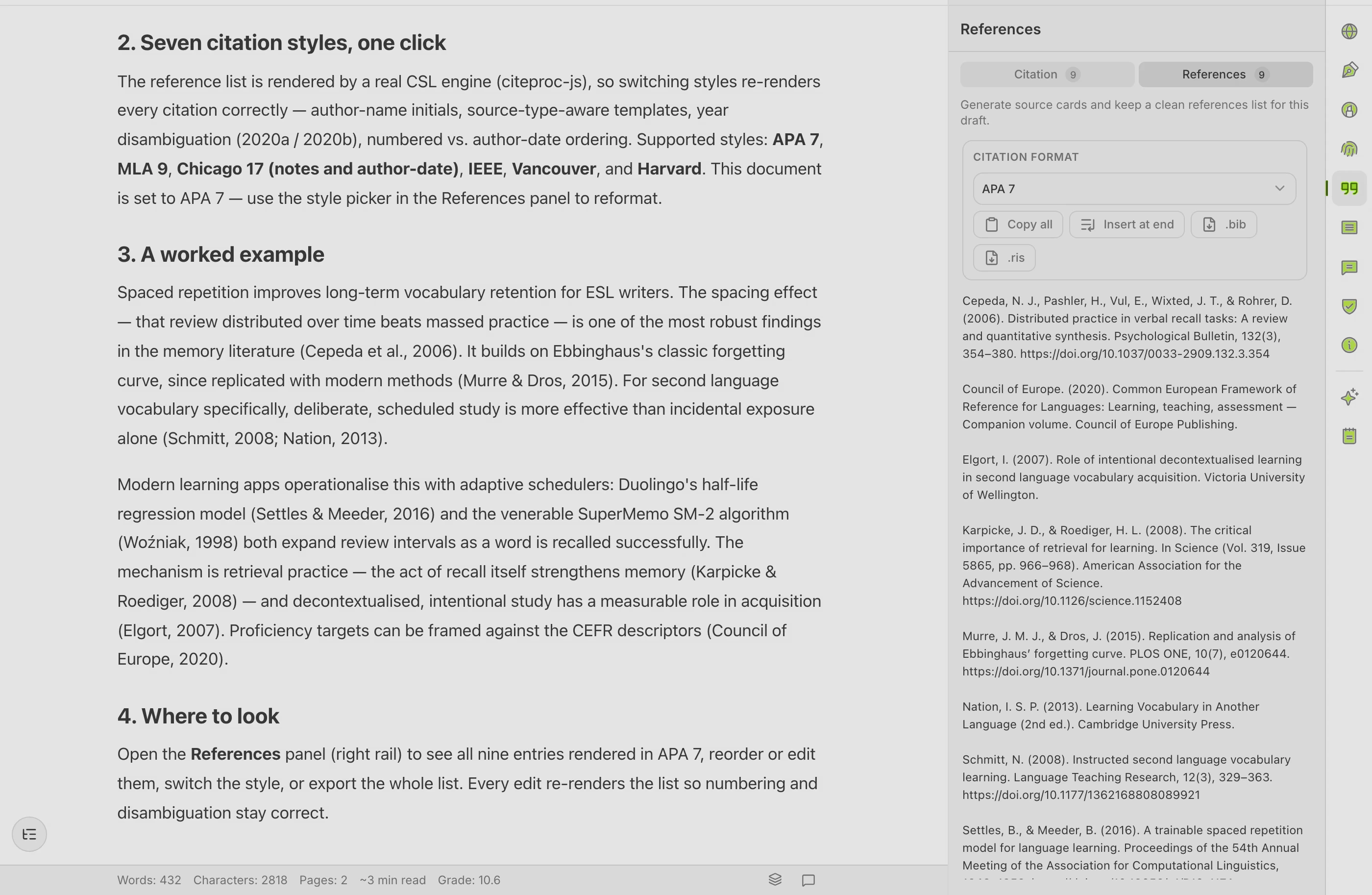
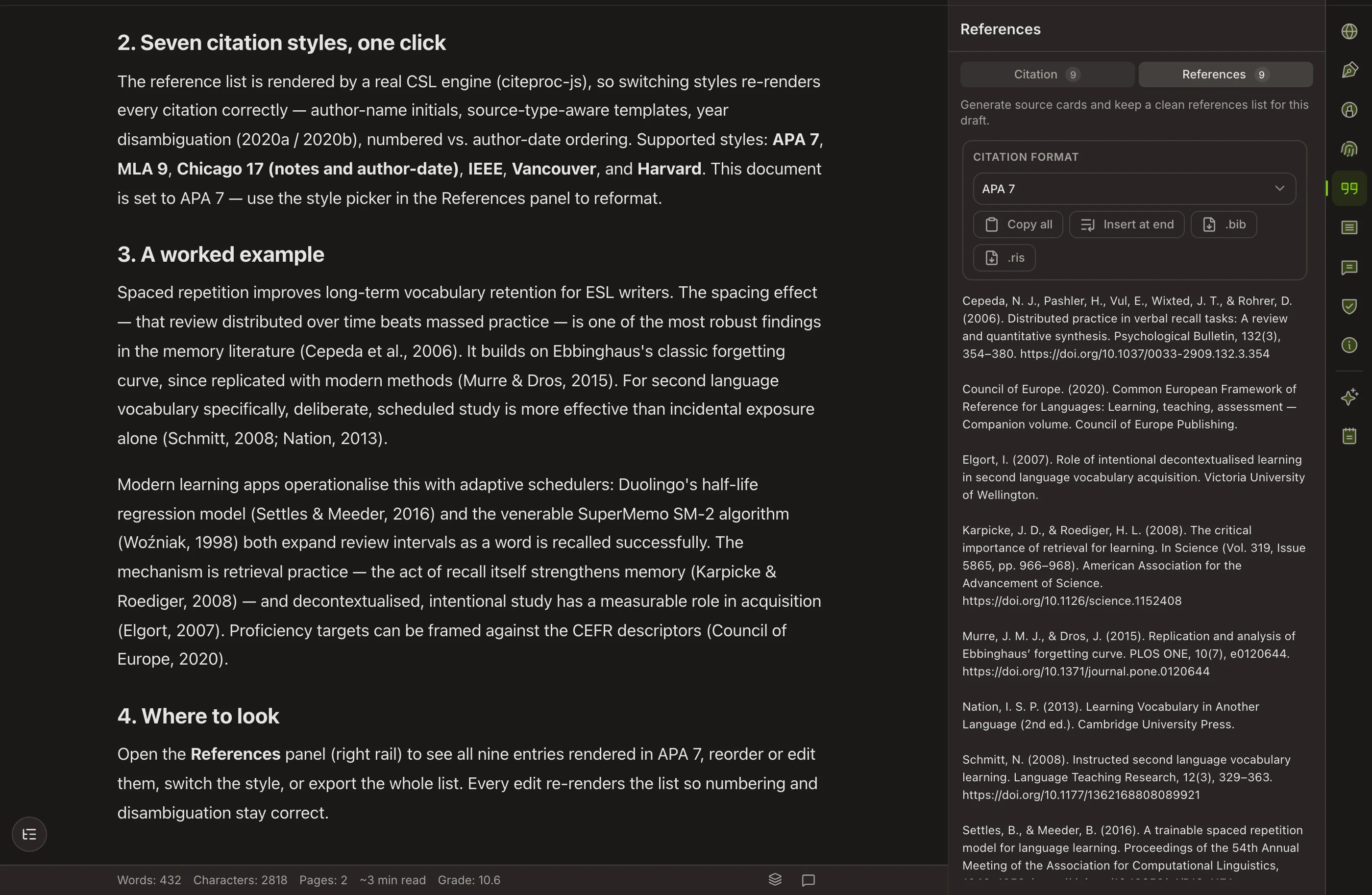
Copyeditor’s Plan mode turns a structure like this into sections you produce one at a time, with citations landing in the bibliography as you go.