Template
What a dissertation proposal has to prove before you can start
You are asking a committee to approve a study you have not run yet, and the document has to convince them it is worth doing and that you can do it.
- Typical length
- Commonly 3,000–8,000 words, though some programs expect a full three-chapter proposal running much longer. The program handbook decides.
- Usual tense
- Future tense for everything you intend to do, present tense for the literature, past tense for pilot work already completed.
- First person
- Generally acceptable and often clearer when describing your own plan, though a few departments still require impersonal phrasing.
- Citation style
- The same style your finished dissertation will use — this is the moment to fix it and start the reference list you will keep for years.
- Approval process
- Usually reviewed by a supervisory committee, sometimes in a defense or upgrade viva. Ethics approval typically follows proposal approval, not the reverse.
- Check with your program
- Required section headings, whether a timeline or budget is mandatory, and whether the proposal is later reused as chapters one to three.
THE SKELETON
Section by section
Each block gives you the heading, what it has to accomplish, and the questions that fill it.
1 · about 10% of the total
Statement of the Problem
Open with the problem in the world, not the gap in the literature. A committee approves projects that matter before it evaluates projects that are novel.
- What is going wrong, unexplained, or unmeasured, stated in two sentences?
- Who is affected by it, and how would they notice if it were solved?
- What evidence shows the problem is real rather than assumed?
2 · about 5–10% of the total
Purpose Statement and Research Questions
Convert the problem into a study. One purpose sentence, then numbered questions or hypotheses that the proposed method can actually answer.
- Can you finish the sentence “The purpose of this study is to …” without a semicolon?
- Is each question answerable with data you can realistically obtain?
- Do your questions overlap, and if so should some be sub-questions?
3 · about 25–30% of the total
Preliminary Literature Review
Show you know the field well enough to have found a real gap. This is shorter than the eventual thesis chapter and more argumentative — its job is to justify one study.
- Which recent work makes your question live rather than settled?
- Which theoretical framework will you use, and what does adopting it commit you to?
- What has been tried already, and why did it not resolve the question?
4 · about 25–30% of the total
Proposed Methodology
Describe the study you intend to run in enough detail that the committee can judge whether it will answer the questions. Written in the future tense throughout.
- What is the design, and what alternative did you consider and reject?
- Who or what will be sampled, how many, and how will you reach them?
- Which instruments or protocols will you use — existing, adapted, or new?
- How will each research question be answered by a specific analysis?
5 · about 10% of the total
Feasibility, Timeline, and Resources
The part committees quietly weigh most heavily. Show that the study fits the time, access, and money you actually have.
- What happens in each remaining semester, month by month?
- Do you already have access to the site, dataset, or population?
- What equipment, software, funding, or training do you still need?
- Which step is most likely to slip, and what is the fallback?
6
Anticipated Contribution
State what will be known, or possible, once the study is finished — for the field, and where relevant for practice or policy.
- What will your discipline be able to claim afterward that it cannot now?
- Who outside academia would use this, and for what?
- If the results come out null, is the study still worth having run?
7
Ethics, Risk, and Positionality
Identify the human-subjects, data-protection, and safety issues, and the approvals you will need. Where your own position affects the research, say so.
- Which approvals are required, and how long do they usually take?
- How will consent, anonymity, and data storage be handled?
- Is any participant group vulnerable, and what protections follow?
- What is your relationship to the setting or participants?
8
References and Appendices
The reference list plus draft instruments, consent forms, recruitment materials, and any letters of access you already hold.
- Do you have a draft of every instrument you intend to use?
- Would a letter of site access strengthen the proposal?
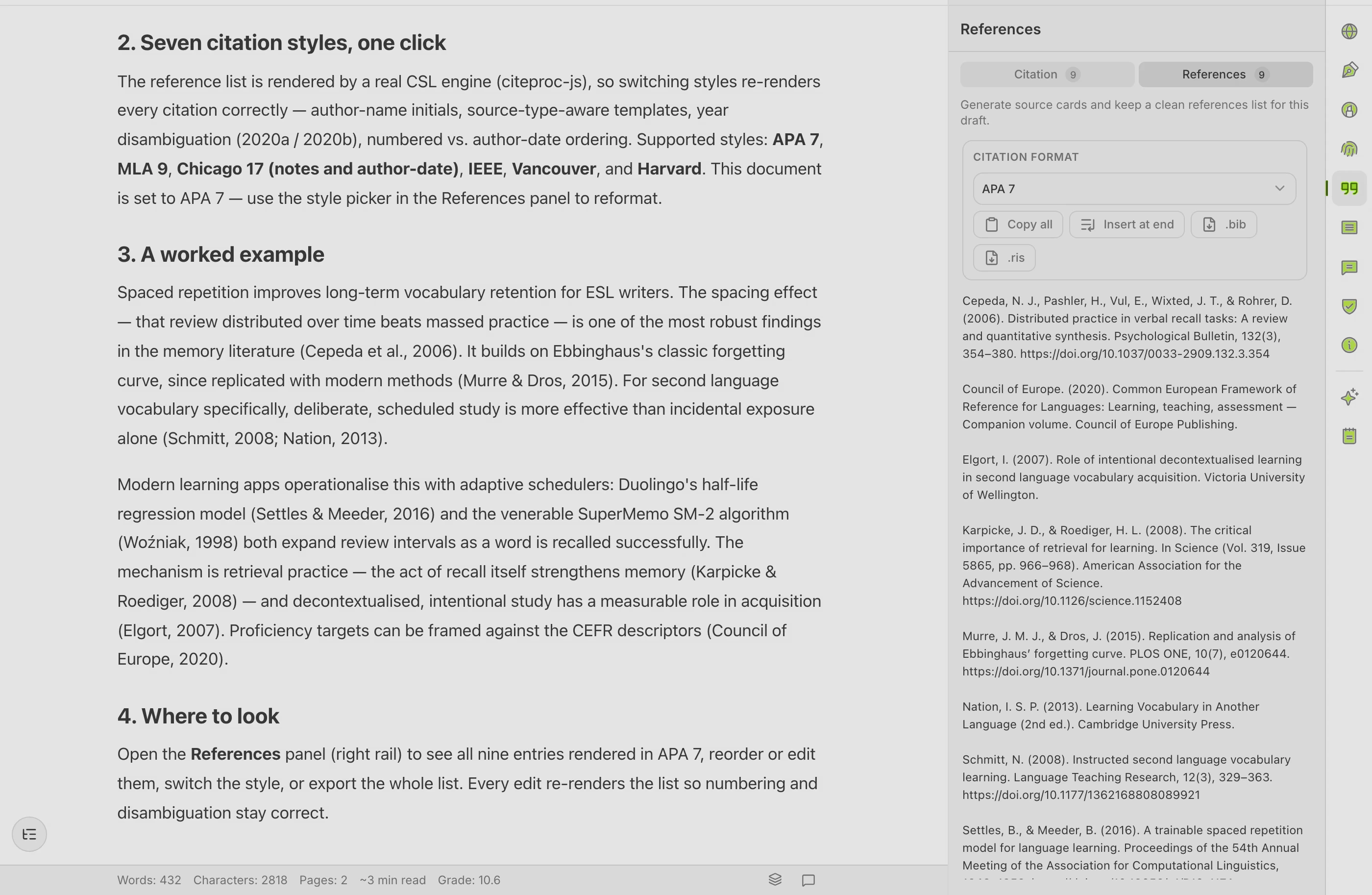
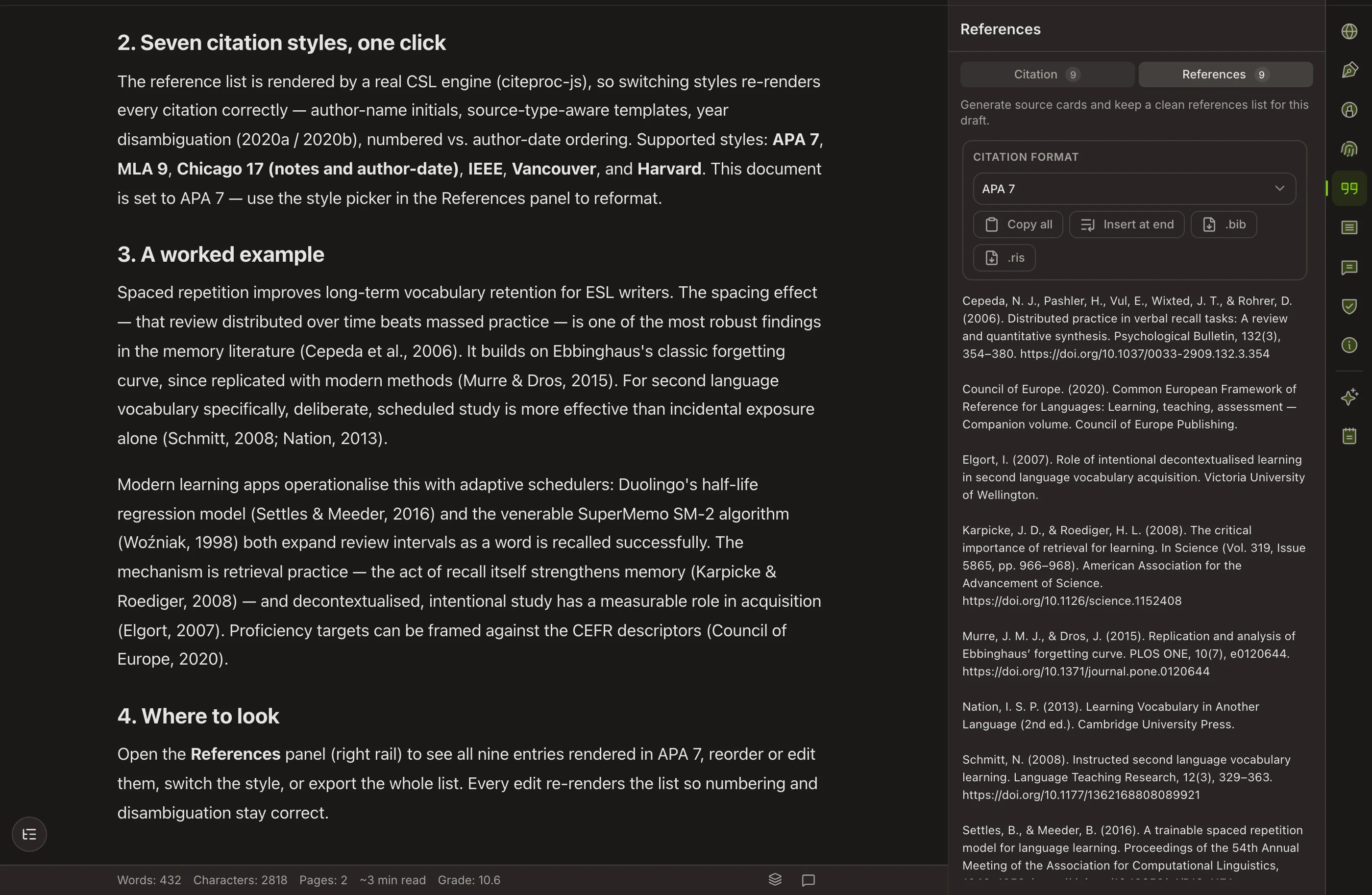
- Is the reference list complete under the required style?
SENTENCE STARTERS
Phrasing you can adapt
Lift these and change the specifics. Academic phrasing is a shared convention, not something each writer has to reinvent.
Despite considerable investment in X, outcomes have not improved for …
Practitioners in X routinely face the decision of …, yet the evidence base is thin.
The scale of X has grown, while the tools for measuring it have not.
This mismatch has practical consequences for …
The purpose of this study is to examine …
Data will be collected from … over a period of …
Participants will be recruited through …
Responses will be analyzed using …
Site access has been secured through …
A pilot conducted in … indicates that recruitment at this rate is achievable.
The dataset is already publicly available under …
Should recruitment fall short, the design allows for …
Questions about the dissertation proposal
How does a proposal differ from the first three chapters of the dissertation?
In many programs they are the same document at different stages: the proposal is written in the future tense and becomes chapters one to three once the study has run and the verbs shift to past tense. Elsewhere the proposal is a shorter standalone case for approval.
What makes committees reject a proposal?
Most often scope and feasibility rather than ideas — a question too large for the time available, a population you have no route to, or an analysis that would not actually answer the question asked.
Do I need preliminary results?
Not usually, but a small pilot is persuasive out of proportion to its size. It shows the instrument works and that recruitment is possible.
Can the study change after approval?
Yes, and it almost always does. Document what changed and why, and tell your supervisor early. Substantial changes to methods involving human participants often require an ethics amendment.
Related templates
Thesis Outline
You have a supervisor, a topic, and a submission date, and you need to see the whole thesis as chapters before you start writing any of them.
Systematic Review Protocol
You are planning a systematic review and need the method fixed and registered before the results can influence your decisions.
Annotated Bibliography
You have been asked to show not only what you have read but what you made of it, usually before a longer piece of writing is due.
An outline is a start
Plan mode is the rest
Copyeditor’s Plan mode turns a structure like this into sections you produce one at a time, with citations landing in the bibliography as you go.