Skip to content

Glossary

The DOI: a permanent address for a piece of published work

Publishers assign a DOI — a Digital Object Identifier — to an article, dataset, or preprint as a permanent alphanumeric handle that resolves to the work’s current location. Unlike a journal URL, it survives a site redesign or a change of publisher, which is why most citation styles now require it when one exists.

Why it matters when you are writing

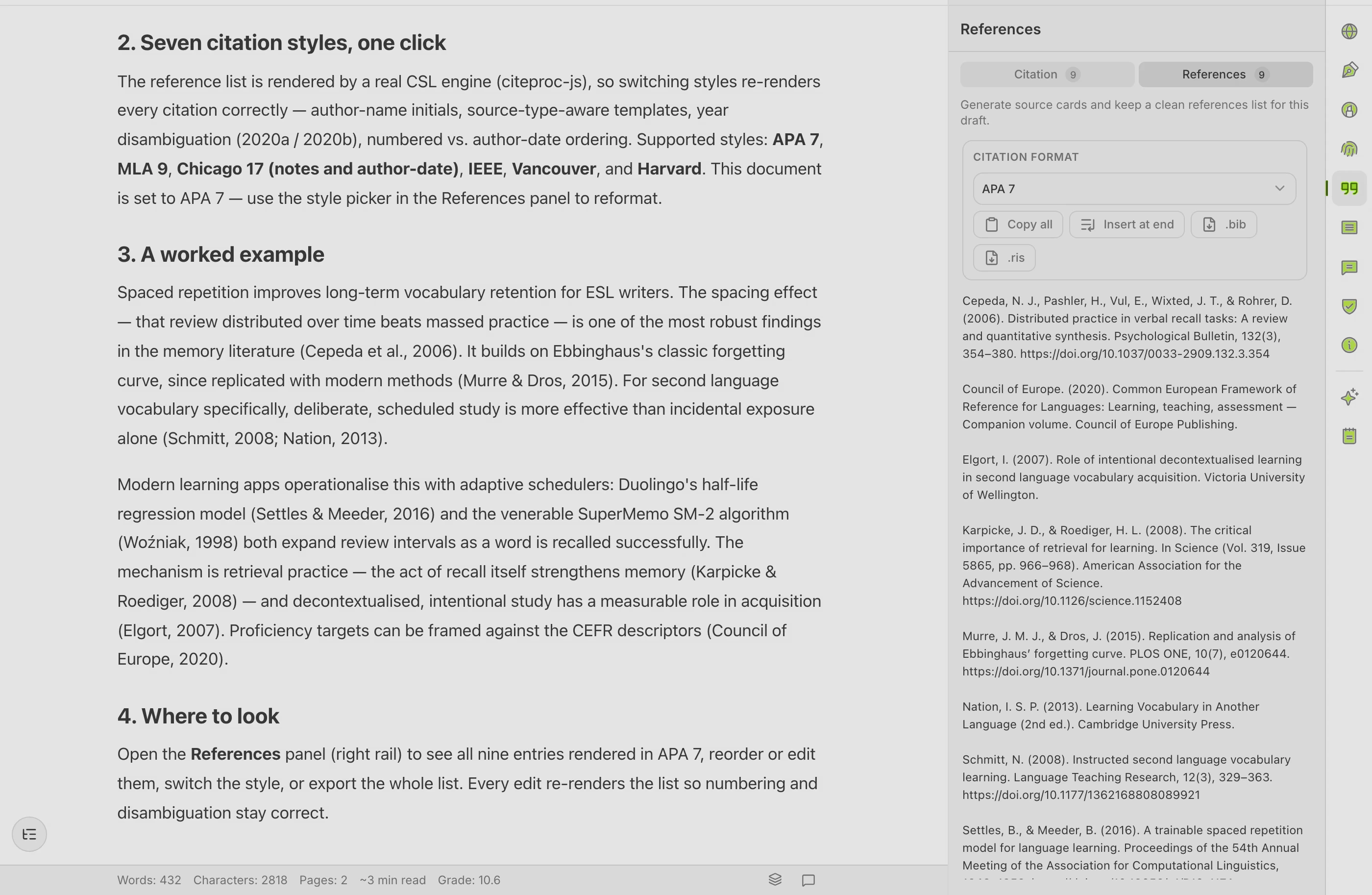
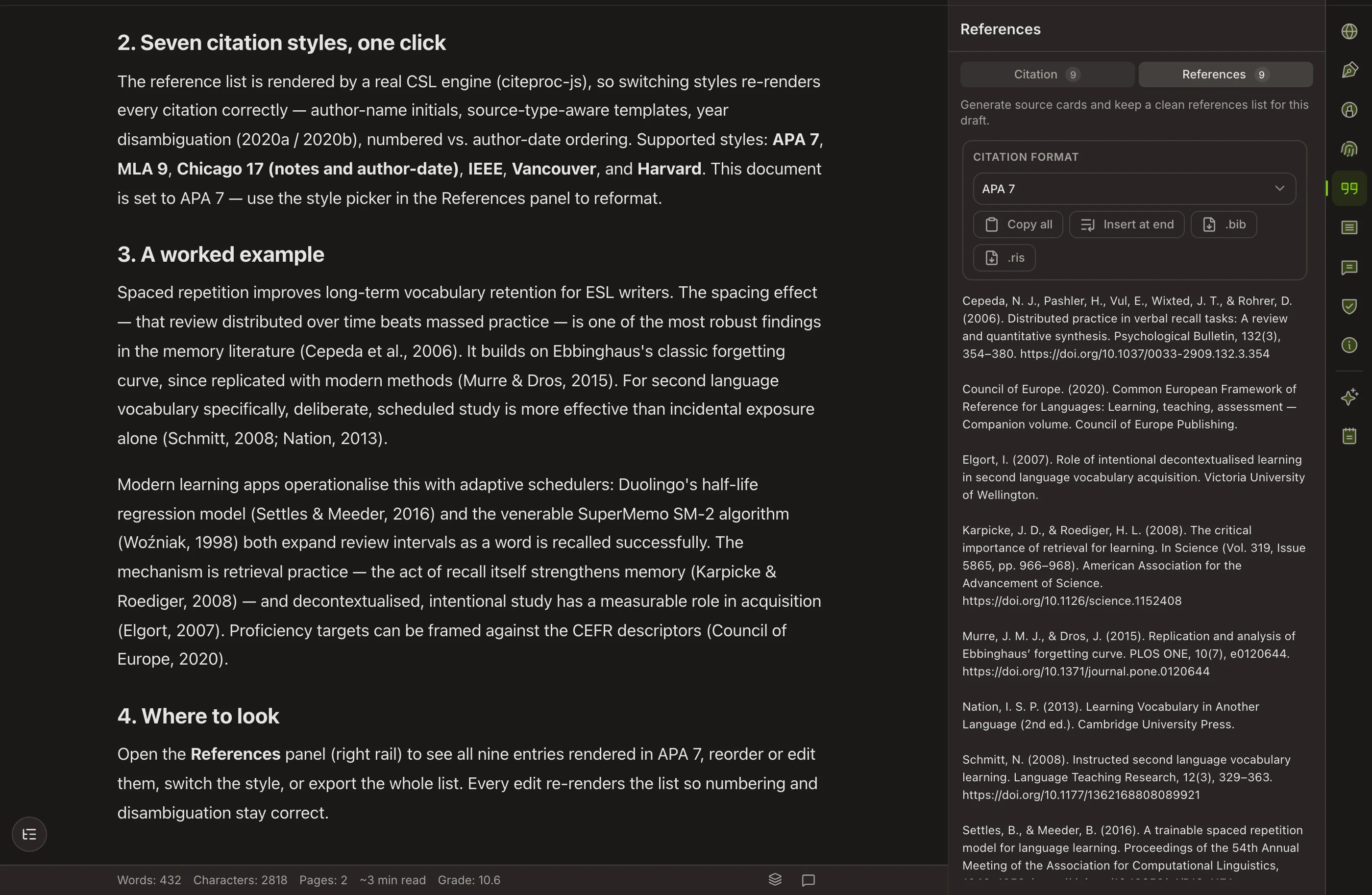
A DOI has two parts separated by a slash: a prefix beginning “10.” that identifies the registrant, and a suffix the publisher chooses. On its own it is just a string; it becomes clickable when you put it behind a resolver, which is why current APA and MLA practice is to print it as a full https://doi.org/ link rather than as a bare number or the older “doi:” form.

Finding one is usually a matter of looking in the right place. It appears on the article’s landing page, on the first page of the PDF, in the export record from a database, and in the CrossRef search index. If a search returns nothing, the work may genuinely have no DOI — book chapters from smaller presses, conference posters, gray literature, and older articles often do not — and in that case you fall back to a stable URL or, for print, to no locator at all.

One habit saves a lot of trouble: capture the DOI at the moment you first save a source, not when you assemble the reference list. Reconstructing forty DOIs from a folder of PDFs named “Okonkwo_final_2.pdf” is an afternoon you will not get back, and it is exactly the point at which entries get quietly dropped.
IN PRACTICE

A DOI inside an APA reference

Okonkwo, A., & Reyes, L. (2021). Framing uncertainty in policy texts. Journal of Applied Linguistics, 42(3), 44–61. https://doi.org/10.1234/jal.2021.0423

OFTEN CONFUSED WITH

What DOI is not

URL
A URL names a location and breaks when the location changes; a DOI names the work and is redirected to wherever it now lives.
ISBN
An ISBN identifies a specific edition of a book as a commercial product; a DOI identifies a work as a citable object and resolves online.
PMID
A PMID is a record number inside the PubMed database; a DOI is publisher-assigned and works regardless of which database you found the article in.

Questions about doi

What if a source has no DOI?

Use a stable URL to the version of record, or the database landing page if that is what your style specifies. For a print source with no online version, no locator is needed.

Should I write “doi:” or the full link?

Current APA and MLA guidance is the full resolver form, https://doi.org/10.xxxx/yyyy, with no period afterward in APA. Older style editions used the “doi:” prefix; follow the edition your journal names.

Do preprints have DOIs?

Most preprint servers assign one, and it is distinct from the DOI the journal later assigns. Cite the version you actually read, and update the reference if the article is published before you submit.

Write it once.
Prove you wrote it.

Copyeditor is an academic writing workspace — structured drafting, citations that build their own bibliography, and a signed record of how your document came together.

Apply for beta

*Beta opens this season — starting with students and researchers.

The Copyeditor writing workspace