Skip to content

Glossary

Academic integrity: honest reporting, proper credit, transparent help

Academic integrity covers the commitments that make scholarly claims trustworthy: reporting honestly what you did, crediting whoever got there first, and being transparent about the help you had — from a colleague, an editor, or a tool. Your institution codifies this in a policy, and that policy, not general custom, governs your work.

Why it matters when you are writing

It is broader than plagiarism, which is only the attribution part. The same principle covers fabricating or selectively reporting data, misrepresenting your methods, listing an author who did not contribute or omitting one who did, reusing your own work without disclosure, and undisclosed conflicts of interest. What unites them is that a reader’s ability to assess the work depends on the account being accurate.

Policies differ in ways that actually matter, and the differences are local. Two universities in the same city can take opposite positions on whether a proofreader may change your sentences, on how much of a taught assignment may be discussed with peers, and on what use of AI assistance must be declared. Reading your own institution’s policy once, properly, is a better investment than any general advice — including this page.

Where the rules are genuinely unclear — and around AI tools they often still are — disclosure is the move that holds up. A short note stating what assistance you used and for what turns an ambiguity into a documented decision. So does keeping a record of your process: drafts, notes, dated versions. If a question is ever raised, the writer with a trail is in a different position from the writer with only an assertion.
IN PRACTICE

A disclosure line that satisfies most policies

A note in the acknowledgments: “Language editing was carried out with software assistance; all sources, analysis, and argument are the author’s own.” Check your institution’s required wording, which may be more specific.

OFTEN CONFUSED WITH

What Academic integrity is not

Plagiarism
Plagiarism is one breach of academic integrity; integrity also covers data handling, authorship, disclosure, and honest reporting of method.
Research ethics
Research ethics governs the treatment of participants and data collection, usually via an ethics board; integrity governs how the work is reported.

Questions about academic integrity

Is using AI assistance a breach of academic integrity?

It depends entirely on your institution’s policy, which will say what is permitted and what must be declared. Where the rule is unclear, disclose what you used and for what.

Does academic integrity cover more than citing sources?

Yes. Data fabrication, selective reporting, misrepresented methods, improper authorship, and undisclosed conflicts of interest are all integrity matters.

Can a proofreader work on my thesis?

Many institutions permit language correction but not substantive rewriting, and some require a declaration. The limit is set by your own regulations, so read them before you hire anyone.

What evidence helps if my work is questioned?

A record of how the work developed — dated drafts, notes, outlines, source files, revision history. Process evidence is what a panel can actually weigh.

Write it once.
Prove you wrote it.

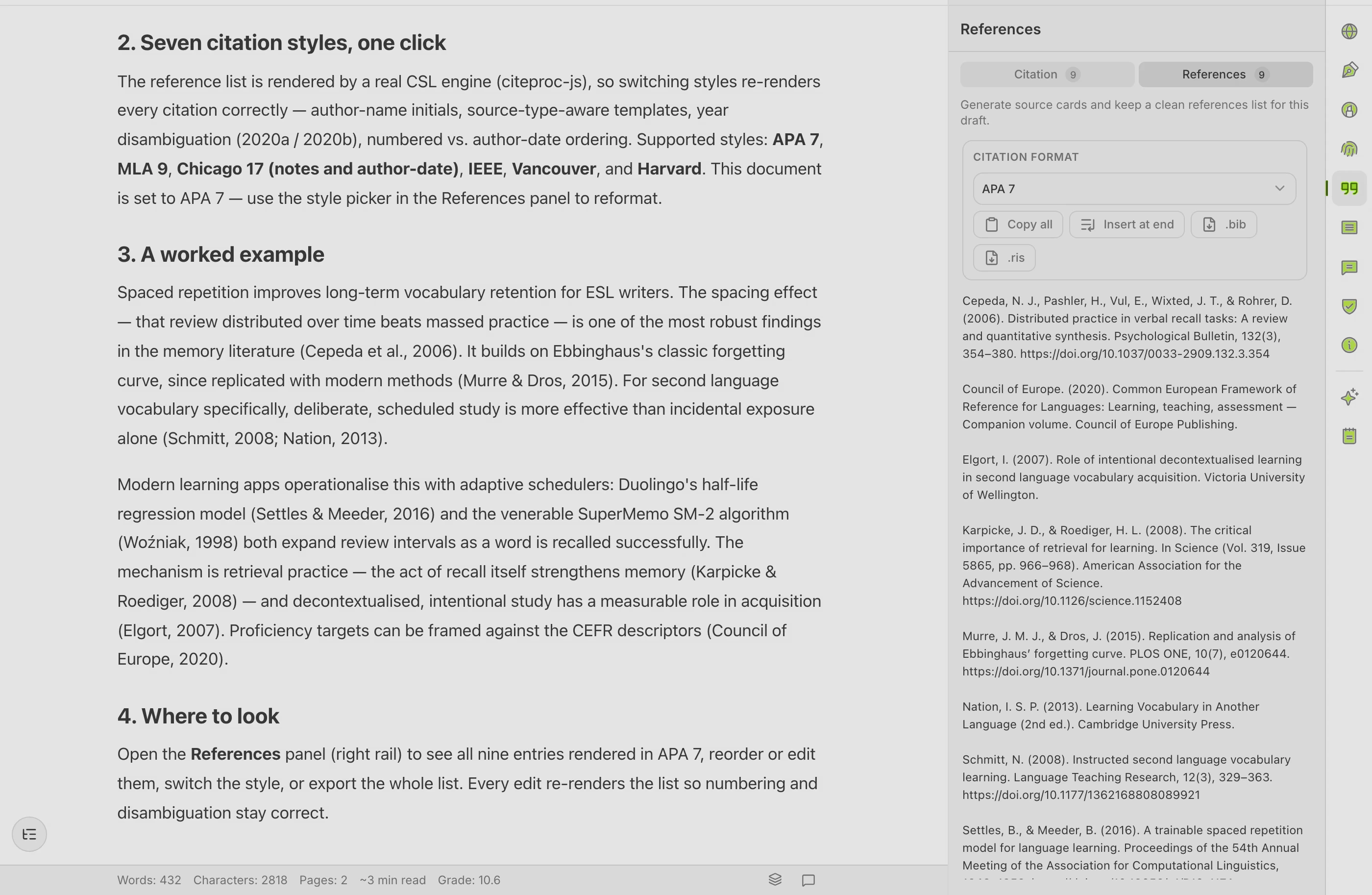
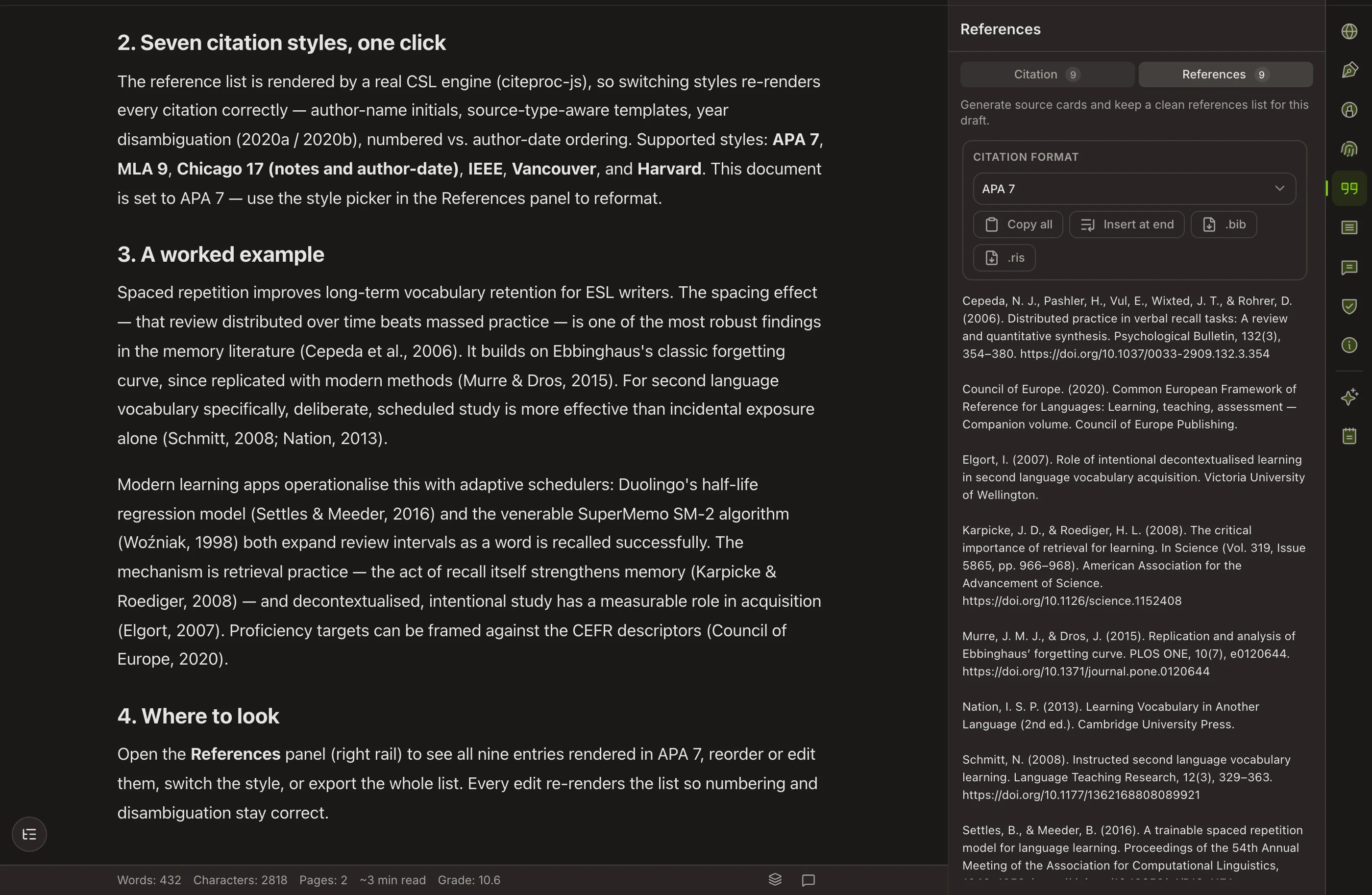
Copyeditor is an academic writing workspace — structured drafting, citations that build their own bibliography, and a signed record of how your document came together.

Apply for beta

*Beta opens this season — starting with students and researchers.

The Copyeditor writing workspace