Nursing
Writing for nursing school, from reflections to EBP papers
Reflective writing in first person, PICO questions, levels of evidence, and the Vancouver-versus-APA split — how nursing coursework is actually written.
- Usual citation style
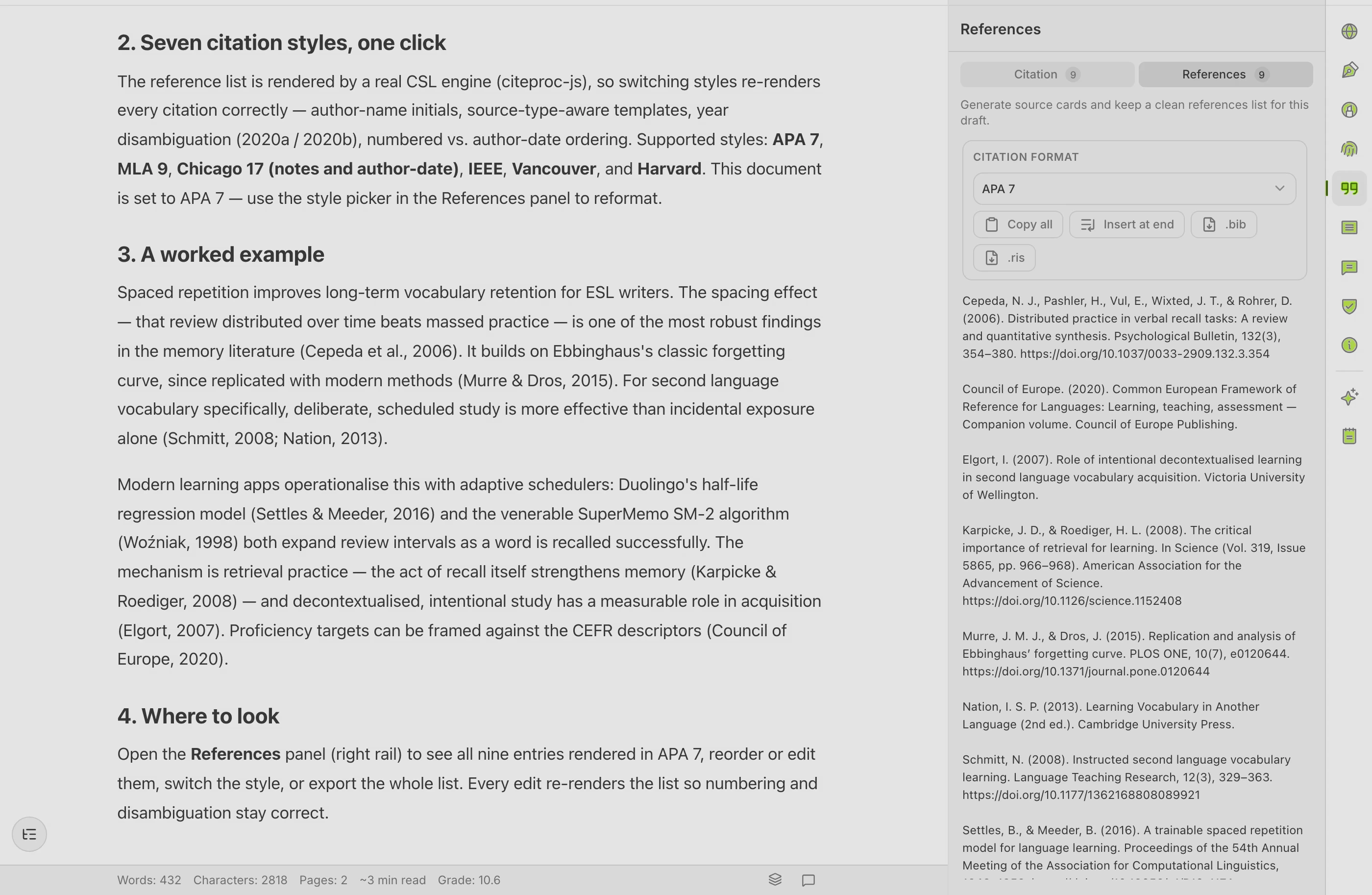
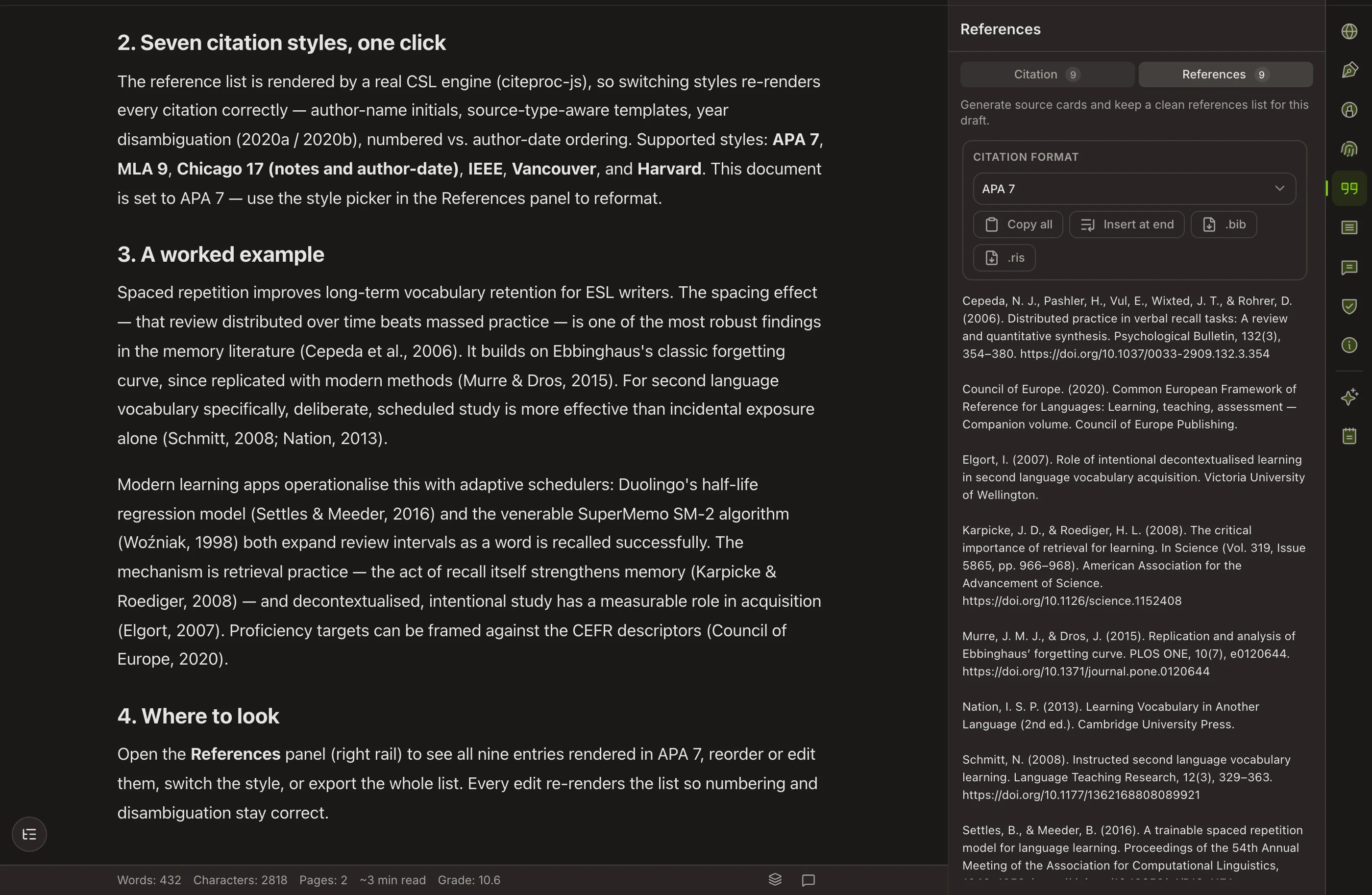
- Vancouver style — not one of the styles Copyeditor formats automatically today.
- What you will be writing
- Reflective accounts of clinical placement · Evidence-based practice papers built on a PICO question · Care plans with structured assessment and rationale · Critical appraisals of a single research article · Case studies drawn from anonymized patient encounters · Quality improvement and clinical audit reports · Capstone or DNP project write-ups
FIELD CONVENTIONS
What nursing expects of a manuscript
Generic writing advice stops here. These are the conventions reviewers in this field actually apply.
- Reflection is written in the first person, and that is correct
- Reflective accounts are the one health-science genre where “I felt uncertain when the patient declined the medication” is the right sentence. Reflective models such as Gibbs’ cycle give the paragraph order — description, feelings, evaluation, analysis, conclusion, action plan — and rubrics often mark against those stages directly.
- Evidence-based practice papers start from a PICO question
- Population, Intervention, Comparison, Outcome is not decoration; it defines the search strategy you then have to report. A paper that states a vague clinical interest instead of a formatted question usually cannot justify why it retrieved the studies it did.
- You appraise sources, you do not just cite them
- Nursing writing ranks evidence — a systematic review is weighted differently from a single cohort study or expert opinion. Every substantive claim needs a sentence about the strength and limitations of the study behind it, not just a reference number.
- Vancouver numbering versus APA depends on your program
- Nursing journals following ICMJE recommendations use Vancouver — sequential numbers in the text, references listed in citation order. Many US nursing schools require APA instead. Copyeditor formats APA automatically; Vancouver is not one of the four styles it builds for you, so a Vancouver reference list still needs manual assembly.
- Patient confidentiality shapes every clinical example
- Names, dates, ward identifiers, and anything else that could identify a person are replaced with a pseudonym, and you say in the text that you have done so. This is a professional obligation, and breaching it in an assignment is treated as a conduct issue, not a style slip.
- Recency limits are enforced on the reference list
- Many nursing rubrics cap sources at roughly five years old, on the grounds that practice guidance moves. Seminal theory is the standard exception, but you have to justify each older citation rather than let it sit there.
THE FRICTION
Where the writing actually slows down
What gets in the way
- Writing reflectively in first person all week, then switching to impersonal academic register for the EBP paper
- A Vancouver reference list that loses its numbering after you insert a source mid-draft
- Appraisal paragraphs that describe a study instead of judging its quality
- De-identifying a clinical case without stripping out the detail that makes it worth discussing
- Deadlines that land in placement weeks, with drafting squeezed around shifts
- Care plan rationale that repeats the intervention instead of citing why it works
How the workflow runs in Copyeditor
- Structure the reflection or the EBP paper — Plan mode maps the stages of a reflective model, or the PICO question and appraisal sections of an evidence-based practice paper, before you draft.
- Draft in the register the assignment asks for — Ask mode helps you keep first-person reflection distinct from the impersonal appraisal sections, so the two do not bleed into each other.
- Cite as you appraise — If your program requires APA, citations and the reference list build themselves as you write. If it requires Vancouver, Copyeditor will not format it for you — plan to number that list yourself.
- Check and hand in — Grammar review plus the AI-detector preview before submission, then Word or PDF export. The Authorship Certificate records how the draft was written if your school asks about AI use.
CITATION SHORTCUTS
Vancouver formats you will need most
Questions from nursing writers
Does Copyeditor support Vancouver referencing?
Not automatically. The four styles it formats are APA, MLA, Chicago, and IEEE. If your program mandates Vancouver, you can draft and cite in Copyeditor but you will assemble the numbered reference list yourself.
Is first person really acceptable in nursing assignments?
In reflective writing, yes — it is expected. In an evidence-based practice paper or a literature review, most rubrics still want the impersonal register. Check the brief, because many modules ask for both in the same semester.
How do I write about a patient without breaching confidentiality?
Use a pseudonym, remove dates, locations, and ward identifiers, and state in the text that details have been changed. Keep the clinical facts that matter to your argument and drop everything that only serves to identify.
Can it check my paper against a plagiarism database?
No. The AI-detector preview shows how your writing reads to AI detectors. It is not a similarity check against published sources, and we do not claim otherwise.
Guides worth reading next
Building a literature review that argues instead of lists
Organize by theme, say what the sources mean together, and end on the gap your study addresses.
Restating a source in your own words, properly
Paraphrase by working from your own notes, changing the structure rather than the vocabulary, and checking the result against the source for accuracy.
What academic writing actually sounds like
Register in academic prose comes from precision and appropriate caution, not from long words — inflated vocabulary usually signals imprecision rather than authority.
Keeping the line between your words and theirs
Avoiding plagiarism is mostly a matter of process: mark every borrowed phrase at the moment you capture it, and cite while drafting rather than afterwards.
Neighboring fields
Academic writing in medicine
Most clinical journals require labeled sections — Background, Methods, Results, Conclusions — inside a hard word limit, often 250 or 300. Every numeric result you claim in the abstract has to appear identically in the body, because reviewers check.
Academic writing in public health
A count means nothing without the population it came from. Rates, prevalence, and incidence are reported with the denominator, the time window, and the standardization method, because a reader has to be able to compare across settings.
Academic writing in psychology
Psychology runs on APA — five levels of heading, an unstructured abstract of roughly 250 words, and a reference list rather than a bibliography. Departments usually grade formatting explicitly, so a paper that is right on substance and wrong on hanging indents still loses marks.
Built for the paper
you are actually writing
Structured drafting, citations that build their own reference list, and an Authorship Certificate that records how the document came together. Copyeditor is in beta — apply and we’ll reach out as spots open.