Psychology
How psychology papers are written, cited, and reported
APA style, JARS reporting, effect sizes and confidence intervals, bias-free language — the writing conventions psychology papers are judged on.
- Usual citation style
- APA 7th edition
- What you will be writing
- Empirical journal articles in IMRaD · Lab reports and research methods coursework · Systematic and narrative literature reviews · Registered reports and preregistration documents · Case conceptualizations and clinical formulations · Conference posters and 250-word abstracts
FIELD CONVENTIONS
What psychology expects of a manuscript
Generic writing advice stops here. These are the conventions reviewers in this field actually apply.
- APA 7 is the house style, down to the heading levels
- Psychology runs on APA — five levels of heading, an unstructured abstract of roughly 250 words, and a reference list rather than a bibliography. Departments usually grade formatting explicitly, so a paper that is right on substance and wrong on hanging indents still loses marks.
- Report effect sizes and intervals, not p-values alone
- A bare “p < .05” reads as incomplete. Journals following the APA Journal Article Reporting Standards (JARS) expect the test statistic, degrees of freedom, an exact p-value, an effect size, and a confidence interval, so a reader can judge magnitude rather than just significance.
- First person is allowed and preferred over false modesty
- APA explicitly favors “we administered the questionnaire” over “the questionnaire was administered by the researchers.” Use “I” for single-authored work. What APA discourages is the editorial “we” standing in for people in general.
- Tense moves with the section
- Method and Results are past tense — you did this, and this happened. The Discussion shifts to present tense for what the findings mean and for established theory, and to past tense when you summarize what you observed.
- Bias-free language is a formatting rule, not a preference
- APA specifies “participants” rather than “subjects,” and asks you to describe people at the level of specificity the study actually used. Follow the community’s own preference on person-first versus identity-first language rather than applying one rule everywhere.
- Causal language is reserved for experimental designs
- Correlational and cross-sectional studies get “was associated with” and “predicted,” never “caused” or “led to.” Reviewers read the Discussion specifically to see whether your claims outrun your design, and this is where most revision requests land.
THE FRICTION
Where the writing actually slows down
What gets in the way
- A results paragraph that has the statistics right but the APA punctuation and italics wrong
- Discussion sentences that quietly slide from association into causation
- A literature review that summarizes study after study instead of building an argument
- Reference lists rebuilt by hand when a paper moves from a course assignment to a journal submission
- Squeezing a full study into a 250-word abstract without losing the design
How the workflow runs in Copyeditor
- Plan the sections before you draft — Use Plan mode to lay out Introduction, Method, Results, and Discussion with what each has to establish. You approve the outline before a word of prose exists.
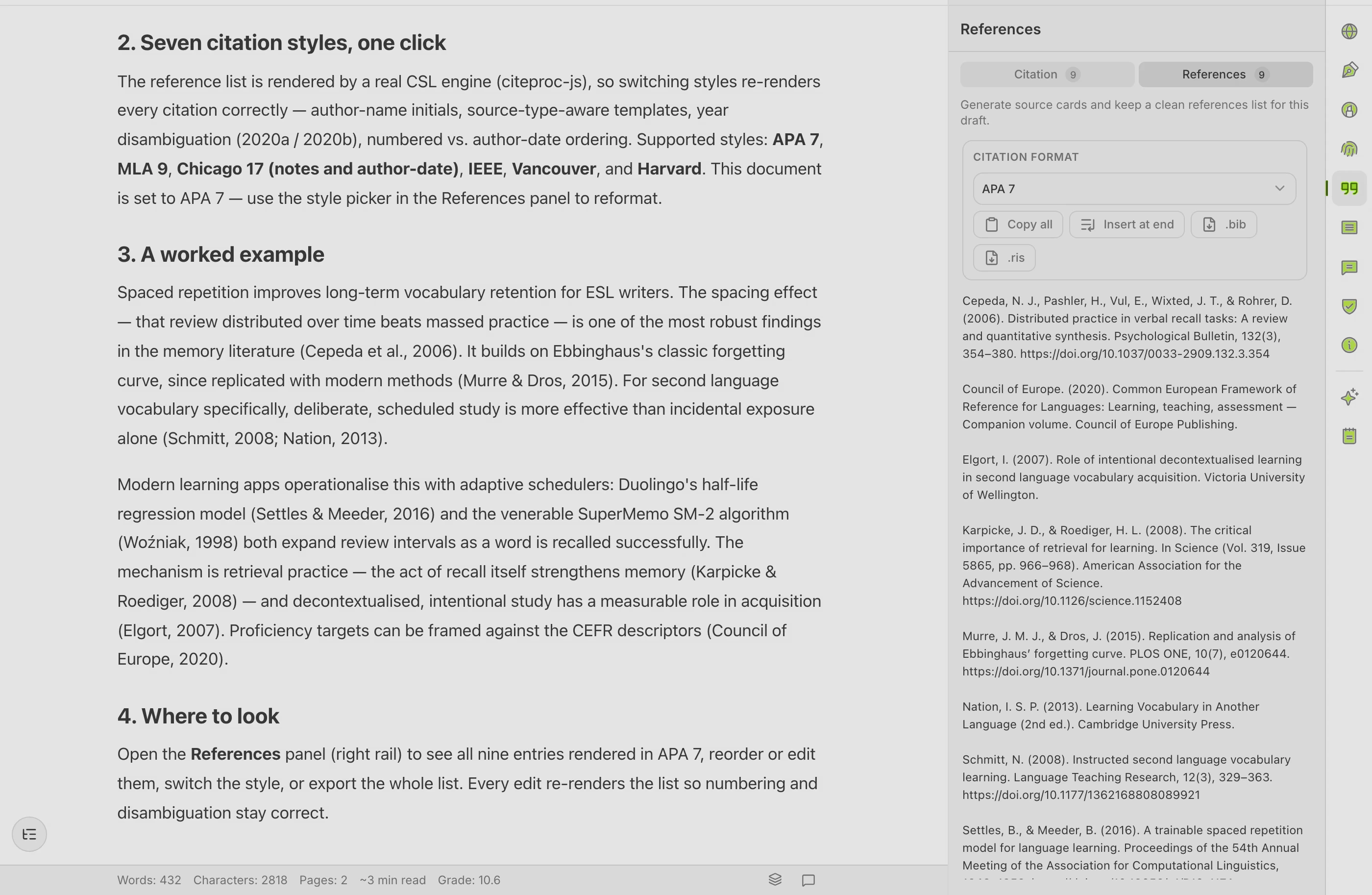
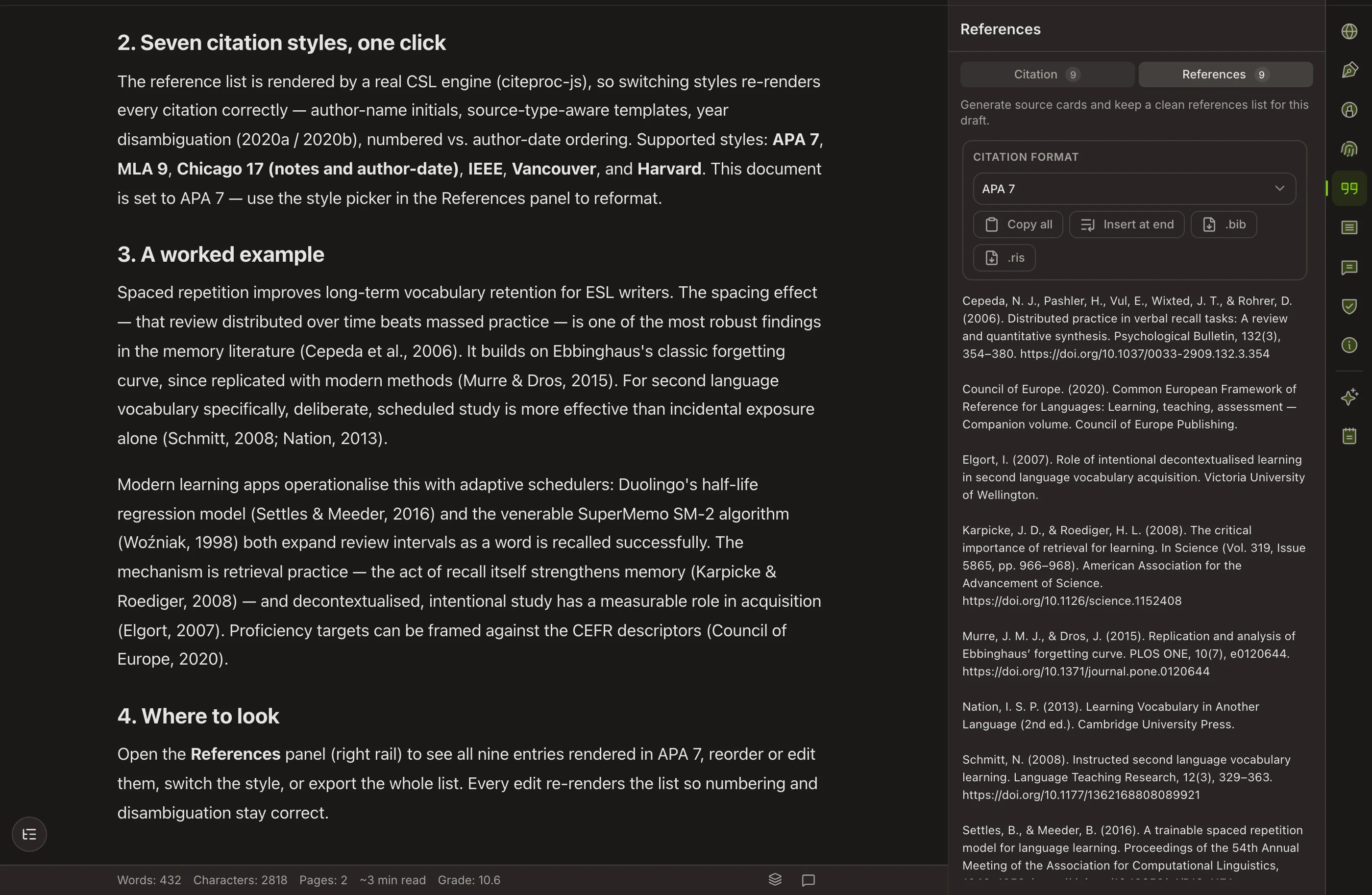
- Draft with citations attached — Cite as you write and the in-text marks plus the reference list build themselves in APA. Switching a manuscript to Chicago for a different journal rebuilds both.
- Tighten the Discussion — Use Edit mode on the paragraphs where you interpret findings, and academic paraphrase to restate source claims in your own words with attribution intact.
- Review and export — Run grammar review and the AI-detector preview, then export to Word for your supervisor. The Authorship Certificate records how the draft took shape if your department asks.
CITATION SHORTCUTS
APA formats you will need most
Questions from psychology writers
Does Copyeditor format APA 7 automatically?
Yes. APA is one of the four styles formatted automatically — in-text citations and the reference list build as you cite, and switching styles rebuilds both.
Can it write my statistics section?
No, and you should not want it to. It helps you phrase and structure what you found; the numbers, the analyses, and the decisions about which tests to run stay yours.
How long should a psychology literature review be?
It depends on whether it stands alone or introduces a study. An empirical paper’s introduction is usually 800–1,200 words; a standalone review chapter runs far longer and needs an explicit organizing logic.
Is the AI-detector preview a plagiarism check?
No. It shows how your draft reads to AI detectors before a supervisor or journal runs one. It does not compare your text against a database of published sources.
Guides worth reading next
Describing your method so another researcher could repeat it
Enough detail to reproduce the study, plus a reason for every design decision you made.
Reporting findings so the text and the tables each do their own job
Data in the tables, pattern in the prose, every planned result reported — including the null ones.
Matching the strength of a claim to its evidence
A hedge states how confident you are. Used well it makes a claim more defensible; stacked without thought it makes a sentence say nothing at all.
Building a literature review that argues instead of lists
Organize by theme, say what the sources mean together, and end on the gap your study addresses.
Neighboring fields
Academic writing in education
Education papers usually declare their theoretical lens in its own section and then use it consistently — it should shape which literature you review, which data you look at, and how you read your findings. A framework that is announced in chapter two and never mentioned again is the classic committee objection.
Academic writing in sociology
Sociology reviews are organized by theoretical position — what a perspective predicts, where it fails, what your work adds. A chronological march through recent papers reads as a coursework summary rather than a contribution.
Academic writing in nursing
Reflective accounts are the one health-science genre where “I felt uncertain when the patient declined the medication” is the right sentence. Reflective models such as Gibbs’ cycle give the paragraph order — description, feelings, evaluation, analysis, conclusion, action plan — and rubrics often mark against those stages directly.
Built for the paper
you are actually writing
Structured drafting, citations that build their own reference list, and an Authorship Certificate that records how the document came together. Copyeditor is in beta — apply and we’ll reach out as spots open.