Education
Education research writing: frameworks, context, and practice
Conceptual frameworks, positionality, thick context description, and implications for practice — the conventions education research writing is judged by.
- Usual citation style
- APA 7th edition
- What you will be writing
- Master’s theses and doctoral dissertations in education · Action research reports from a practitioner’s own classroom · Program and curriculum evaluations · Qualitative case studies of a school or district · Reflective practice portfolios and teaching philosophies · Conference proposals for education research associations
FIELD CONVENTIONS
What education expects of a manuscript
Generic writing advice stops here. These are the conventions reviewers in this field actually apply.
- A named conceptual framework does structural work
- Education papers usually declare their theoretical lens in its own section and then use it consistently — it should shape which literature you review, which data you look at, and how you read your findings. A framework that is announced in chapter two and never mentioned again is the classic committee objection.
- Positionality is stated, not assumed away
- Qualitative work in education expects you to say who you are in relation to the setting — a teacher researching your own classroom, an outsider in a district. This is written plainly in the first person and connected to specific choices you made, not offered as a ritual disclaimer.
- Context is described thickly because it is not transferable
- Class size, funding model, tracking policy, and community demographics are part of the finding, not background color. A reader in a different system has to be able to judge whether anything you found could travel to their setting.
- Qualitative rigor is argued through trustworthiness criteria
- Instead of validity and reliability, qualitative education research reports credibility, transferability, dependability, and confirmability, and shows the practices behind each — member checking, audit trails, prolonged engagement. Naming the criteria without the practices convinces nobody.
- The implications section speaks to practitioners
- Education has a working readership of teachers, coaches, and administrators, so the closing section says what a person could do differently on Monday. Keep it separate from implications for policy and for future research, which have different audiences.
- Research with minors carries visible ethics reporting
- Parental consent, student assent, and the board approval reference are stated explicitly in the methods. Where students are quoted, pseudonyms and altered identifying details are the norm and you say that you have used them.
THE FRICTION
Where the writing actually slows down
What gets in the way
- A conceptual framework chapter that never reconnects to the findings chapter
- Balancing thesis writing against a full teaching load
- Practitioner voice and academic register pulling the same sentence in two directions
- Findings chapters that stack quotations without analytic commentary between them
- Reformatting a dissertation chapter into a journal article a fifth of its length
How the workflow runs in Copyeditor
- Outline the chapter, framework first — Plan mode maps the framework, methods, findings, and implications so the lens you declare is the lens the findings chapter actually uses.
- Draft findings with the evidence in place — Ask mode helps you write analytic commentary around each quotation instead of letting the data speak for itself. You choose which excerpts carry the claim.
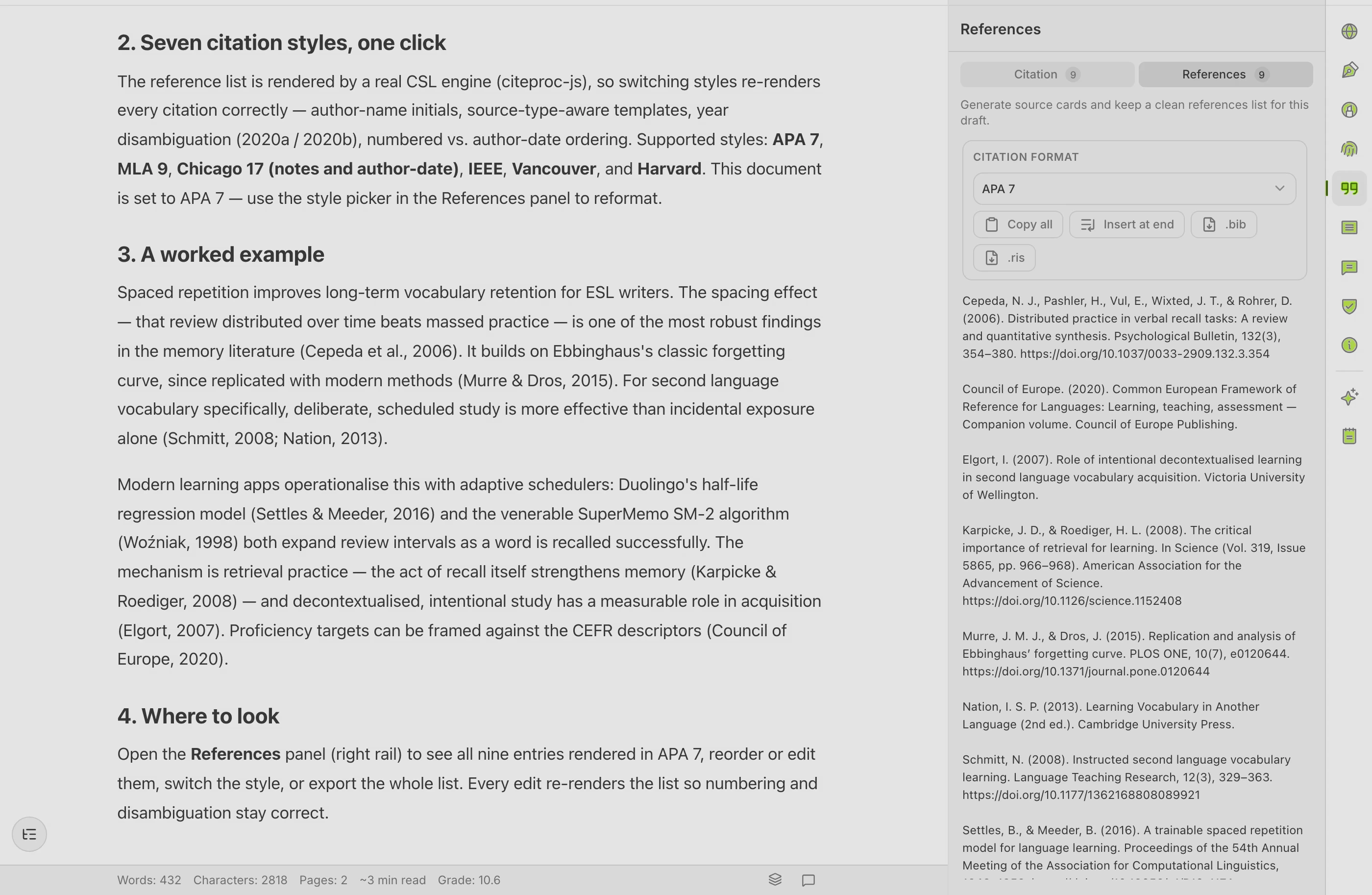
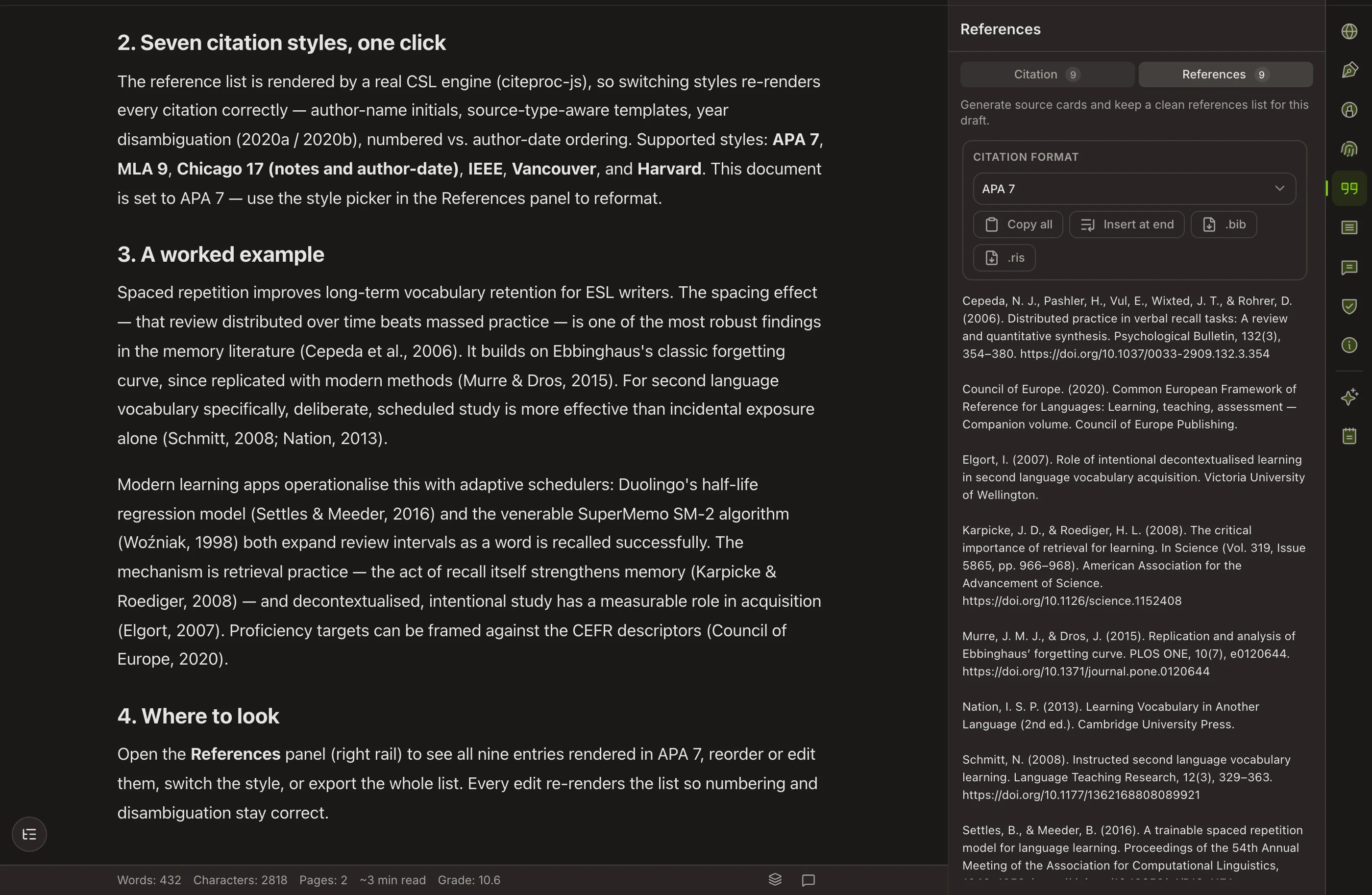
- Keep APA citations attached — Citations and the reference list build themselves in APA as you write, so a chapter that grows over months does not drift out of sync with its bibliography.
- Check, then send to your committee — Grammar review and the AI-detector preview, then Word export for supervisor comments. The Authorship Certificate documents the writing process for programs that ask.
CITATION SHORTCUTS
APA formats you will need most
Questions from education writers
Is first person acceptable in an education dissertation?
In qualitative work, yes — positionality and methodological choices are normally written in the first person. Quantitative chapters usually keep a more impersonal register. Many dissertations legitimately use both.
What citation style do education programs use?
APA is the default across most education faculties, with Harvard common outside the US and Chicago in history-of-education work. Copyeditor formats APA, MLA, Chicago, and IEEE automatically.
How is action research written differently?
It is cyclical rather than linear — plan, act, observe, reflect — and it is openly written by a participant. The report has to show the cycles, not flatten them into a single study narrative.
Can Copyeditor turn my dissertation chapter into an article?
It can help you restructure and compress: Plan mode for the new shape, Edit mode for cutting, paraphrase for tightening. The decisions about what to drop are yours.
Guides worth reading next
Describing your method so another researcher could repeat it
Enough detail to reproduce the study, plus a reason for every design decision you made.
Building a literature review that argues instead of lists
Organize by theme, say what the sources mean together, and end on the gap your study addresses.
Turning a topic into a claim someone could argue with
One arguable sentence that tells the reader what the paper will defend, and why.
Making the case that your study is worth doing and can be done
A specific question, a method that visibly fits it, and evidence that you can finish the work.
Neighboring fields
Academic writing in psychology
Psychology runs on APA — five levels of heading, an unstructured abstract of roughly 250 words, and a reference list rather than a bibliography. Departments usually grade formatting explicitly, so a paper that is right on substance and wrong on hanging indents still loses marks.
Academic writing in sociology
Sociology reviews are organized by theoretical position — what a perspective predicts, where it fails, what your work adds. A chronological march through recent papers reads as a coursework summary rather than a contribution.
Academic writing in linguistics
Example sentences are set off, numbered sequentially as (1), (2), with sub-items lettered (3a), (3b), and the prose refers back to them rather than repeating the string. Every numbered example must be discussed somewhere in the text, or a reviewer will ask why it is there.
Built for the paper
you are actually writing
Structured drafting, citations that build their own reference list, and an Authorship Certificate that records how the document came together. Copyeditor is in beta — apply and we’ll reach out as spots open.