Sociology
How sociological arguments are built and referenced
Theory-driven framing, ASA style, reflexivity, thick description, and regression tables — the writing conventions sociology papers are held to.
- Usual citation style
- APA 7th edition
- What you will be writing
- Theory-driven journal articles · Ethnographic monographs and field-based articles · Interview-based qualitative studies · Quantitative analyses of survey and administrative data · Book reviews for disciplinary journals · Comprehensive exam essays and dissertation proposals
FIELD CONVENTIONS
What sociology expects of a manuscript
Generic writing advice stops here. These are the conventions reviewers in this field actually apply.
- The literature review argues with theory, not just about studies
- Sociology reviews are organized by theoretical position — what a perspective predicts, where it fails, what your work adds. A chronological march through recent papers reads as a coursework summary rather than a contribution.
- ASA style is author–date and close to APA, but not identical
- The American Sociological Association style uses author–date in-text citations and a “References” list, with its own rules for capitalization and note placement. If you draft in APA the shape is close enough to convert cleanly; the details still need a manual pass against the ASA guide.
- Reflexivity is a methods obligation in qualitative work
- Ethnographers and interviewers write about access, rapport, and the effect of their own presence on what people said and did. This belongs in the methods as an analytic account of the fieldwork, not as an apology tacked onto the limitations.
- Thick description earns its length
- Fieldwork writing reconstructs a scene closely enough that a reader can see how you got from observation to interpretation. The discipline tolerates long descriptive passages precisely because the analysis has to be visible inside them.
- Quantitative results live in tables, and the prose interprets them
- Regression output goes in a numbered table with standard errors and model fit; the text explains what a coefficient means substantively rather than restating the number. Reporting the size of an effect in real-world units is what separates an interpretation from a readout.
- Causal claims from observational data are hedged deliberately
- With survey and administrative data you write about associations, selection, and the mechanisms you can and cannot rule out. When a paper does claim identification, the design that licenses the claim is argued explicitly rather than implied.
THE FRICTION
Where the writing actually slows down
What gets in the way
- A literature review that becomes an annotated bibliography instead of a theoretical argument
- Fieldnotes written informally that resist conversion into publishable prose
- ASA formatting details that differ just enough from APA to slip through unnoticed
- Quotations from participants that carry the argument without commentary around them
- Journal articles that run 10,000 words, making structure hard to hold in view
- Long review cycles where a revised draft has to be reconciled with the original argument
How the workflow runs in Copyeditor
- Build the theoretical frame first — Plan mode maps how the theory section sets up the analysis, so the framing and the findings are designed to meet rather than assembled separately.
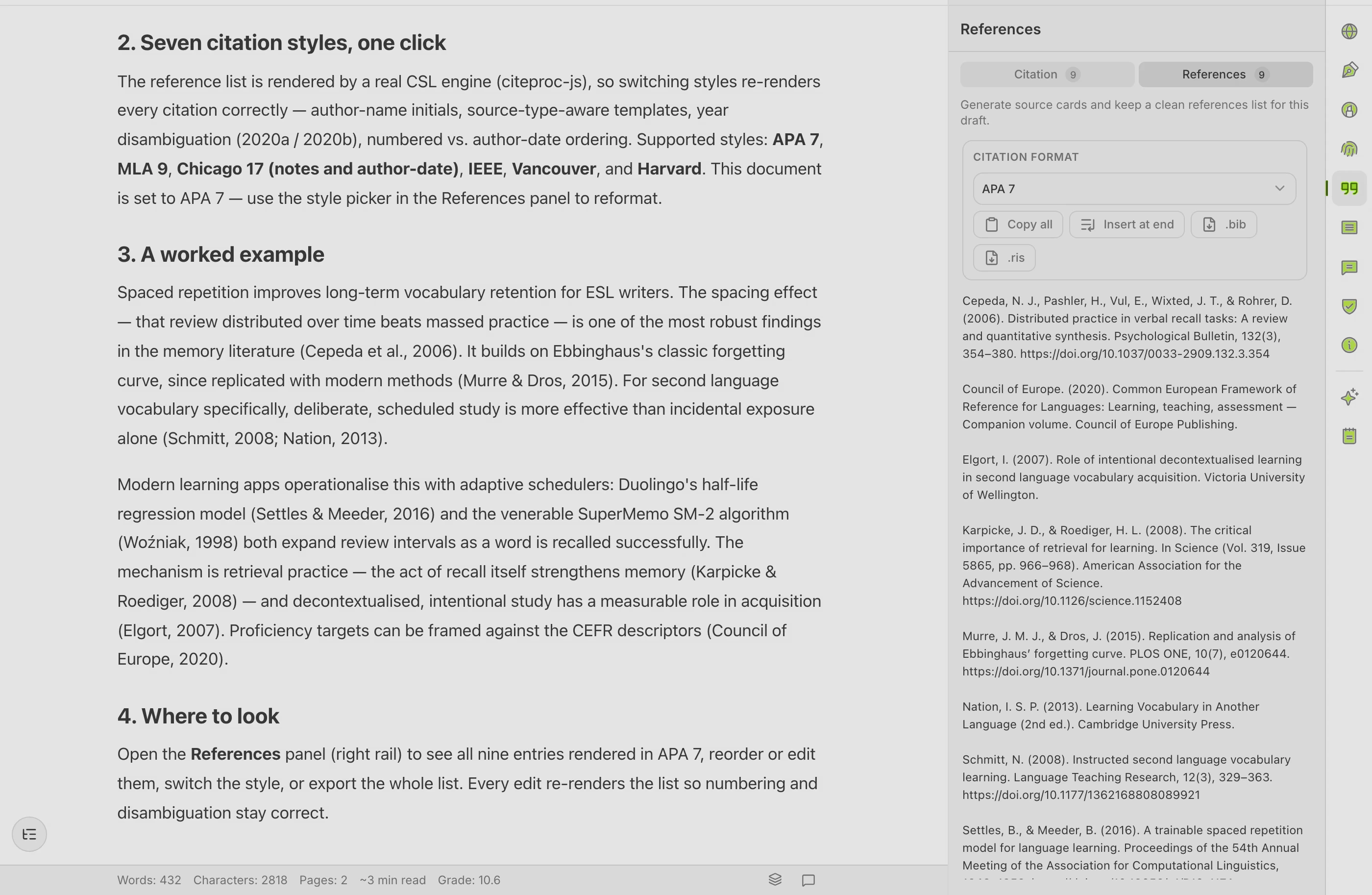
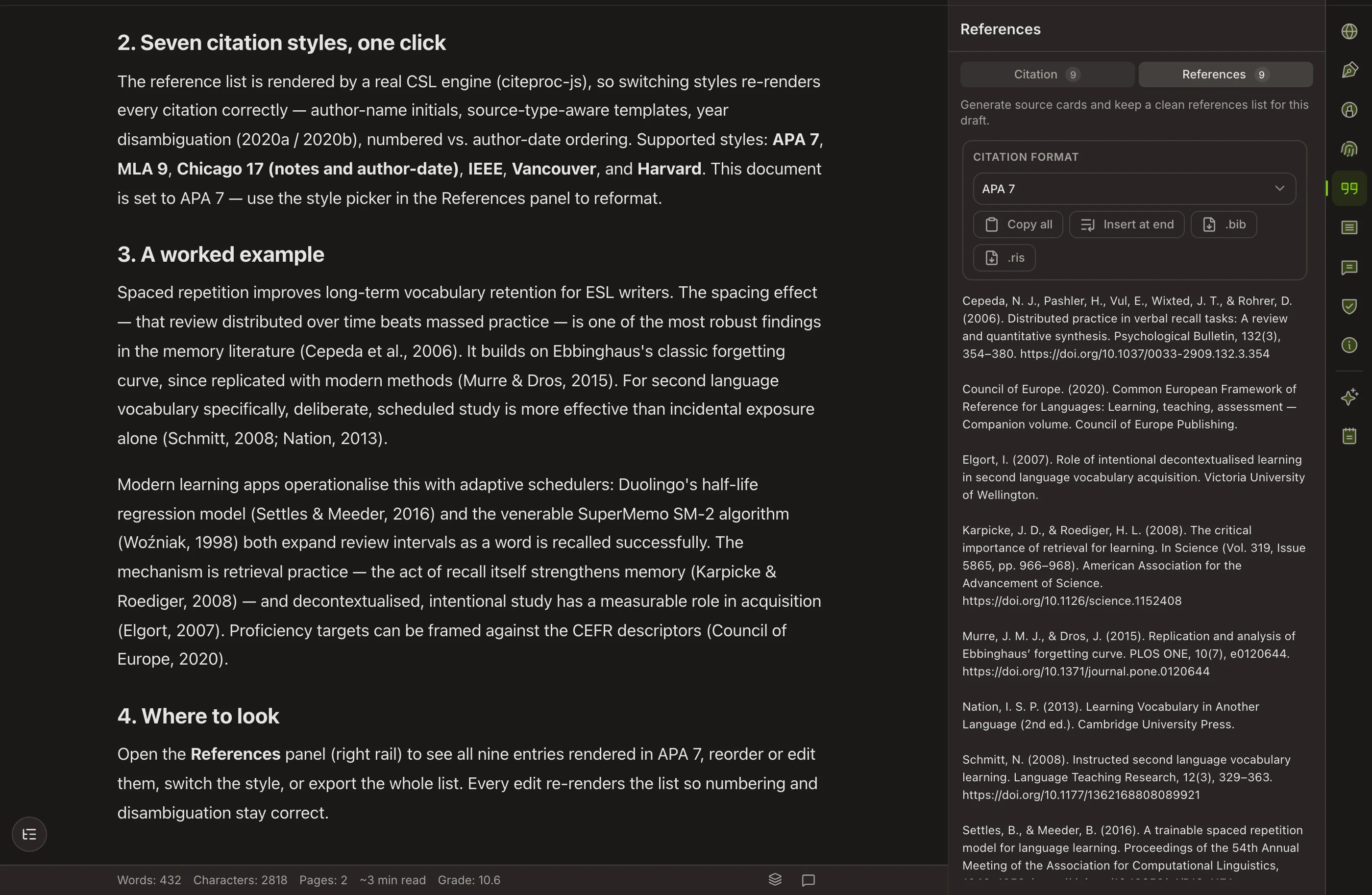
- Draft with sources attached — Cite as you write and the bibliography builds itself. Draft in APA — the closest supported style to ASA author–date — then do a manual pass against the ASA guide before submission.
- Work the fieldwork prose — Edit mode tightens descriptive passages without flattening them, and academic paraphrase helps restate a theorist’s position in your own words with the citation intact.
- Review, export, document — Grammar review and the AI-detector preview, then Word or PDF export for co-authors or a journal portal. The Authorship Certificate records how the manuscript was written.
CITATION SHORTCUTS
APA formats you will need most
Questions from sociology writers
Does Copyeditor support ASA style?
Not directly. It formats APA, MLA, Chicago, and IEEE. ASA is an author–date system close to APA, so drafting in APA and converting is workable, but the final pass against the ASA guide is manual.
Can I write an ethnography in the first person?
Yes. Fieldwork-based sociology routinely uses “I” for what the researcher did, saw, and was told. Quantitative papers in the same journals are usually more impersonal.
How long should a sociology journal article be?
Considerably longer than in the health sciences — full-length articles frequently run 8,000 to 12,000 words including notes and references. Check your target journal, because the range is wide.
How do I keep participant quotations from carrying the whole argument?
Frame each excerpt: say what it shows before it appears, and analyze it after. A findings section built from quotations with connective sentences between them reads as data, not analysis.
Guides worth reading next
Building a literature review that argues instead of lists
Organize by theme, say what the sources mean together, and end on the gap your study addresses.
What academic writing actually sounds like
Register in academic prose comes from precision and appropriate caution, not from long words — inflated vocabulary usually signals imprecision rather than authority.
Matching the strength of a claim to its evidence
A hedge states how confident you are. Used well it makes a claim more defensible; stacked without thought it makes a sentence say nothing at all.
From the wide field to your specific question, in about a page
Establish the territory, name the gap, state the question — and stop before it becomes a review.
Neighboring fields
Academic writing in psychology
Psychology runs on APA — five levels of heading, an unstructured abstract of roughly 250 words, and a reference list rather than a bibliography. Departments usually grade formatting explicitly, so a paper that is right on substance and wrong on hanging indents still loses marks.
Academic writing in political science
The American Political Science Association style manual is built on the Chicago author–date system, with in-text parenthetical citations and a references list. Drafting in Chicago author–date puts you close to compliant before any journal-specific pass.
Academic writing in public health
A count means nothing without the population it came from. Rates, prevalence, and incidence are reported with the denominator, the time window, and the standardization method, because a reader has to be able to compare across settings.
Built for the paper
you are actually writing
Structured drafting, citations that build their own reference list, and an Authorship Certificate that records how the document came together. Copyeditor is in beta — apply and we’ll reach out as spots open.