Public Health
Writing for population health: evidence, equity, and policy
Population framing, STROBE reporting, grey literature, equity language, and policy implications — how public health writing differs from clinical writing.
- Usual citation style
- Vancouver style — not one of the styles Copyeditor formats automatically today.
- What you will be writing
- Observational epidemiology papers reported against STROBE · Policy briefs written for non-academic decision makers · Program evaluation reports with a logic model · Mixed-methods studies combining survey and interview strands · Needs assessments and situational analyses · Grant proposals to funders and agencies · Systematic reviews of intervention effectiveness
FIELD CONVENTIONS
What public health expects of a manuscript
Generic writing advice stops here. These are the conventions reviewers in this field actually apply.
- The unit of analysis is a population, so denominators matter
- A count means nothing without the population it came from. Rates, prevalence, and incidence are reported with the denominator, the time window, and the standardization method, because a reader has to be able to compare across settings.
- Two audiences, two documents, from the same evidence
- The journal article and the policy brief say the same thing to different readers. A brief leads with the recommendation and puts the method in a box; a paper builds to the recommendation and puts the method in the middle. Writing one and hoping it works as the other fails both.
- Equity language is scrutinized as closely as the statistics
- Describe people by circumstance rather than by category — “people experiencing homelessness,” not a label that fuses the person to the condition. Avoid deficit framing that locates a problem in a community rather than in the conditions and policies acting on it.
- Grey literature is legitimate evidence and awkward to cite
- Agency reports, surveillance bulletins, and government statistics often carry the best data available, and they rarely have a clean author-date-journal shape. Record the issuing body, report number, and access date at the moment you use them, because reconstructing them later is painful.
- Mixed-methods papers report each strand on its own terms
- The quantitative strand gets estimates and intervals; the qualitative strand gets themes with illustrative quotations and a note on how they were coded. The integration paragraph — where the two strands meet — is the part reviewers most often say is missing.
- Implications are written for people who act, not just for readers
- A discussion that ends at “further research is needed” underdelivers in this field. State who would do what, at what level — clinic, district, national policy — and be explicit about the cost and feasibility assumptions behind the recommendation.
THE FRICTION
Where the writing actually slows down
What gets in the way
- One evidence base that has to become a paper, a brief, and a slide deck on different deadlines
- Citing a WHO or agency report that has no obvious author and a URL that changes
- Reference lists in Vancouver that need manual numbering across long multi-author drafts
- Compressing a full evaluation into a two-page brief without losing the caveats
- Grant narratives with strict character limits and separate formatting rules per funder
How the workflow runs in Copyeditor
- Separate the documents early — Plan mode outlines the paper and the brief as different structures from the same findings, so you are not reverse-engineering one out of the other the night before.
- Draft with the reporting elements in place — Ask mode helps phrase population framing, denominators, and limitations. Edit mode compresses paragraphs to fit a funder’s character limit without dropping the caveat.
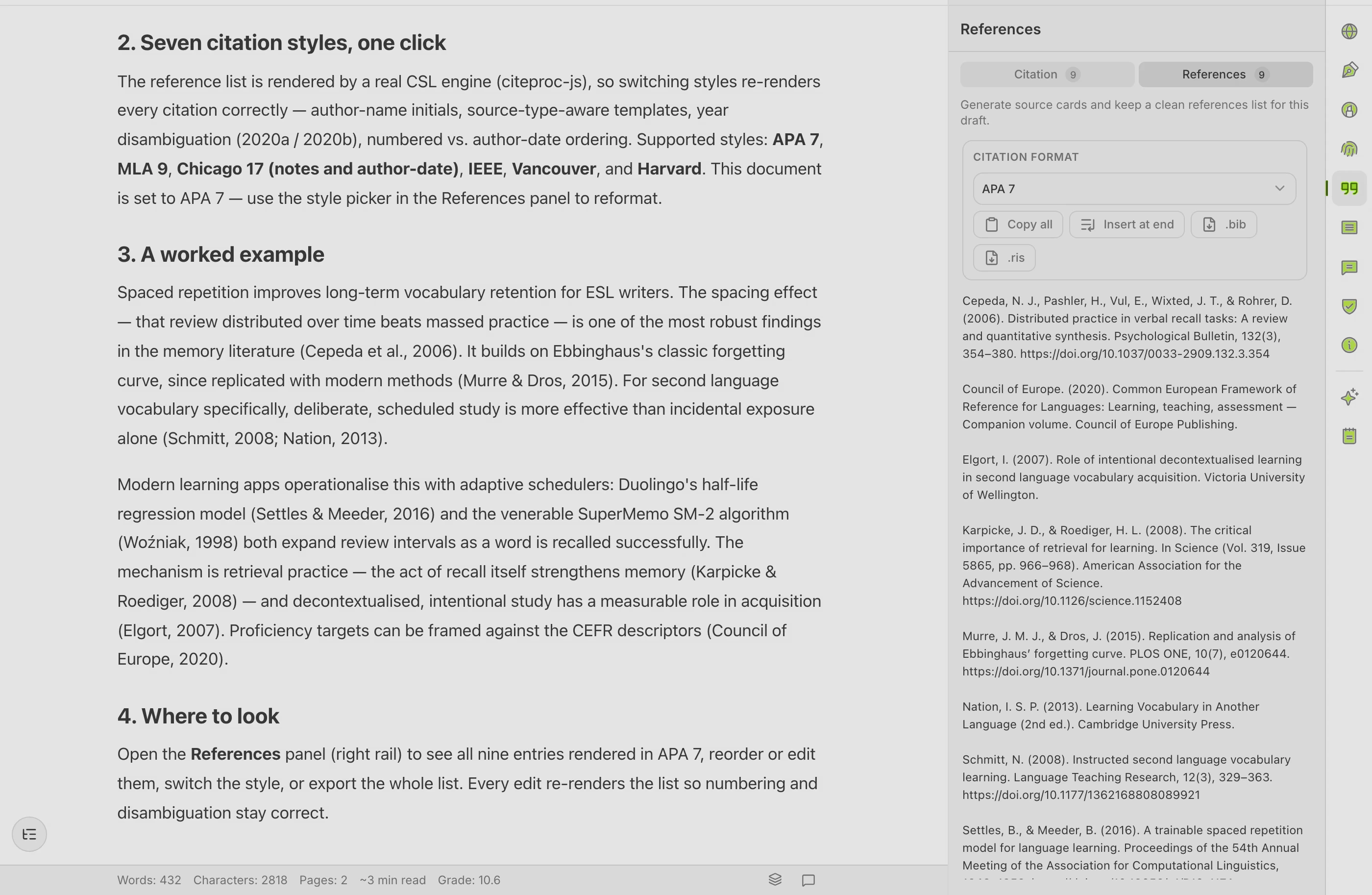
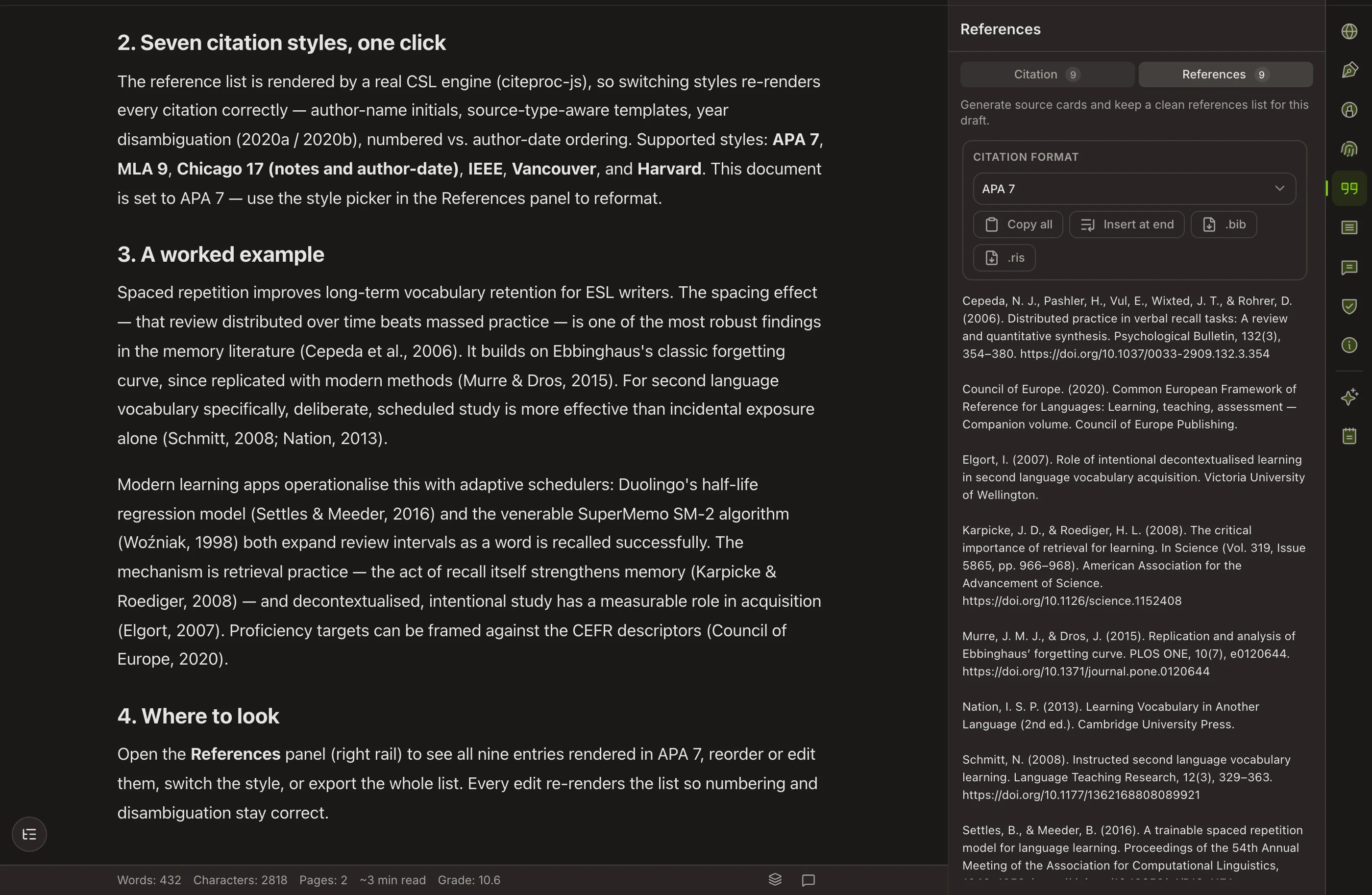
- Keep the sources attached — Cite as you write and the bibliography builds in APA, MLA, Chicago, or IEEE. Vancouver, common in public health journals, is not formatted automatically.
- Check, export, and document — Grammar review, AI-detector preview, then Word or PDF export for co-authors or a funder portal. The Authorship Certificate records how each draft was produced.
CITATION SHORTCUTS
Vancouver formats you will need most
Questions from public health writers
How is a policy brief different from a journal abstract?
An abstract summarizes a study for researchers. A brief argues for a decision, opens with the recommendation, and treats method as supporting detail. The same findings need genuinely different prose in each.
Which citation style does public health use?
Vancouver dominates in epidemiology and health-services journals; APA and Harvard appear in behavioral and social public health. Copyeditor formats APA automatically, but not Vancouver or Harvard.
How do I cite a government surveillance report?
Treat the issuing agency as the author, and record the report title, series or report number, publication year, and the date you accessed it. Capture those details at first use, not at the end of the draft.
Can Copyeditor help with a grant narrative?
Yes, as a drafting workspace — Plan mode for the structure, Edit mode for cutting to a limit, and export to Word or PDF for the submission portal. It does not fill in funder forms for you.
Guides worth reading next
Making the case that your study is worth doing and can be done
A specific question, a method that visibly fits it, and evidence that you can finish the work.
The four-part shape behind most empirical papers
Introduction, Methods, Results, Discussion — what each part owns, and when the format stops helping.
Turning results into an argument about what they mean
Answer the question first, interpret against the literature, bound the claims, then say what follows.
Condensing a paper without distorting it
Read in the right order, capture the claim the paper actually makes, and keep your summary proportional to where the paper spends its weight.
Neighboring fields
Academic writing in medicine
Most clinical journals require labeled sections — Background, Methods, Results, Conclusions — inside a hard word limit, often 250 or 300. Every numeric result you claim in the abstract has to appear identically in the body, because reviewers check.
Academic writing in nursing
Reflective accounts are the one health-science genre where “I felt uncertain when the patient declined the medication” is the right sentence. Reflective models such as Gibbs’ cycle give the paragraph order — description, feelings, evaluation, analysis, conclusion, action plan — and rubrics often mark against those stages directly.
Academic writing in sociology
Sociology reviews are organized by theoretical position — what a perspective predicts, where it fails, what your work adds. A chronological march through recent papers reads as a coursework summary rather than a contribution.
Built for the paper
you are actually writing
Structured drafting, citations that build their own reference list, and an Authorship Certificate that records how the document came together. Copyeditor is in beta — apply and we’ll reach out as spots open.