Medicine
How clinical papers are structured, reported, and cited
Structured abstracts, CONSORT and STROBE reporting, ICMJE authorship, and Vancouver numbering — the conventions clinical manuscripts are held to.
- Usual citation style
- Vancouver style — not one of the styles Copyeditor formats automatically today.
- What you will be writing
- Original research articles reporting trials or cohorts · Systematic reviews and meta-analyses · Clinical case reports and case series · Narrative reviews and clinical practice updates · Letters to the editor and correspondence · Study protocols and ethics committee submissions · Grant applications to funding bodies
FIELD CONVENTIONS
What medicine expects of a manuscript
Generic writing advice stops here. These are the conventions reviewers in this field actually apply.
- Abstracts are structured, and the headings are prescribed
- Most clinical journals require labeled sections — Background, Methods, Results, Conclusions — inside a hard word limit, often 250 or 300. Every numeric result you claim in the abstract has to appear identically in the body, because reviewers check.
- The reporting checklist depends on the design
- Randomized trials follow CONSORT, observational studies follow STROBE, and systematic reviews follow PRISMA with its flow diagram. Journals ask for the completed checklist at submission, so it is cheaper to write the Methods against it than to retrofit later.
- Report estimates with intervals, and register the trial first
- Effect estimates carry confidence intervals; a p-value on its own is treated as thin reporting. Trials are expected to be registered before enrollment, and the registration number belongs in the abstract or the Methods.
- ICMJE authorship and disclosure are checked at submission
- The four ICMJE criteria decide who is an author and who belongs in acknowledgments. Conflict-of-interest, funding, and data-sharing statements are separate required sections, not optional courtesies.
- Observational findings never get causal verbs
- Cohort and case-control work says “was associated with” and lists the residual confounding you could not adjust for. Editors treat causal phrasing on non-randomized data as a substantive error, and it is one of the most common reasons for a revise decision.
- Case reports are their own genre with a consent requirement
- The structure is presentation, investigations, management, outcome, and a discussion of why this case adds something. Written patient consent for publication is required, and journals ask you to state that you obtained it.
THE FRICTION
Where the writing actually slows down
What gets in the way
- A structured abstract that will not fit the word limit without cutting the design description
- A Vancouver reference list whose numbering breaks every time a citation is inserted mid-draft
- Reformatting an entire manuscript for a second journal after a desk rejection
- Discussion paragraphs that overstate what an observational design can support
- Coordinating co-author edits across several Word versions before the deadline
- Point-by-point reviewer responses that have to be firm without being defensive
How the workflow runs in Copyeditor
- Draft against the design’s reporting checklist — Plan mode lays out IMRaD with the items your design requires — the CONSORT or STROBE elements go into the outline, not into a panicked revision.
- Write the Methods and Results — Ask mode helps with phrasing while you supply every number. Edit mode tightens paragraphs that run long against a journal word limit.
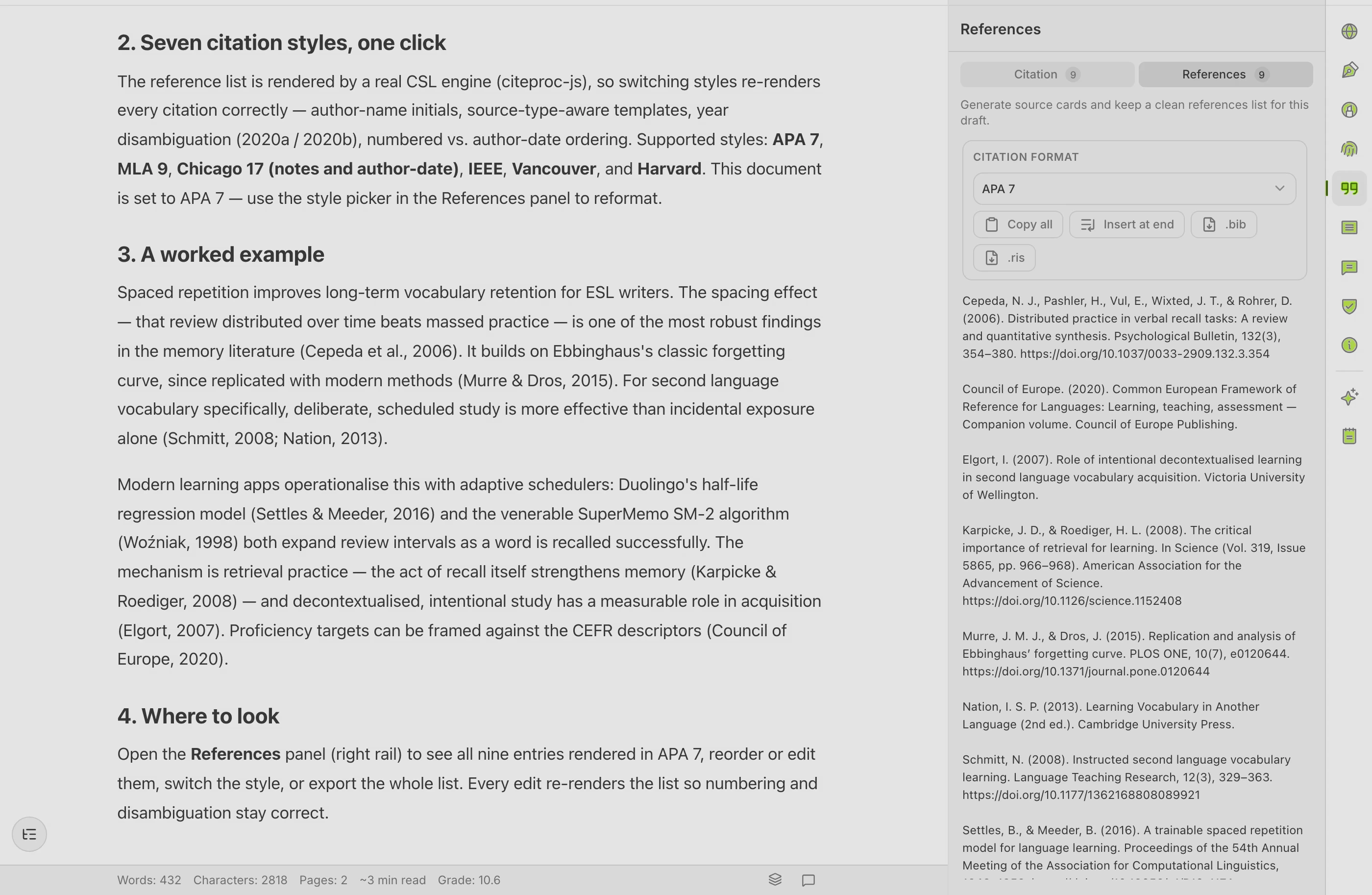
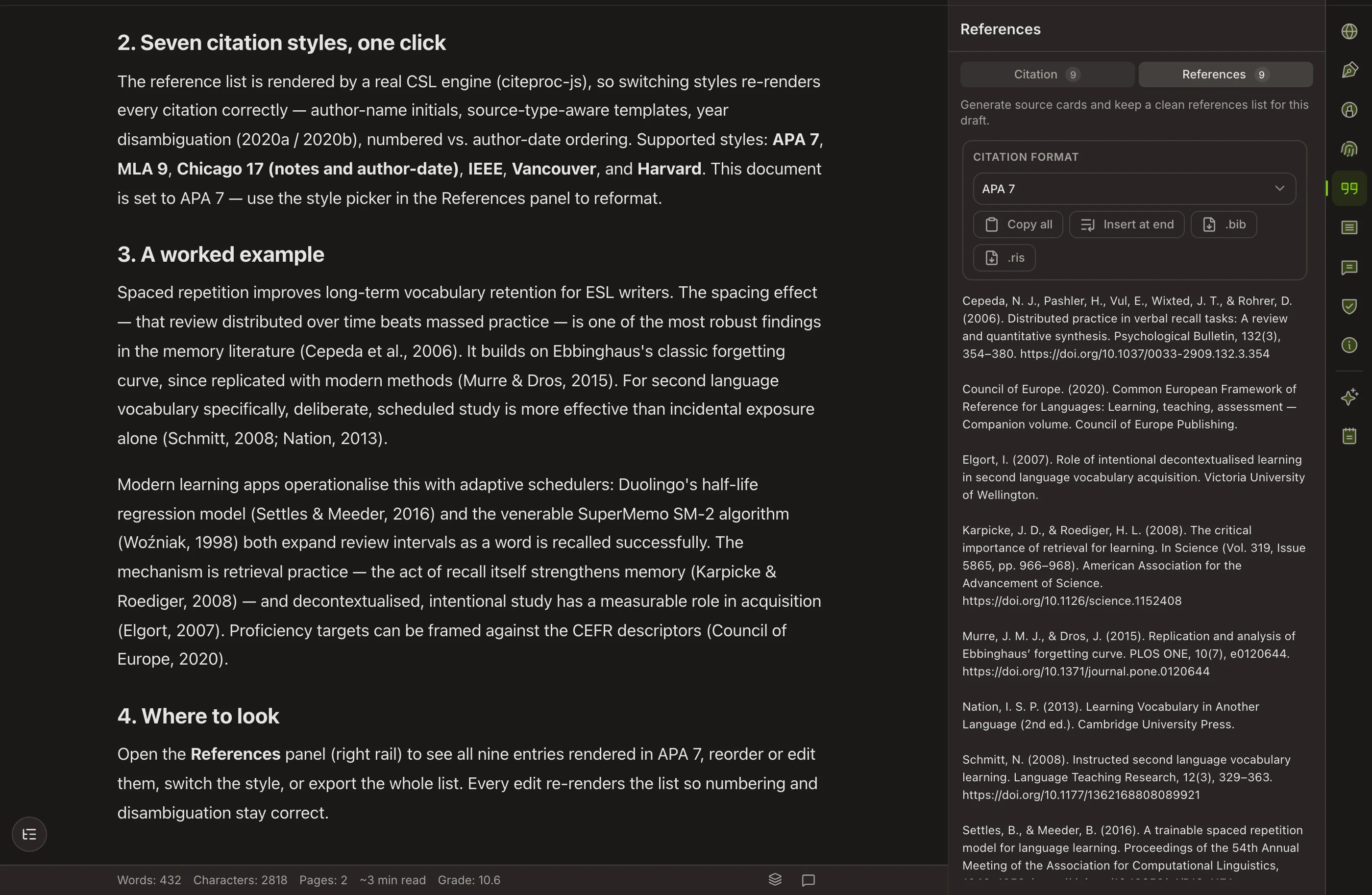
- Handle citations — Citations and the bibliography build themselves in APA, MLA, Chicago, or IEEE. Vancouver, the default in most clinical journals, is not among them — you will number that list yourself.
- Polish, export, document — Grammar review and the AI-detector preview before submission, then Word or PDF export. The Authorship Certificate records how the manuscript was written if a journal asks about AI assistance.
CITATION SHORTCUTS
Vancouver formats you will need most
Questions from medicine writers
Does Copyeditor format Vancouver or AMA references?
No. It formats APA, MLA, Chicago, and IEEE automatically. Most clinical journals want Vancouver, so plan to assemble that numbered list manually rather than expecting it to build itself.
Can I use an AI co-writer on a manuscript I plan to submit?
Most journals allow AI assistance with language and require you to disclose it, while refusing to list a tool as an author. Check your target journal’s policy, and use the Authorship Certificate as a record of how the draft was produced.
How long should a clinical Discussion section be?
Typically four to six paragraphs: what you found, how it sits against prior work, the mechanism or interpretation, the limitations, and what follows clinically. Limitations are not a formality — reviewers read them first.
What is the difference between the AI-detector preview and a plagiarism check?
The preview estimates how your text reads to AI detectors. It does not compare your manuscript against published literature, so it is not a substitute for your institution’s similarity screening.
Guides worth reading next
The one page an editor reads before deciding to send your paper out
One page: what the paper reports, why it belongs in this journal, and the declarations required.
The four-part shape behind most empirical papers
Introduction, Methods, Results, Discussion — what each part owns, and when the format stops helping.
Compressing a whole paper into 250 useful words
Four moves — background, method, result, implication — with the result sentence doing most of the work.
Turning results into an argument about what they mean
Answer the question first, interpret against the literature, bound the claims, then say what follows.
Reporting findings so the text and the tables each do their own job
Data in the tables, pattern in the prose, every planned result reported — including the null ones.
Neighboring fields
Academic writing in nursing
Reflective accounts are the one health-science genre where “I felt uncertain when the patient declined the medication” is the right sentence. Reflective models such as Gibbs’ cycle give the paragraph order — description, feelings, evaluation, analysis, conclusion, action plan — and rubrics often mark against those stages directly.
Academic writing in public health
A count means nothing without the population it came from. Rates, prevalence, and incidence are reported with the denominator, the time window, and the standardization method, because a reader has to be able to compare across settings.
Academic writing in biology
Write the full genus and species in italics at first mention — Drosophila melanogaster — then abbreviate the genus to its initial thereafter. Genus is capitalized, species is not, and the italics are not optional styling.
Built for the paper
you are actually writing
Structured drafting, citations that build their own reference list, and an Authorship Certificate that records how the document came together. Copyeditor is in beta — apply and we’ll reach out as spots open.