Biology
Writing biological research: reproducible methods and figures
Species nomenclature, reproducible methods, figure-led results, data availability statements, and CSE name–year citation — how biology papers are written.
- Usual citation style
- Harvard referencing — not one of the styles Copyeditor formats automatically today.
- What you will be writing
- Primary research articles in IMRaD · Short-format reports and brief communications · Review articles synthesizing a subfield · Data descriptor papers accompanying a deposited dataset · Grant proposals with preliminary data · Field and lab notebooks feeding the methods section
FIELD CONVENTIONS
What biology expects of a manuscript
Generic writing advice stops here. These are the conventions reviewers in this field actually apply.
- Species names follow binomial nomenclature exactly
- Write the full genus and species in italics at first mention — Drosophila melanogaster — then abbreviate the genus to its initial thereafter. Genus is capitalized, species is not, and the italics are not optional styling.
- Methods are written so another lab could repeat them
- Strains, reagents with supplier and catalog number, concentrations, temperatures, incubation times, and instrument settings all belong in the text or a supplement. “Standard protocols were followed” is the sentence that generates a reviewer comment every time.
- Figures carry the argument; the text walks the reader through them
- A biology results section is largely an ordered tour of the figures, each panel labeled and referenced as “Fig. 2C.” Error bars must be defined in the caption — standard deviation, standard error, or confidence interval — along with the sample size and what n counts.
- Statistics are reported with the test, the statistic, and n
- Name the test, give the statistic with degrees of freedom, the exact p-value, and the number of biological replicates. Biological and technical replicates are distinguished explicitly, because conflating them inflates apparent significance.
- Results describe and Discussion interprets, with a hard boundary
- A results sentence says what was observed; interpretation, mechanism, and comparison to prior work wait for the discussion. Reviewers routinely ask authors to move interpretive sentences out of results, so it is cheaper to keep them separated while drafting.
- Data availability and accession numbers are required statements
- Sequence, structure, and expression data are deposited in public repositories before submission, and the accession numbers appear in the paper. A data availability statement is now a standard section at most journals rather than a courtesy.
THE FRICTION
Where the writing actually slows down
What gets in the way
- Reconstructing a methods section from lab notebooks months after the experiments
- Figure captions that grow into mini-discussions and then contradict the main text
- Reference lists in CSE name–year that need conversion for each journal’s house variant
- Interpretation creeping into the results section during revision
- Coordinating a manuscript across a lab where several people ran different panels
How the workflow runs in Copyeditor
- Draft the methods while the work is fresh — Plan mode structures the methods by procedure so the details you still remember get written down before they are lost to a notebook.
- Write results figure by figure — Ask mode helps keep results descriptive and discussion interpretive, which is the boundary reviewers police hardest.
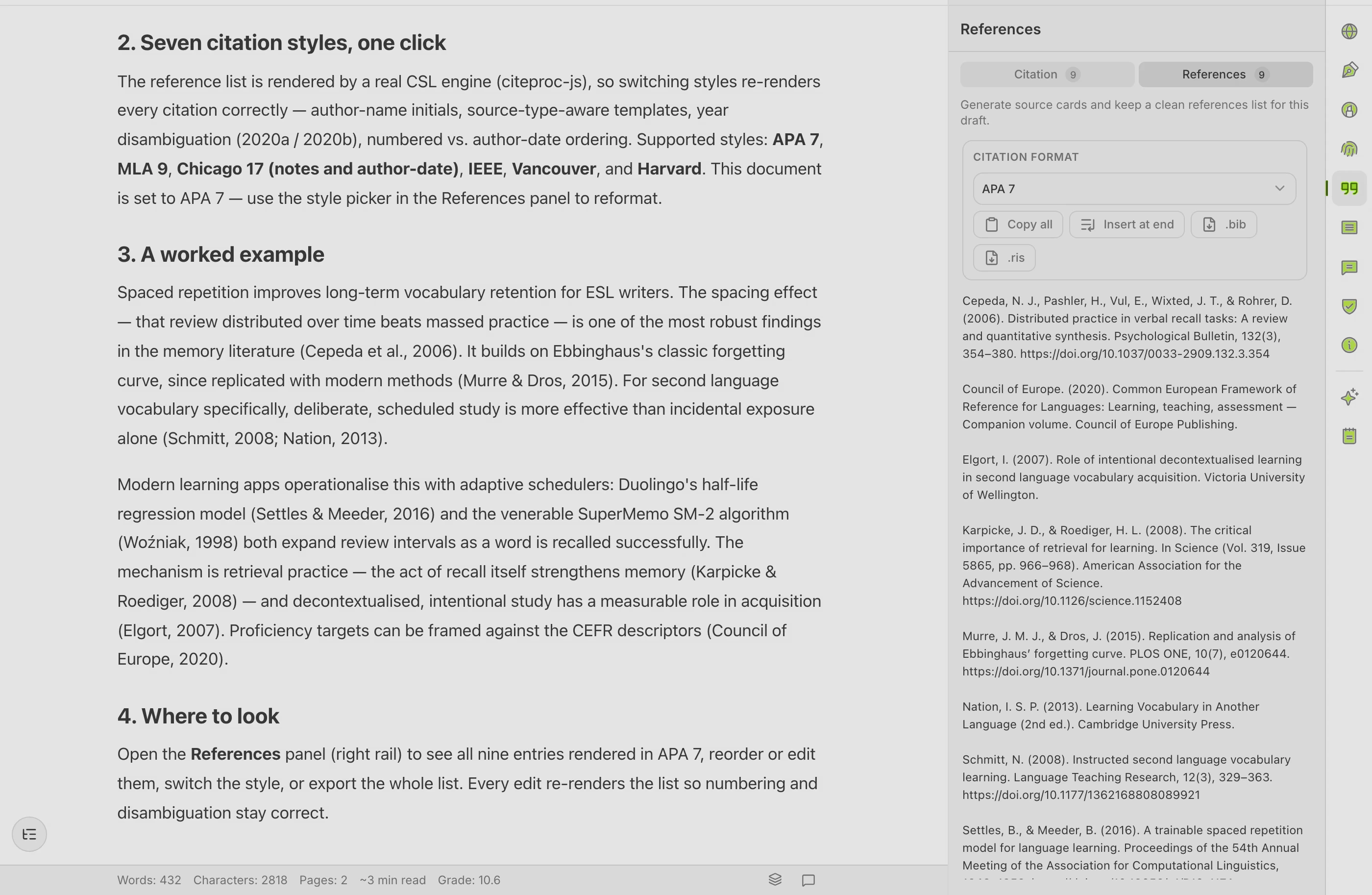
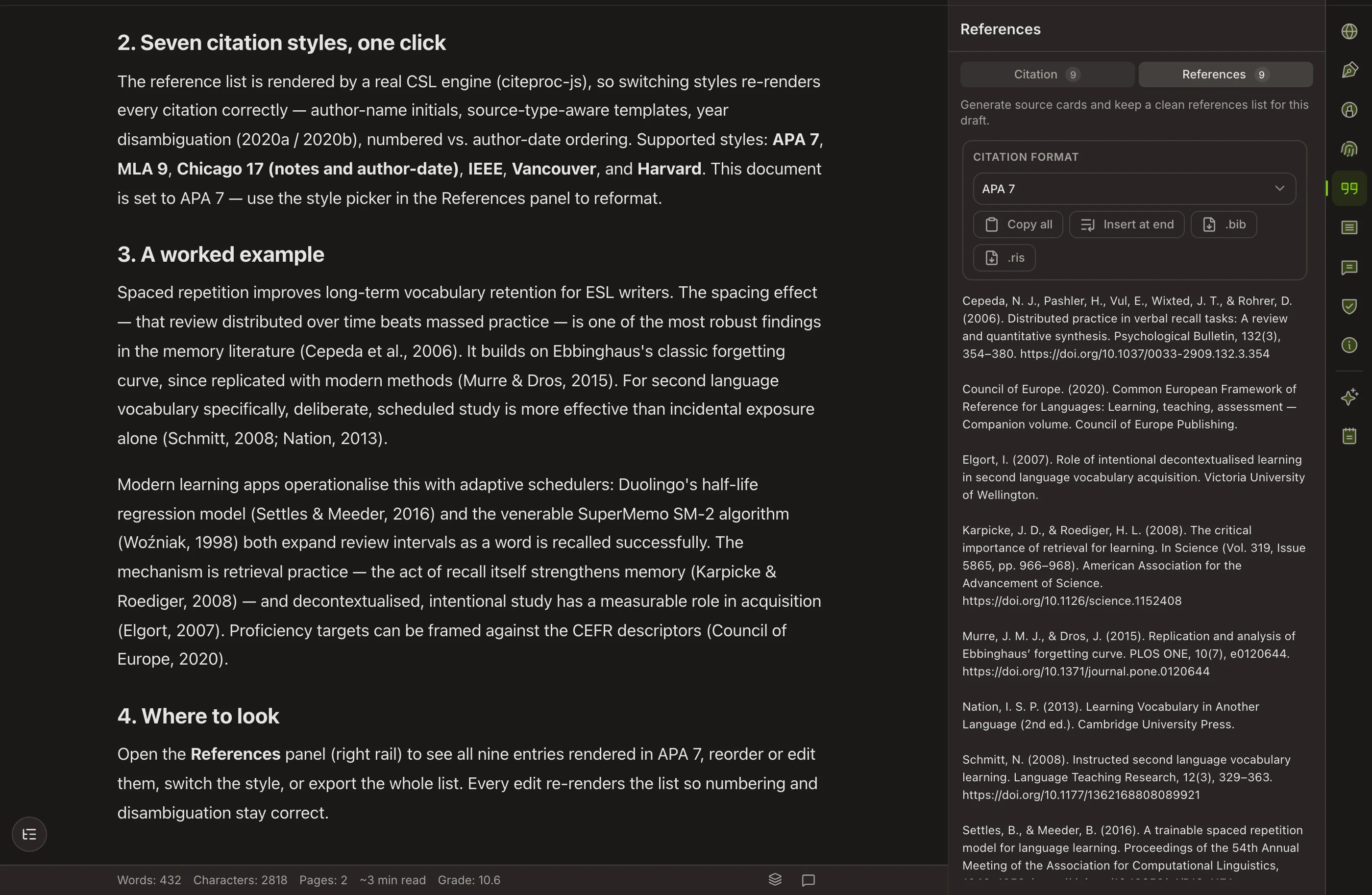
- Cite as you write — Citations and the bibliography build in APA, MLA, Chicago, or IEEE. CSE name–year, common in biology, is not formatted automatically, so plan a conversion pass for a journal that requires it.
- Polish and circulate — Grammar review and the AI-detector preview, then Word export for co-authors. The Authorship Certificate records how the manuscript was written if a journal asks.
CITATION SHORTCUTS
Harvard formats you will need most
Questions from biology writers
Does Copyeditor format CSE style?
No. The supported styles are APA, MLA, Chicago, and IEEE. CSE name–year is an author–date system close to APA in shape, so drafting in APA and converting is the practical path.
How much methodological detail is enough?
Enough that a competent researcher in your subfield could repeat the experiment without contacting you. If a step required a judgment call, describe the call rather than the ideal procedure.
Should biology methods be in passive voice?
Traditionally yes, though many journals now accept “we cultured” in the methods. Consistency matters more than the choice — pick one and hold it across the manuscript.
What belongs in a figure caption?
What the panel shows, the sample size, what the error bars represent, and the statistical test. The caption should let a reader understand the figure without hunting through the methods.
Guides worth reading next
The one page an editor reads before deciding to send your paper out
One page: what the paper reports, why it belongs in this journal, and the declarations required.
Describing your method so another researcher could repeat it
Enough detail to reproduce the study, plus a reason for every design decision you made.
Reporting findings so the text and the tables each do their own job
Data in the tables, pattern in the prose, every planned result reported — including the null ones.
The four-part shape behind most empirical papers
Introduction, Methods, Results, Discussion — what each part owns, and when the format stops helping.
When the passive is the right choice — and when it is not
Voice is a choice about what the sentence should be about. The passive is correct whenever the actor is irrelevant, and wrong whenever it conceals who did something.
Neighboring fields
Academic writing in chemistry
Each procedure is written in past tense with exact quantities, molar equivalents, solvent volumes, temperatures, times, and isolated yields with the mass. Order of addition matters and is stated, because for many reactions it changes the outcome.
Academic writing in medicine
Most clinical journals require labeled sections — Background, Methods, Results, Conclusions — inside a hard word limit, often 250 or 300. Every numeric result you claim in the abstract has to appear identically in the body, because reviewers check.
Academic writing in engineering
IEEE numbers references [1], [2], [3] as they first appear, and the number is reused for every later mention. The number behaves like a noun in a sentence — “as shown in [4]” — which is why inserting a source mid-draft renumbers everything after it.
Built for the paper
you are actually writing
Structured drafting, citations that build their own reference list, and an Authorship Certificate that records how the document came together. Copyeditor is in beta — apply and we’ll reach out as spots open.