Engineering
Technical writing for engineers: papers, reports, and figures
IEEE numbered citations, passive-voice methods, numbered equations, figure and table conventions, and SI units — how engineering documents are written.
- Usual citation style
- IEEE style
- What you will be writing
- IEEE-format conference papers within a page limit · Journal articles on methods, materials, or systems · Technical reports for industry sponsors · Laboratory and experimental reports · Design specification and requirements documents · Feasibility studies and engineering theses
FIELD CONVENTIONS
What engineering expects of a manuscript
Generic writing advice stops here. These are the conventions reviewers in this field actually apply.
- Citations are bracketed numbers in order of first appearance
- IEEE numbers references [1], [2], [3] as they first appear, and the number is reused for every later mention. The number behaves like a noun in a sentence — “as shown in [4]” — which is why inserting a source mid-draft renumbers everything after it.
- Passive voice in the methods is still the norm
- “The specimen was loaded at 2 mm/min” keeps attention on the procedure rather than the operator, and reviewers in most engineering venues expect it. Active voice is increasingly accepted in the introduction and conclusions, where the contribution is yours to claim.
- Equations are displayed, numbered, and punctuated as sentences
- Each displayed equation gets a right-aligned number in parentheses and is referred to as “(2).” Equations carry the punctuation of the sentence they sit inside — a comma or period at the end — and every symbol is defined on first use with its units.
- Figures and tables follow fixed placement rules
- In IEEE format, table captions sit above the table and figure captions below the figure, and both are numbered in citation order. Every figure must be referred to in the text before it appears; a figure nobody points at reads as decoration.
- Units are SI, with spacing and symbols treated as correctness
- A space separates the value from the unit (5 kN, not 5kN), unit symbols are never pluralized, and derived units follow the standard forms. Reviewers treat unit errors as evidence about the care taken with the measurements themselves.
- Conference papers are hard-limited and formatted to a template
- Six or eight pages in a two-column template is a real constraint that shapes what you can argue, not a target. Trimming happens by cutting scope, not by shrinking margins, and the template is supplied by the venue rather than chosen by you.
THE FRICTION
Where the writing actually slows down
What gets in the way
- IEEE reference numbers that shift when a citation is added partway through a draft
- Two-column templates where a figure will not fit at a readable size
- Cutting a paper to a page limit without losing the experimental detail that makes it reproducible
- Reports written for a sponsor who needs conclusions before methods
- Equations and notation that drift between a thesis chapter and the paper drawn from it
How the workflow runs in Copyeditor
- Outline against the page limit — Plan mode allocates the sections of a conference paper so you know before drafting how much room the experiments actually get.
- Draft the methods and results — Ask mode helps keep procedural writing consistent in voice and tense. Edit mode compresses a section running over the limit without dropping the reproducible detail.
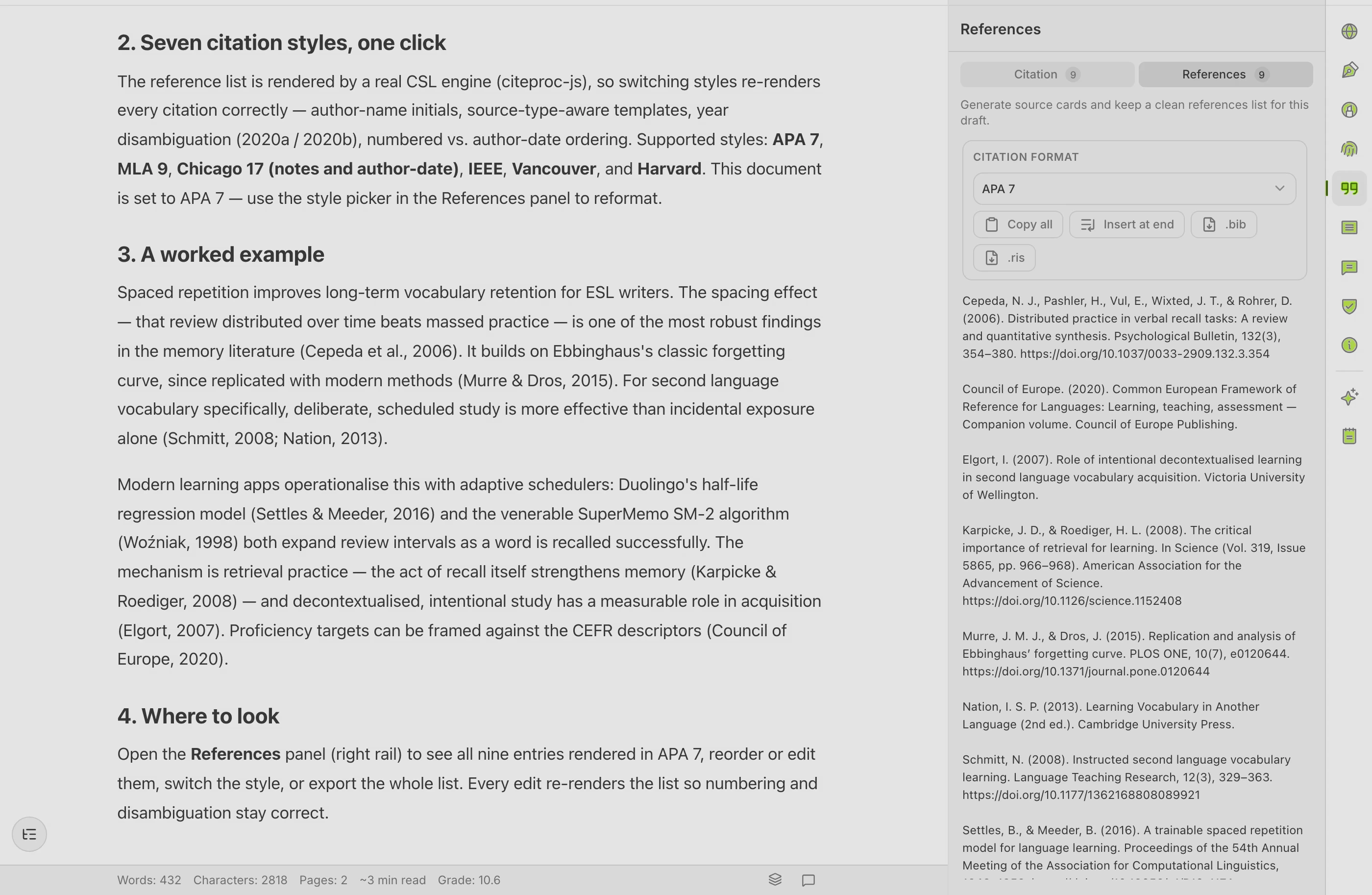
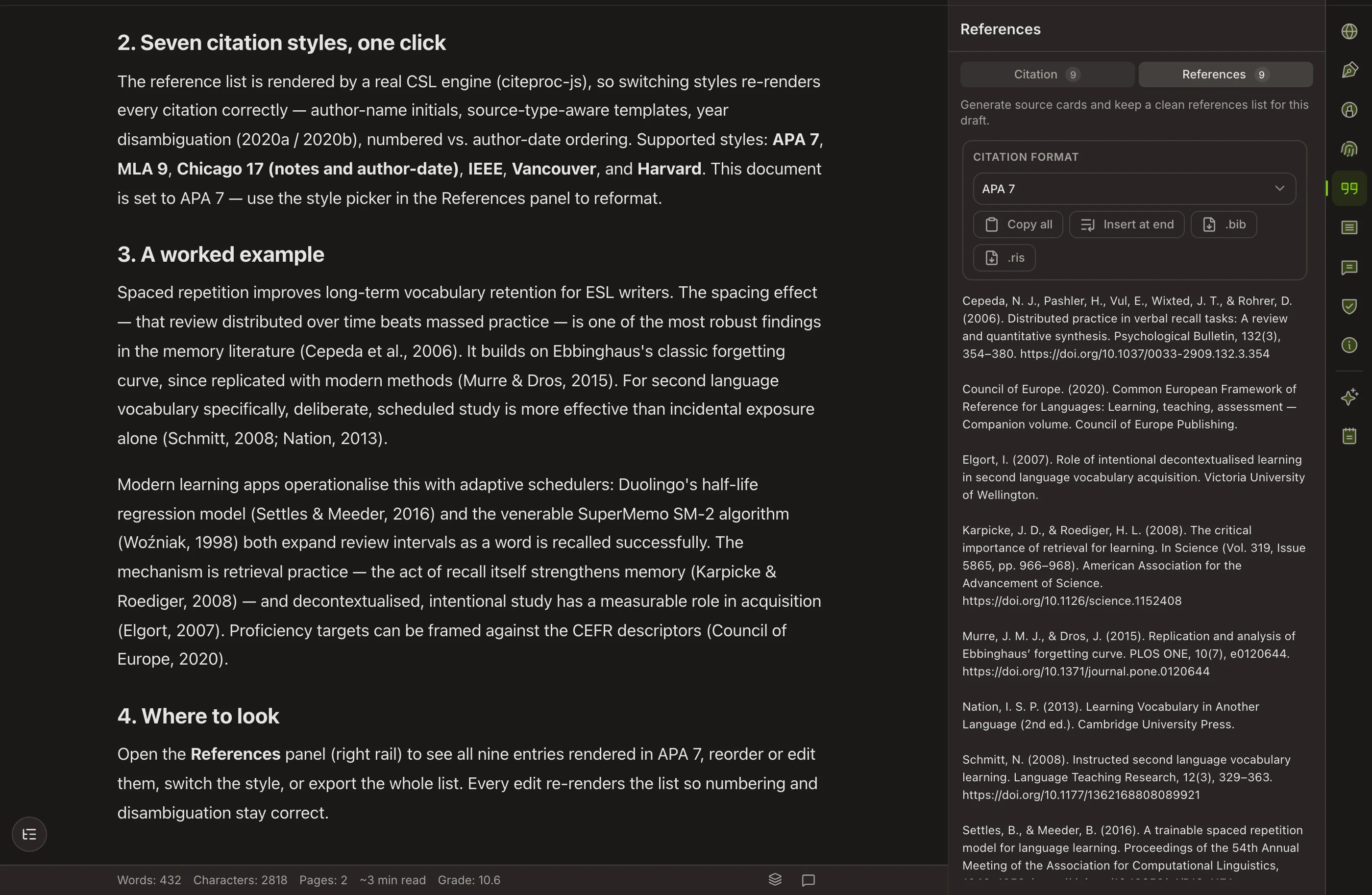
- Let IEEE citations manage themselves — IEEE is one of the four styles formatted automatically — bracketed numbers and the reference list renumber themselves when you insert a source mid-draft.
- Proofread and export — Grammar review and the AI-detector preview, then Word or PDF export. The Authorship Certificate records how the paper was written if a venue asks about AI assistance.
CITATION SHORTCUTS
IEEE formats you will need most
Questions from engineering writers
Does Copyeditor handle IEEE numbering automatically?
Yes. IEEE is one of the four supported styles, so bracketed numbers and the reference list stay in order even when you add a source in the middle of a draft.
Can I write in LaTeX or export a .tex file?
No. Word and PDF are the export formats today. For a venue that requires LaTeX, treat Copyeditor as where the prose gets written, not where the paper gets typeset.
Should an engineering paper use “we”?
In the introduction and conclusions, commonly yes — “we propose a controller that…” is standard. Methods sections usually stay passive. Follow the conventions of your target venue.
How is a sponsor report different from a paper?
It is inverted. The report opens with findings and recommendations for readers who may never reach the methods, and the technical detail moves to appendices.
Guides worth reading next
The four-part shape behind most empirical papers
Introduction, Methods, Results, Discussion — what each part owns, and when the format stops helping.
Compressing a whole paper into 250 useful words
Four moves — background, method, result, implication — with the result sentence doing most of the work.
When the passive is the right choice — and when it is not
Voice is a choice about what the sentence should be about. The passive is correct whenever the actor is irrelevant, and wrong whenever it conceals who did something.
Reporting findings so the text and the tables each do their own job
Data in the tables, pattern in the prose, every planned result reported — including the null ones.
Neighboring fields
Academic writing in computer science
Top computer science conferences are peer-reviewed with acceptance decisions that count for careers, and journals often come second. This shapes the writing: a fixed deadline, a fixed page count, and a paper that must be self-contained because there is no revise-and-resubmit in most cycles.
Academic writing in chemistry
Each procedure is written in past tense with exact quantities, molar equivalents, solvent volumes, temperatures, times, and isolated yields with the mass. Order of addition matters and is stated, because for many reactions it changes the outcome.
Academic writing in biology
Write the full genus and species in italics at first mention — Drosophila melanogaster — then abbreviate the genus to its initial thereafter. Genus is capitalized, species is not, and the italics are not optional styling.
Built for the paper
you are actually writing
Structured drafting, citations that build their own reference list, and an Authorship Certificate that records how the document came together. Copyeditor is in beta — apply and we’ll reach out as spots open.