Chemistry
Writing chemistry papers: procedures, characterization, and SI
Experimental procedures as replicable recipes, fixed characterization formats, compound numbering, IUPAC names, and supporting information conventions.
- Usual citation style
- Vancouver style — not one of the styles Copyeditor formats automatically today.
- What you will be writing
- Full papers describing new syntheses or methods · Communications reporting a single significant result · Supporting information documents with spectra and procedures · Review articles on a reaction class or material · Safety and risk assessments for hazardous procedures · Thesis chapters combining several published studies
FIELD CONVENTIONS
What chemistry expects of a manuscript
Generic writing advice stops here. These are the conventions reviewers in this field actually apply.
- The experimental section reads as a replicable recipe
- Each procedure is written in past tense with exact quantities, molar equivalents, solvent volumes, temperatures, times, and isolated yields with the mass. Order of addition matters and is stated, because for many reactions it changes the outcome.
- Characterization data follow a fixed order and punctuation
- Compounds are reported in a set sequence — typically 1H NMR, 13C NMR, IR, then high-resolution mass spectrometry — with solvent, frequency, chemical shifts, multiplicity, coupling constants, and integration in a rigid format. Journals treat deviations from that format as errors, not preferences.
- Compounds are numbered in bold and referred to by number
- New compounds get a bold arabic number at first appearance and are called by that number everywhere after, including in schemes. The numbering must match the scheme, the experimental section, and the supporting information exactly.
- Supporting information carries the evidence, not the leftovers
- Spectra, crystallographic data, and full procedures live in the SI, which is peer-reviewed alongside the paper. It has its own numbering scheme, and a claim in the main text has to be traceable to a specific SI page.
- Names follow IUPAC, and structures do the heavy lifting
- Systematic IUPAC names are used for new compounds even when a trivial name is common in the lab. Reaction schemes are the argument’s backbone; the prose explains what changed between structures rather than restating them in words.
- Hazards are stated at the point of the procedure
- Where a step involves a pyrophoric reagent, a peroxide former, or a pressurized reaction, a caution statement sits in the experimental section next to that step. Burying safety information in a general note is not acceptable practice.
THE FRICTION
Where the writing actually slows down
What gets in the way
- Transcribing characterization data into a journal’s exact punctuation format without typos
- Compound numbering that stops matching the schemes after a reordering
- Assembling a supporting information document that runs longer than the paper
- ACS style not being one of the styles a general writing tool formats
- Chemical notation, subscripts, and superscripts surviving a copy-paste between tools
How the workflow runs in Copyeditor
- Structure the paper and the SI together — Plan mode outlines the main text and the supporting information side by side so every claim has a place to point at.
- Draft the discussion around the schemes — Ask mode helps you explain mechanism and scope in connected prose. The procedures and the data you transcribe yourself, because precision there is the point.
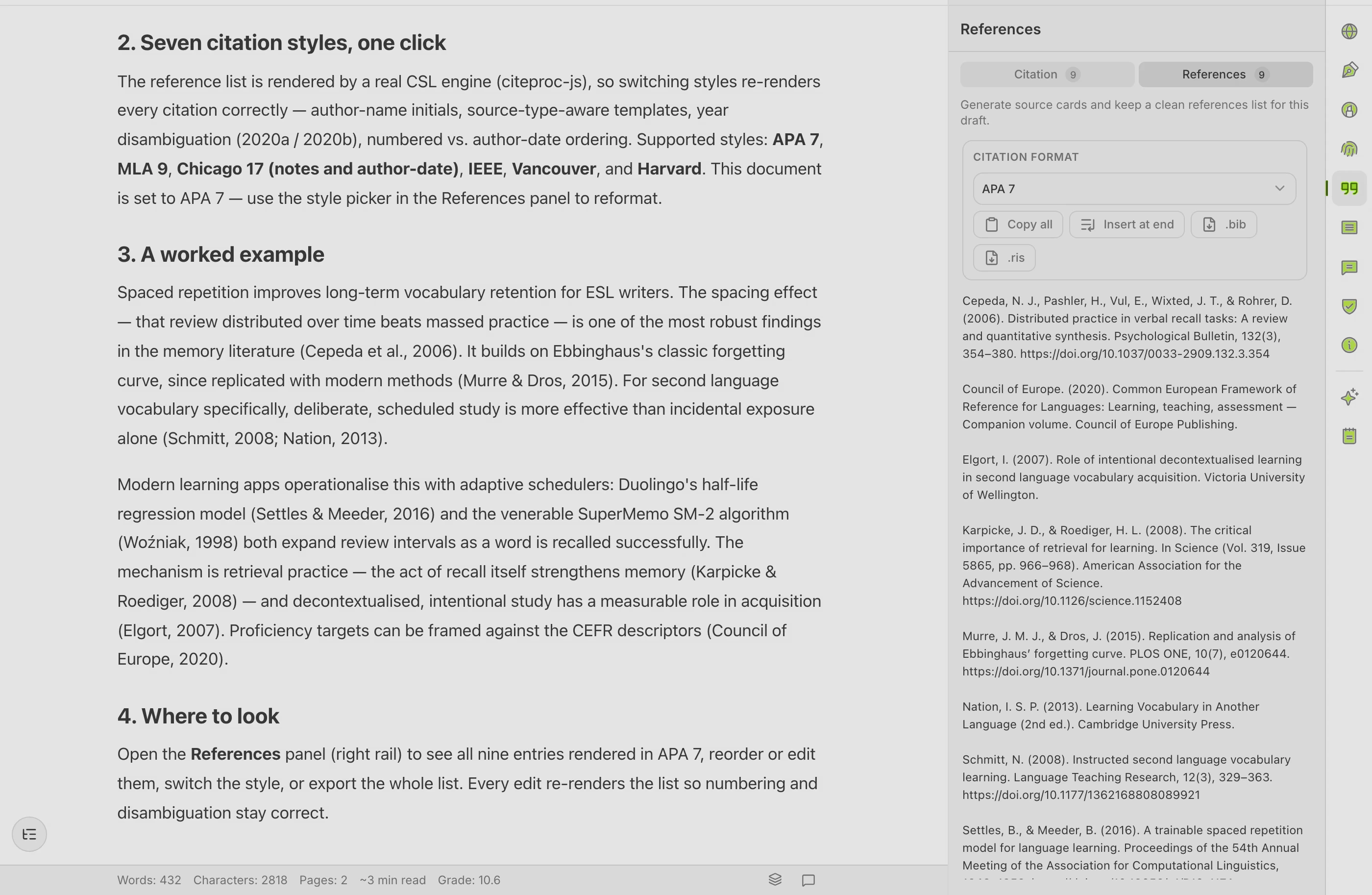
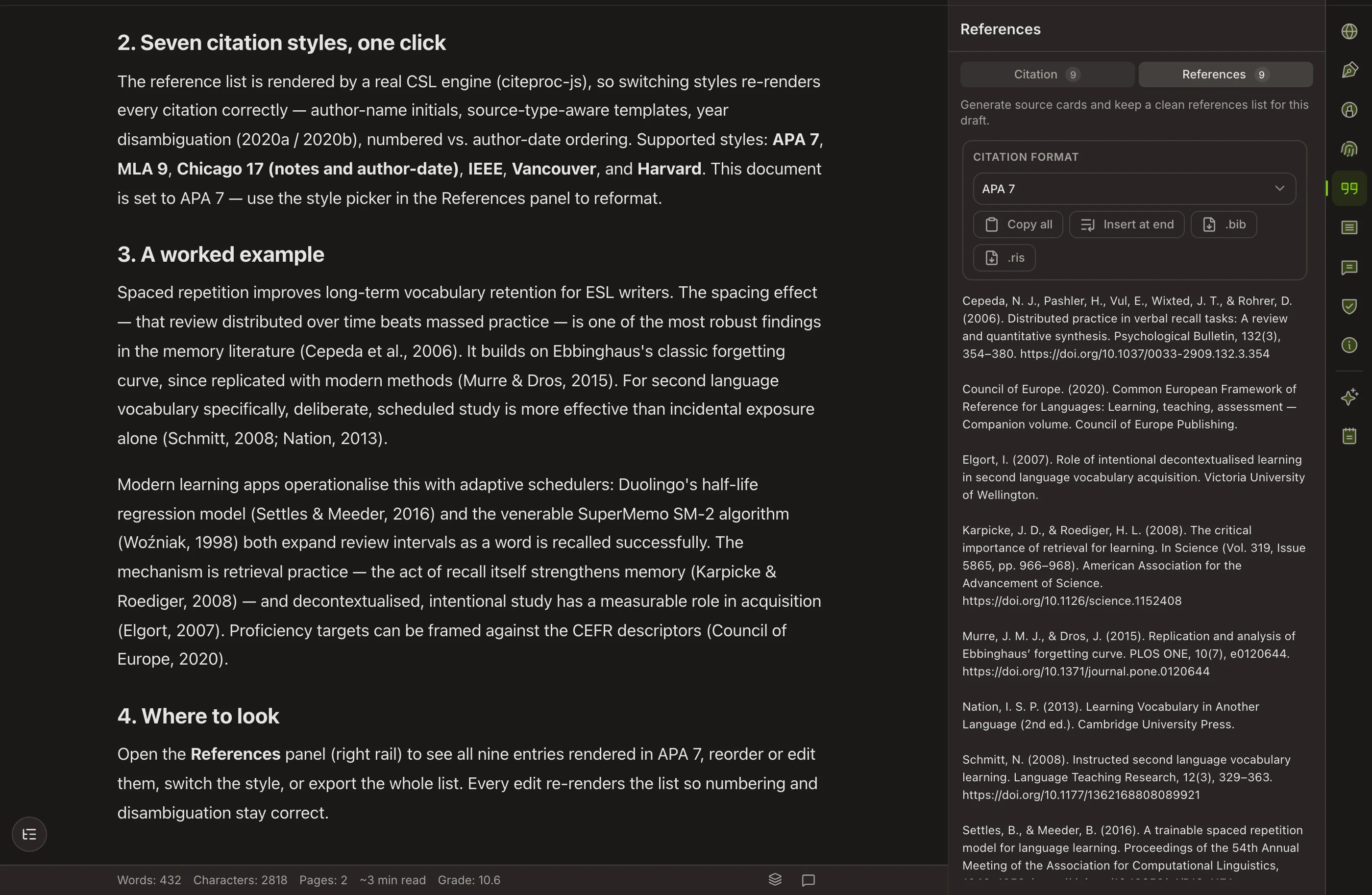
- Handle citations realistically — ACS style is not among the four Copyeditor formats, and neither is Vancouver. Both are numeric systems cited in order of appearance, so drafting in IEEE — which is supported — converts with far less friction than an author–date style.
- Proofread and export — Grammar review across the discussion and introduction, the AI-detector preview before submission, then Word or PDF export for co-authors and the journal portal.
CITATION SHORTCUTS
Vancouver formats you will need most
Questions from chemistry writers
Does Copyeditor support ACS style?
No. It formats APA, MLA, Chicago, and IEEE. ACS uses numeric citation, so IEEE is the closest supported system, but the final formatting pass for an ACS journal is manual.
Should the experimental section go in the paper or the SI?
It depends on the journal and the format. Communications often push full procedures to the supporting information; full papers usually keep a condensed experimental section in the main text with spectra in the SI.
What tense is used for procedures?
Past tense throughout — you are reporting what was done, not writing instructions. Present tense creeps in when authors adapt a lab protocol, and reviewers notice.
Can it check my structures or spectra?
No. Copyeditor works on text — structure, register, phrasing, and citations. Chemical drawing, spectral assignment, and data validation stay in your specialist software.
Guides worth reading next
Describing your method so another researcher could repeat it
Enough detail to reproduce the study, plus a reason for every design decision you made.
Catching the errors your eyes skip over
Proofreading your own text works when you deliberately break familiarity — with time, a different medium, your ear, and one error type per pass.
Reporting findings so the text and the tables each do their own job
Data in the tables, pattern in the prose, every planned result reported — including the null ones.
The four-part shape behind most empirical papers
Introduction, Methods, Results, Discussion — what each part owns, and when the format stops helping.
Neighboring fields
Academic writing in biology
Write the full genus and species in italics at first mention — Drosophila melanogaster — then abbreviate the genus to its initial thereafter. Genus is capitalized, species is not, and the italics are not optional styling.
Academic writing in engineering
IEEE numbers references [1], [2], [3] as they first appear, and the number is reused for every later mention. The number behaves like a noun in a sentence — “as shown in [4]” — which is why inserting a source mid-draft renumbers everything after it.
Academic writing in medicine
Most clinical journals require labeled sections — Background, Methods, Results, Conclusions — inside a hard word limit, often 250 or 300. Every numeric result you claim in the abstract has to appear identically in the body, because reviewers check.
Built for the paper
you are actually writing
Structured drafting, citations that build their own reference list, and an Authorship Certificate that records how the document came together. Copyeditor is in beta — apply and we’ll reach out as spots open.