Linguistics
Writing linguistics papers: examples, glossing, and evidence
Numbered examples, Leipzig glossing, grammaticality judgments, IPA conventions, and the Unified Style Sheet — how linguistics papers are actually written.
- Usual citation style
- APA 7th edition
- What you will be writing
- Theoretical papers in syntax, semantics, or phonology · Corpus studies with quantitative analysis · Experimental papers on processing or acquisition · Descriptive grammars and language documentation reports · Sociolinguistic variation studies · Conference abstracts judged anonymously on a one-page limit
FIELD CONVENTIONS
What linguistics expects of a manuscript
Generic writing advice stops here. These are the conventions reviewers in this field actually apply.
- Data appear as numbered examples referenced by number
- Example sentences are set off, numbered sequentially as (1), (2), with sub-items lettered (3a), (3b), and the prose refers back to them rather than repeating the string. Every numbered example must be discussed somewhere in the text, or a reviewer will ask why it is there.
- Non-English data are glossed line by line
- The standard is a three-line format — the object language, a morpheme-by-morpheme gloss with grammatical categories in small caps, and a free translation in single quotes. The Leipzig Glossing Rules define the abbreviations and the alignment, and misaligned morpheme boundaries make the example unreadable.
- Grammaticality is marked with a fixed set of diacritics
- An asterisk marks ungrammaticality, a question mark marginal acceptability, a hash a semantic or pragmatic anomaly. These are conventional and load-bearing, so you say in the text where the judgments come from — your own intuitions, consultants, or an acceptability study.
- Transcription notation distinguishes phonemic from phonetic
- Slashes enclose phonemic representations and square brackets phonetic ones, with IPA symbols rather than ad-hoc respellings. Italics mark forms cited as forms, and single quotes enclose meanings — a distinction the field enforces closely.
- Language data carry provenance and speaker ethics
- For fieldwork data, state the language with its identifying code, where and when it was collected, and how consultants consented and are credited. Anonymization practices and community agreements are described in the methods, not assumed.
- Typological claims are hedged to the sample they rest on
- A generalization drawn from a convenience sample of a dozen languages is written as such. The field is attentive to the difference between “no language does X” and “X is unattested in our sample,” and the second is usually the honest sentence.
THE FRICTION
Where the writing actually slows down
What gets in the way
- Keeping interlinear glosses aligned when a document moves between editors and formats
- Example numbering that has to be renumbered after inserting data mid-draft
- IPA characters and special diacritics that break on copy-paste or font substitution
- One-page anonymous conference abstracts that must include examples and still argue a point
- Journals that follow the Unified Style Sheet while your department requires APA
How the workflow runs in Copyeditor
- Plan the argument around the data — Plan mode structures the paper so each section is anchored to the examples that motivate it, rather than examples being fitted to finished prose.
- Draft the analysis — Ask mode helps with connective prose between examples and with keeping technical terminology consistent across a long paper. The judgments and glosses stay yours.
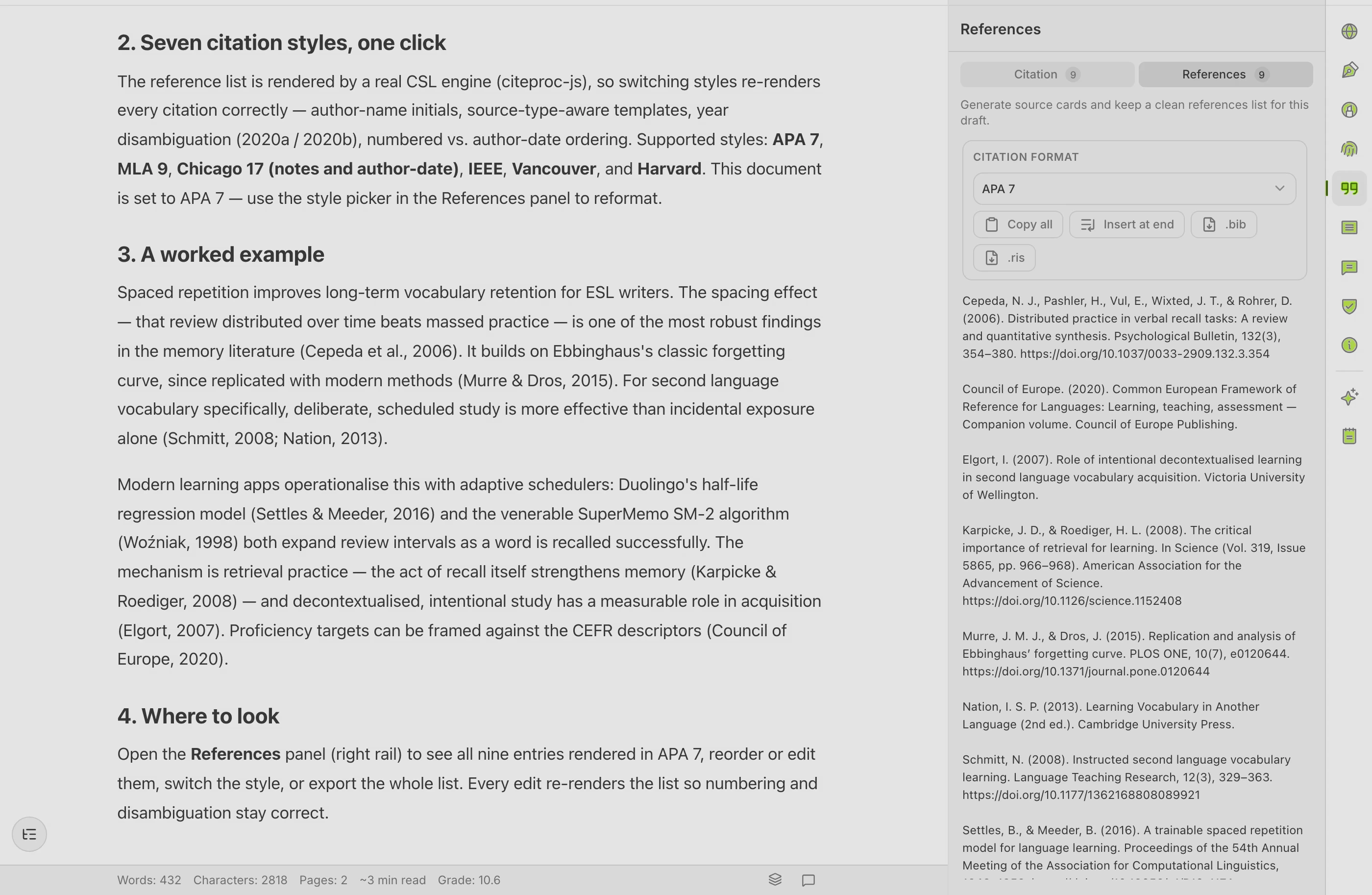
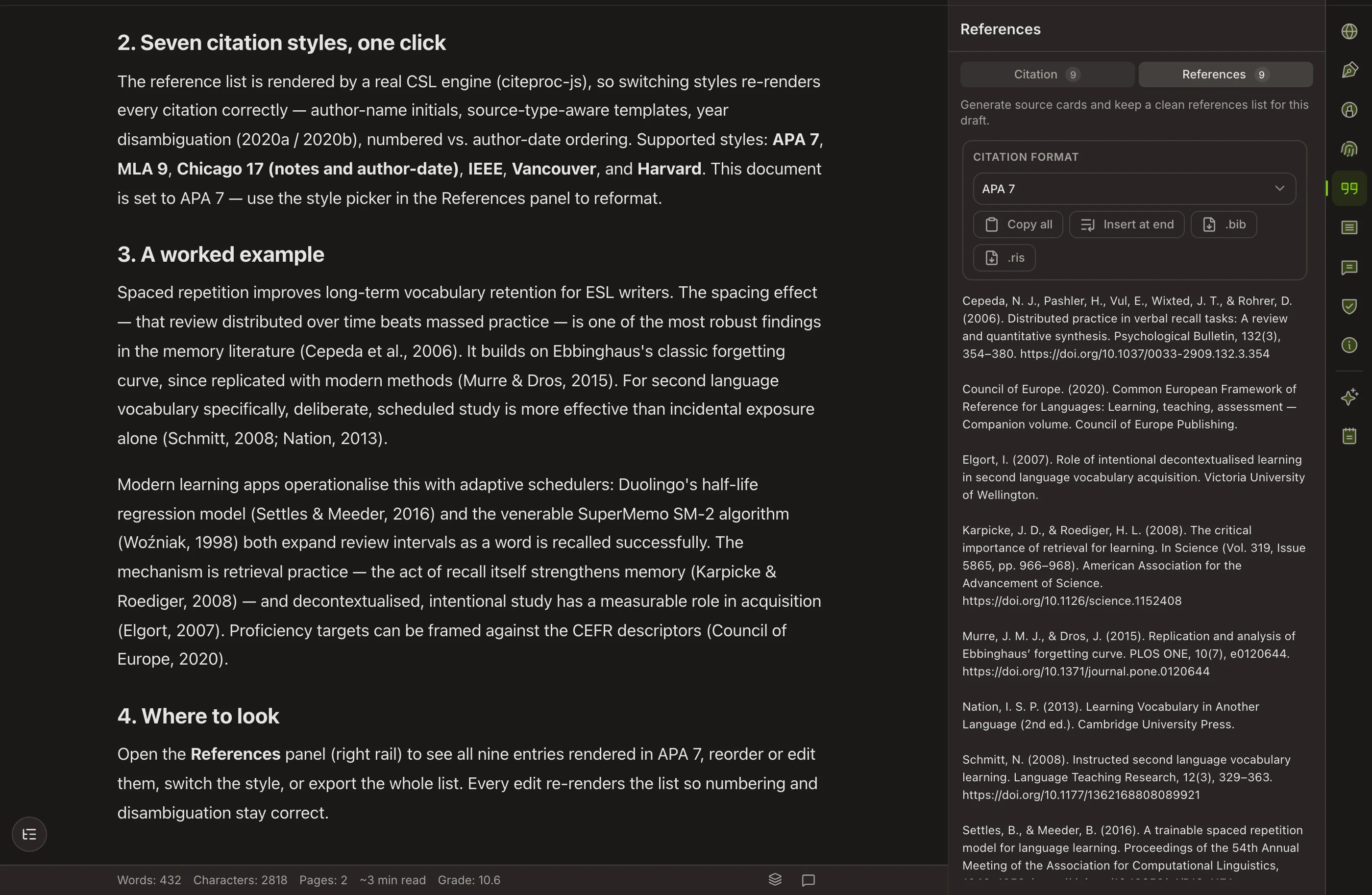
- Cite as you write — Citations and the bibliography build in APA, the closest supported style to the author–date conventions most linguistics journals use, and rebuild if you switch to Chicago or MLA.
- Proofread and export — Grammar review across the prose sections, the AI-detector preview before submission, then Word or PDF export for a supervisor or a journal portal.
CITATION SHORTCUTS
APA formats you will need most
Questions from linguistics writers
Which citation style do linguistics journals use?
Most follow the Unified Style Sheet for Linguistics, an author–date system, though APA, Chicago, and MLA all appear depending on the journal and the subfield. Copyeditor formats APA, MLA, and Chicago automatically.
Can Copyeditor format interlinear glosses?
No. It has no special handling for aligned three-line glosses, so treat the prose as the part it helps with and lay out your examples yourself.
How do I report where grammaticality judgments came from?
Say plainly whether they are your own intuitions, elicited from consultants, or collected in an acceptability experiment, and give the number of speakers. Unsourced judgments are the most common reviewer complaint.
What goes into a one-page conference abstract?
The claim, the crucial data with one or two numbered examples, the analysis in outline, and why it matters. Anonymous review means removing self-identifying citations before you submit.
Guides worth reading next
Describing your method so another researcher could repeat it
Enough detail to reproduce the study, plus a reason for every design decision you made.
What academic writing actually sounds like
Register in academic prose comes from precision and appropriate caution, not from long words — inflated vocabulary usually signals imprecision rather than authority.
Turning results into an argument about what they mean
Answer the question first, interpret against the literature, bound the claims, then say what follows.
Condensing a paper without distorting it
Read in the right order, capture the claim the paper actually makes, and keep your summary proportional to where the paper spends its weight.
Neighboring fields
Academic writing in psychology
Psychology runs on APA — five levels of heading, an unstructured abstract of roughly 250 words, and a reference list rather than a bibliography. Departments usually grade formatting explicitly, so a paper that is right on substance and wrong on hanging indents still loses marks.
Academic writing in education
Education papers usually declare their theoretical lens in its own section and then use it consistently — it should shape which literature you review, which data you look at, and how you read your findings. A framework that is announced in chapter two and never mentioned again is the classic committee objection.
Academic writing in computer science
Top computer science conferences are peer-reviewed with acceptance decisions that count for careers, and journals often come second. This shapes the writing: a fixed deadline, a fixed page count, and a paper that must be self-contained because there is no revise-and-resubmit in most cycles.
Built for the paper
you are actually writing
Structured drafting, citations that build their own reference list, and an Authorship Certificate that records how the document came together. Copyeditor is in beta — apply and we’ll reach out as spots open.