Roundup
Citation generators that produce references you can submit
A citation generator is only as good as the record it starts from: a DOI produces a clean reference, a scraped web page often does not. This list ranks tools by how reliably the output survives a supervisor reading the reference list. Disclosure: we build Copyeditor, and free tools rank above it here because they are free and they work.
HOW THESE WERE JUDGED
The criteria, stated up front
- Does it start from a structured record — DOI, BibTeX, RIS — or from a guess at a web page?
- How many citation styles does it cover, and can you switch style without redoing the work?
- Does the reference stay connected to your document, or is it text you copy once?
- How does it handle awkward sources — a dataset, a preprint, a government report, a thesis?
- Is it free, and is the free version enough?
Copyeditor publishes this list and also appears on it. We rank ourselves where we genuinely land rather than at the top of every category, and we say plainly when another tool is the better answer. Verify current features and pricing on each vendor’s own site.
7 TOOLS
The list
1. Best for Anyone who wants correct references and keeps them for years
Zotero
Free, open source and better at capturing sources than anything else in this list. One click in the browser saves a citable record and usually the PDF, and the Word plugin builds and reformats the bibliography as you write. If you are choosing one tool from this page, choose this one.
- Free and open source, with no reference or seat limits
- Thousands of styles through CSL, including the obscure departmental ones
- The browser connector is the best source capture in the category
- Word, LibreOffice and Google Docs plugins rebuild the bibliography when you change style
- Cloud storage beyond the free quota is paid, though you can sync files yourself
- The interface rewards time spent learning it
2. Best for A quick, free citation without installing anything
Scribbr
The free generators are fast, cover the common styles and sit next to some of the clearest citation guidance on the web. For a handful of references on a coursework essay, this is often the whole answer.
- Free, with no account required for the basics
- Style guidance alongside the generator, which teaches as well as produces
- Output is text you copy — nothing stays attached to your document
- Not built for maintaining a reference list across a long project
3. Best for Citing while you draft, with the bibliography assembling itself
Copyeditor
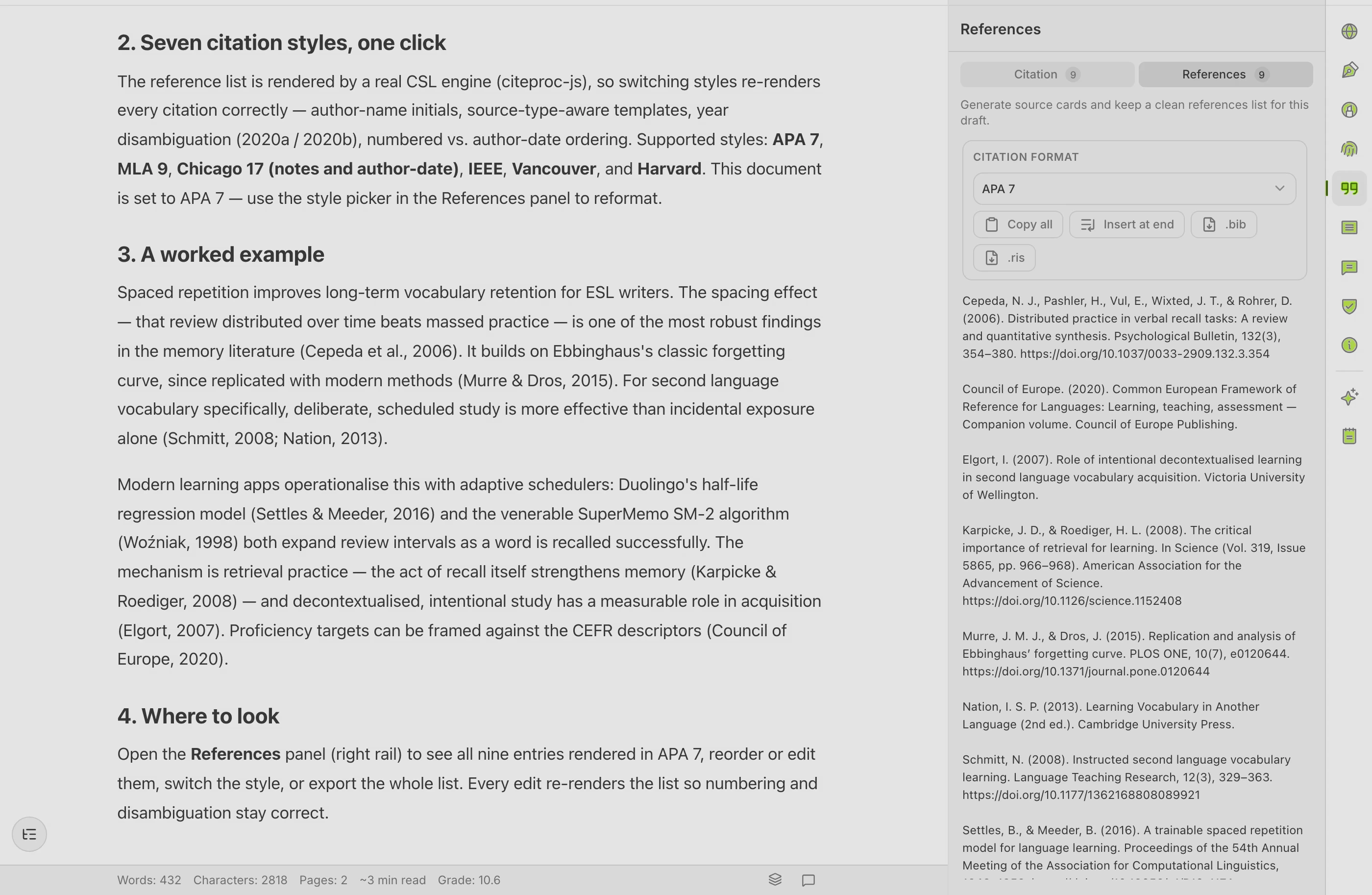
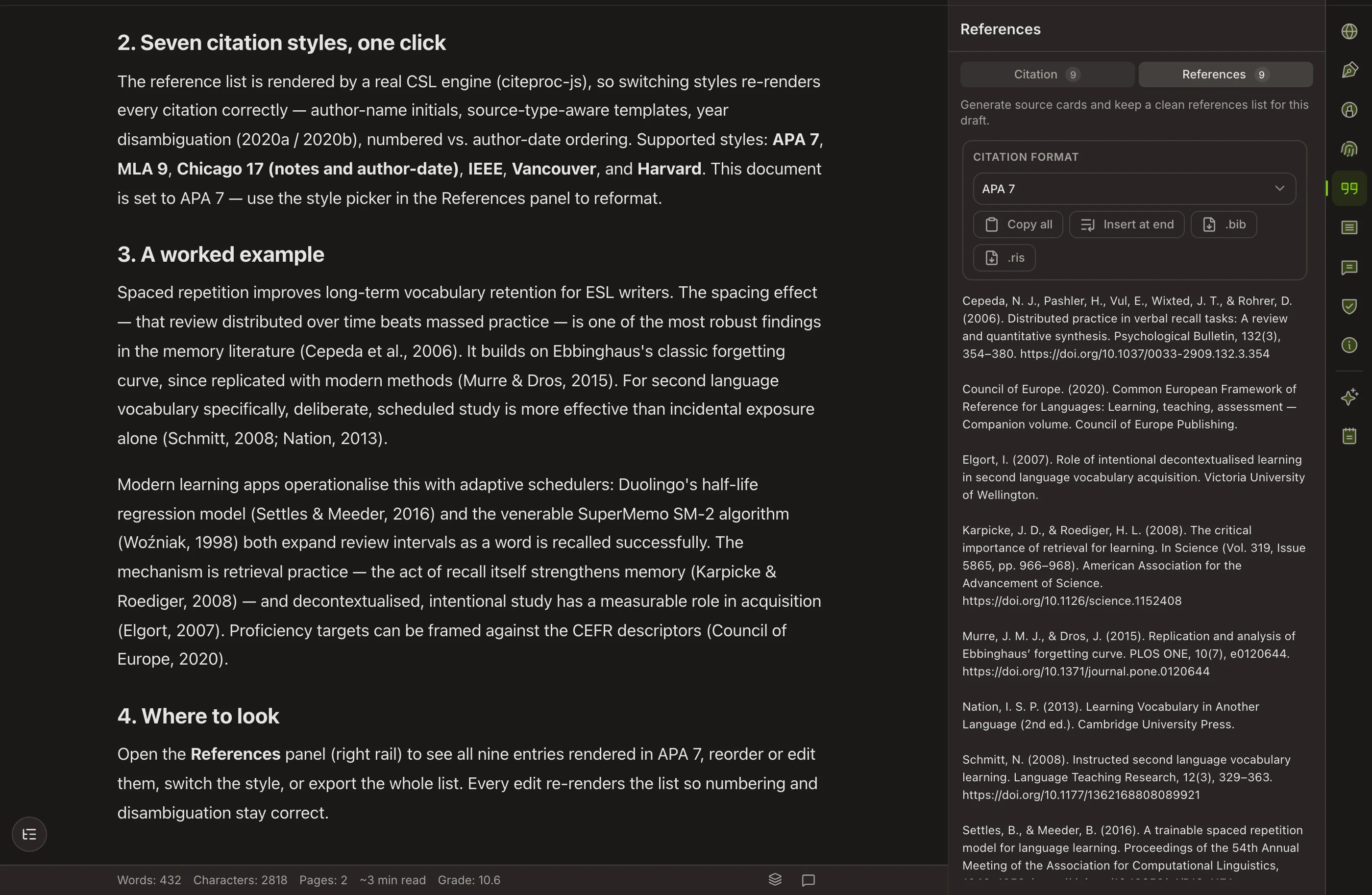
Sources go in by DOI, URL, BibTeX or RIS and the bibliography builds itself in APA, MLA, Chicago or IEEE as you cite, then rebuilds when the required style changes. Four styles is far fewer than a reference manager offers, and it is in closed beta — both are real limits worth weighing.
- The reference list is part of the document rather than something you assemble at the end
- Structured input by DOI, BibTeX or RIS keeps references traceable to a real record
- Four styles only — no CSL library behind it
- Closed beta, and no Zotero or Mendeley sync today
4. Best for Long documents with hundreds or thousands of references
EndNote
Cite While You Write in Word handles scale that lighter tools struggle with, and the style library goes further than anything else here, down to editing a style field by field. Many universities license it, which changes the cost calculation entirely.
- Built for very large reference lists and long documents
- Enormous, editable style library for awkward journal requirements
- Frequently free through an institutional license
- Paid, and desktop-centric, if your institution does not provide it
- More tool than a short essay needs
5. Best for Citing in Word with a free, synced library behind it
Mendeley
Mendeley Cite inserts references in Word, including Word on the web, and builds the list as you go, backed by a free library that syncs across devices. The reading experience is a genuine reason to pick it over alternatives if you annotate heavily.
- Free tier includes sync across devices
- Cite add-in works in desktop and web versions of Word
- Built-in PDF reader with annotation
- Free storage is capped, which a large PDF library eventually reaches
6. Best for A free generator alongside the rewriting tools you already use
QuillBot Citation Generator
Convenient if QuillBot is already open for paraphrasing, and it covers the common styles. It produces citations to copy rather than a library you maintain, so it suits essays more than a thesis.
- Free and immediate
- Sits with the writing tools you may already be using
- Not a reference manager — nothing is maintained across projects
7. Best for LaTeX writers who want exact, reproducible references
Overleaf with BibTeX
Not a generator in the usual sense — you maintain a .bib file and the document compiles the bibliography from it. In exchange you get precision and reproducibility that no click-to-cite tool matches, and journal styles that come with the template.
- Exact control, and references that reproduce identically on any machine
- Journal and conference styles arrive with the template
- Manual work, and unforgiving of a malformed entry
- Only relevant if you are writing in LaTeX
Questions about this category
Why do citation generators get references wrong?
Most errors come from the metadata, not the formatter. A DOI or a publisher-supplied record produces a clean citation; a scraped web page often lacks an author, a date or a proper title. Start from the DOI whenever one exists, and read the finished list before you submit.
Which is best for APA?
All of these handle APA. The difference is what happens next: whether the reference stays connected to your document, whether you can switch styles without redoing the work, and whether it will still be there for your next paper.
Do I need a reference manager, or is a generator enough?
For a short essay, a generator is enough. For a thesis, a multi-year project or anything you will cite again, a manager pays for itself in a week.
Can a citation generator handle a dataset or a preprint?
The better ones can, but this is where output quality diverges sharply. Check any unusual source type against the actual style manual — awkward sources are where reference lists lose marks.
Is the information here current?
Features and pricing change across all of these tools. Confirm on each vendor’s own site before choosing one.
Related roundups
Reference managers worth building your library on
A reference manager is the piece of your toolchain you will still be using in five years, so the questions that matter are capture quality, style coverage and whether you can get your data out again.
The tools that actually help with a literature review
A literature review is three separate jobs — collecting sources, understanding them, and synthesizing them into an argument — and no single tool is best at all three.
Free tools that actually get an academic paper written
There is a difference between a tool that is free and a free tier designed to run out.
Fewer tools
one document
Copyeditor puts drafting, citations, paraphrase and export in one place, with a verifiable record of how the paper was written. In beta — apply and we’ll reach out as spots open.