History
Writing history: argument, evidence, and archival citation
Chicago notes–bibliography, archival citation with box and folder, historiography instead of a literature review, and argument-driven structure.
- Usual citation style
- Chicago 17th edition (notes–bibliography)
- What you will be writing
- Research articles built on archival evidence · Monographs and dissertation chapters · Historiographical essays surveying an interpretive debate · Book reviews and review essays · Primary source analyses and document studies · Conference papers read aloud to an audience
FIELD CONVENTIONS
What history expects of a manuscript
Generic writing advice stops here. These are the conventions reviewers in this field actually apply.
- Chicago notes–bibliography is the working system
- Citations go in footnotes, with the full form at first use and a shortened form thereafter, and a separate bibliography at the end. Author–date is rare in history because a note can carry commentary alongside the reference.
- Archival citation identifies the physical location of the document
- A footnote names the item, the collection, the box and folder, and the repository with its city — enough for another historian to request the same document. Digitized collections add the database and, where stable, a permanent link.
- Historiography replaces the literature review
- Instead of summarizing findings, you narrate how interpretations of your subject have changed and which school your argument enters. The point is to locate a live disagreement, which is what makes the reader care about your intervention.
- The thesis is an argument, not a hypothesis
- History papers are argument-driven: you make a contestable claim about causes, meaning, or change over time, and the evidence is marshaled to support it. There is no methods section testing a prediction, so the argument has to be visible from the introduction.
- Primary evidence is quoted; the interpretation is yours
- Extended quotation from sources is normal and expected, with original spelling and punctuation preserved and any intervention marked in brackets. Every substantial quotation needs analysis attached, or the paper reads as a transcription.
- Tense marks the difference between events and texts
- Past events are written in the past tense, but what a source or a historian says is often present tense — “Thompson argues,” “the petition claims.” Holding that distinction keeps the reader clear on whether you are narrating or analyzing.
- Translation and transliteration choices are declared
- When working across languages, state whose translation you use, or that translations are your own, and name the transliteration system for non-Latin scripts. Once declared in a note, the choice is applied consistently throughout.
THE FRICTION
Where the writing actually slows down
What gets in the way
- Footnotes that outgrow the page and have to be rebalanced against the main text
- Archival references captured incompletely in the reading room and impossible to reconstruct later
- Long-form chapters where the argument drifts across 15,000 words
- Shortened citation forms that stop matching the first full note after a reordering
- Quotations from primary sources that need transcription accuracy alongside readable prose
How the workflow runs in Copyeditor
- Sharpen the argument before drafting — Plan mode turns a research question into a contestable thesis and maps how each section advances it.
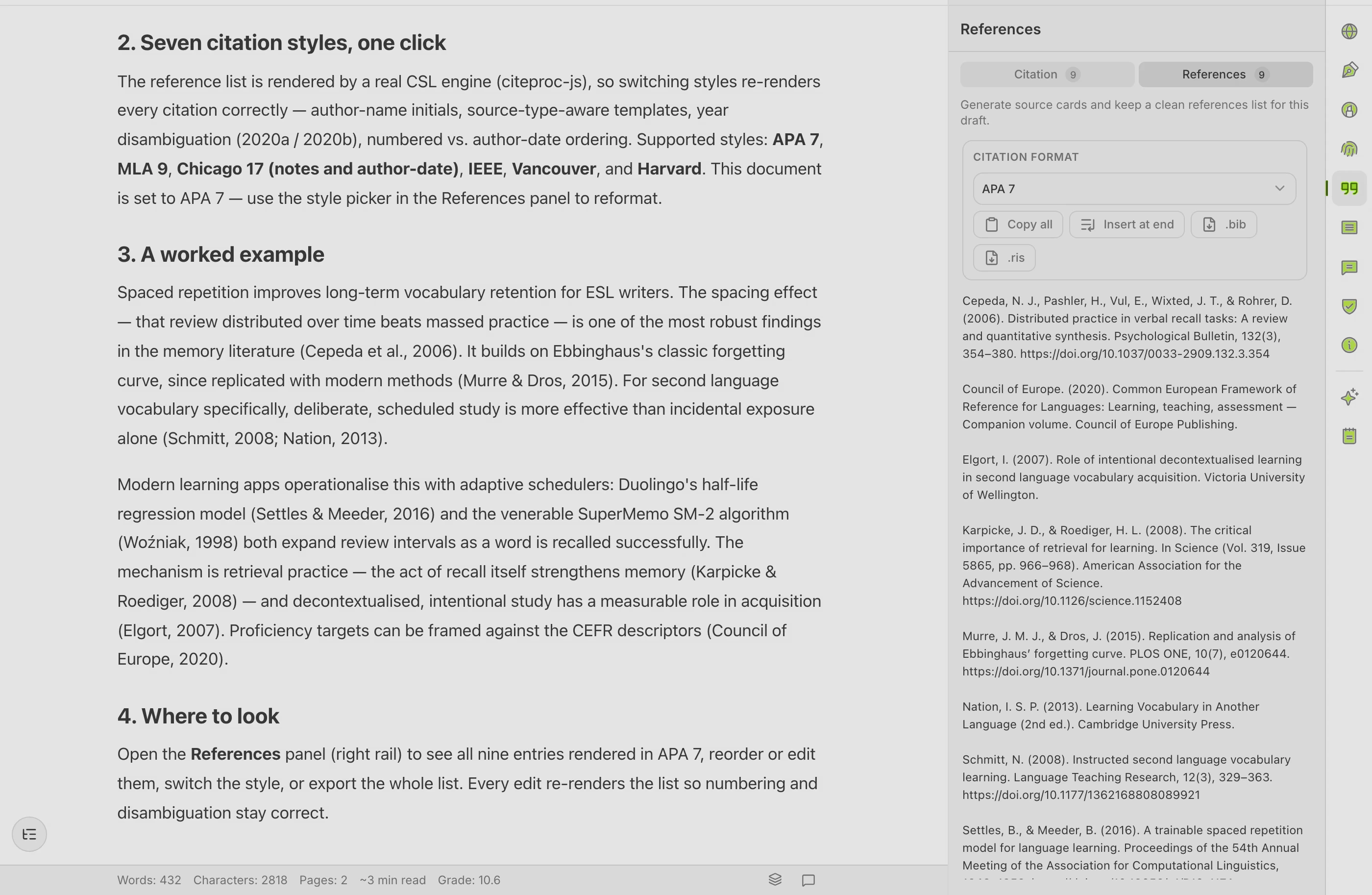
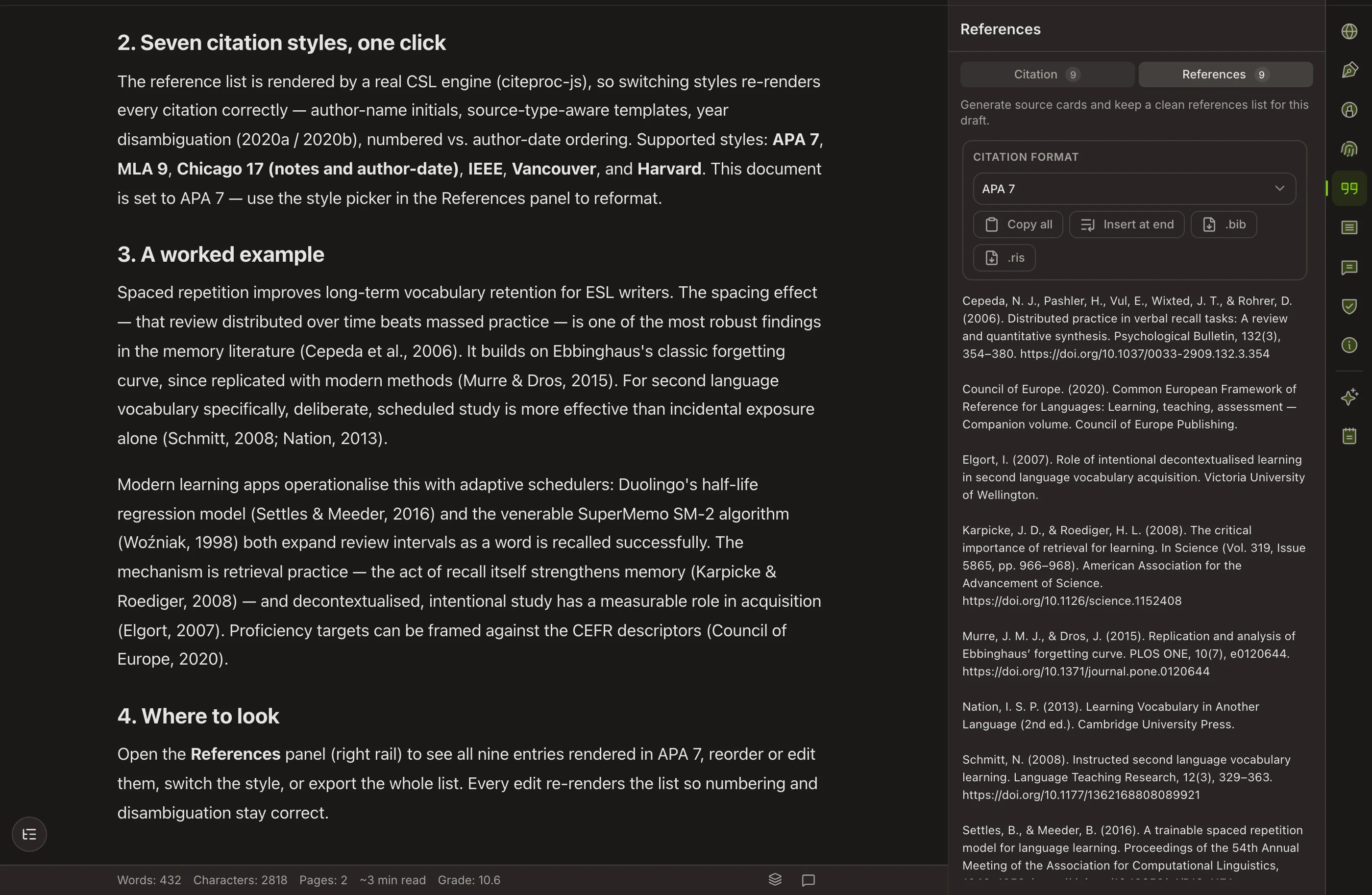
- Draft with Chicago notes attached — Chicago is one of the four supported styles, so footnotes and the bibliography build as you cite instead of being assembled at the end.
- Work the interpretive prose — Edit mode tightens paragraphs where analysis has thinned into narrative, and paraphrase helps restate a historian’s position without lifting their phrasing.
- Proofread and submit — Grammar review and the AI-detector preview, then Word or PDF export for a supervisor or a journal. The Authorship Certificate records how the chapter was written.
CITATION SHORTCUTS
Chicago formats you will need most
Questions from history writers
Does Copyeditor build Chicago footnotes?
Yes. Chicago notes–bibliography is one of the four supported styles, so notes and the bibliography build as you write and rebuild if you switch styles.
How do I cite an unpublished manuscript in an archive?
Give the item description and date, the collection name, box and folder, then the repository and city. Record all of it while you are in the reading room — reconstructing a folder number remotely is rarely possible.
How is a historiographical essay different from a literature review?
A literature review reports what is known. A historiographical essay explains why historians have disagreed, how the interpretations shifted, and what those shifts reveal about the field.
Can Copyeditor paraphrase a primary source for me?
It can help you restate a secondary argument in your own words. Primary sources are usually quoted rather than paraphrased, because their exact wording is the evidence.
Guides worth reading next
Turning a topic into a claim someone could argue with
One arguable sentence that tells the reader what the paper will defend, and why.
From the wide field to your specific question, in about a page
Establish the territory, name the gap, state the question — and stop before it becomes a review.
Restating a source in your own words, properly
Paraphrase by working from your own notes, changing the structure rather than the vocabulary, and checking the result against the source for accuracy.
Giving the reader a map they can follow
Signposting tells a reader where they are, where they are going, and why one paragraph follows another — using relationships, not decorative connectives.
Neighboring fields
Academic writing in political science
The American Political Science Association style manual is built on the Chicago author–date system, with in-text parenthetical citations and a references list. Drafting in Chicago author–date puts you close to compliant before any journal-specific pass.
Academic writing in sociology
Sociology reviews are organized by theoretical position — what a perspective predicts, where it fails, what your work adds. A chronological march through recent papers reads as a coursework summary rather than a contribution.
Academic writing in law
US legal writing uses the Bluebook; the UK and much of the Commonwealth use OSCOLA, and other jurisdictions have their own guides. Copyeditor formats APA, MLA, Chicago, and IEEE only — legal citation stays a manual job, so treat this page as guidance on the writing, not a promise about the footnotes.
Built for the paper
you are actually writing
Structured drafting, citations that build their own reference list, and an Authorship Certificate that records how the document came together. Copyeditor is in beta — apply and we’ll reach out as spots open.