Law
Writing law papers: authority, footnotes, and argument
Bluebook and OSCOLA citation, substantive footnotes, doctrinal structure, and pinpoint references — how legal academic writing works and where it differs.
- Usual citation style
- Chicago 17th edition (notes–bibliography)
- What you will be writing
- Law review and student note articles · Case notes analyzing a single judgment · Doctrinal analyses tracing a rule across authorities · Comparative law essays across jurisdictions · Legal memoranda and problem questions in IRAC form · Policy submissions and consultation responses
FIELD CONVENTIONS
What law expects of a manuscript
Generic writing advice stops here. These are the conventions reviewers in this field actually apply.
- Citation runs on Bluebook or OSCOLA, and neither is formatted here
- US legal writing uses the Bluebook; the UK and much of the Commonwealth use OSCOLA, and other jurisdictions have their own guides. Copyeditor formats APA, MLA, Chicago, and IEEE only — legal citation stays a manual job, so treat this page as guidance on the writing, not a promise about the footnotes.
- Footnotes carry argument, not just references
- A legal footnote often runs several sentences, distinguishing a case, noting a circuit split, or parking a qualification that would derail the paragraph. Reviewers read them closely, and a paper with thin notes reads as underresearched.
- Every proposition is pinpointed to a page or paragraph
- Citing a judgment as a whole is not enough — you point to the page, paragraph, or section that says what you claim. A pinpoint that does not support the sentence in front of it is the single most damaging error in legal writing.
- IRAC governs memoranda; articles are structured by argument
- Issue, Rule, Application, Conclusion is the working structure for memos and problem questions. Law review articles abandon it for a thesis-driven structure with numbered parts, where the roadmap paragraph at the end of the introduction tells the reader exactly what each part will do.
- Statutes and holdings are quoted, not paraphrased
- The exact wording of a provision is the object of analysis, so it is reproduced verbatim with a pinpoint. Paraphrasing a statutory text quietly changes what you are arguing about, which is why it is treated as a substantive error rather than a stylistic one.
- Hedging is weaker than in the sciences
- Legal scholarship asserts what the law is and argues what it should be. “The court erred” and “this reading cannot survive section 12” are normal sentences; a paper padded with “it may perhaps be arguable” reads as evasive rather than careful.
- Tense follows the authority, not the calendar
- What a case holds is written in the present tense — “Donoghue establishes a duty of care” — while what the parties did is past tense. Mixing the two makes it unclear whether you are reporting history or stating the current rule.
THE FRICTION
Where the writing actually slows down
What gets in the way
- Bluebook and OSCOLA formatting done by hand, with no reference manager doing it for you
- Footnote numbering that shifts as text moves between sections
- Word limits on student notes that collide with the volume of authority to cite
- Comparative papers where two jurisdictions demand two different citation conventions in one document
- Verifying that every pinpoint still points at the right paragraph after a redraft
How the workflow runs in Copyeditor
- Structure the argument, then the parts — Plan mode drafts the thesis and the numbered parts, including the roadmap paragraph that tells a reader what each part does.
- Draft the analysis — Ask mode helps with phrasing and transitions between doctrinal steps; Edit mode tightens a section running over a word limit. The reading of the authorities is yours.
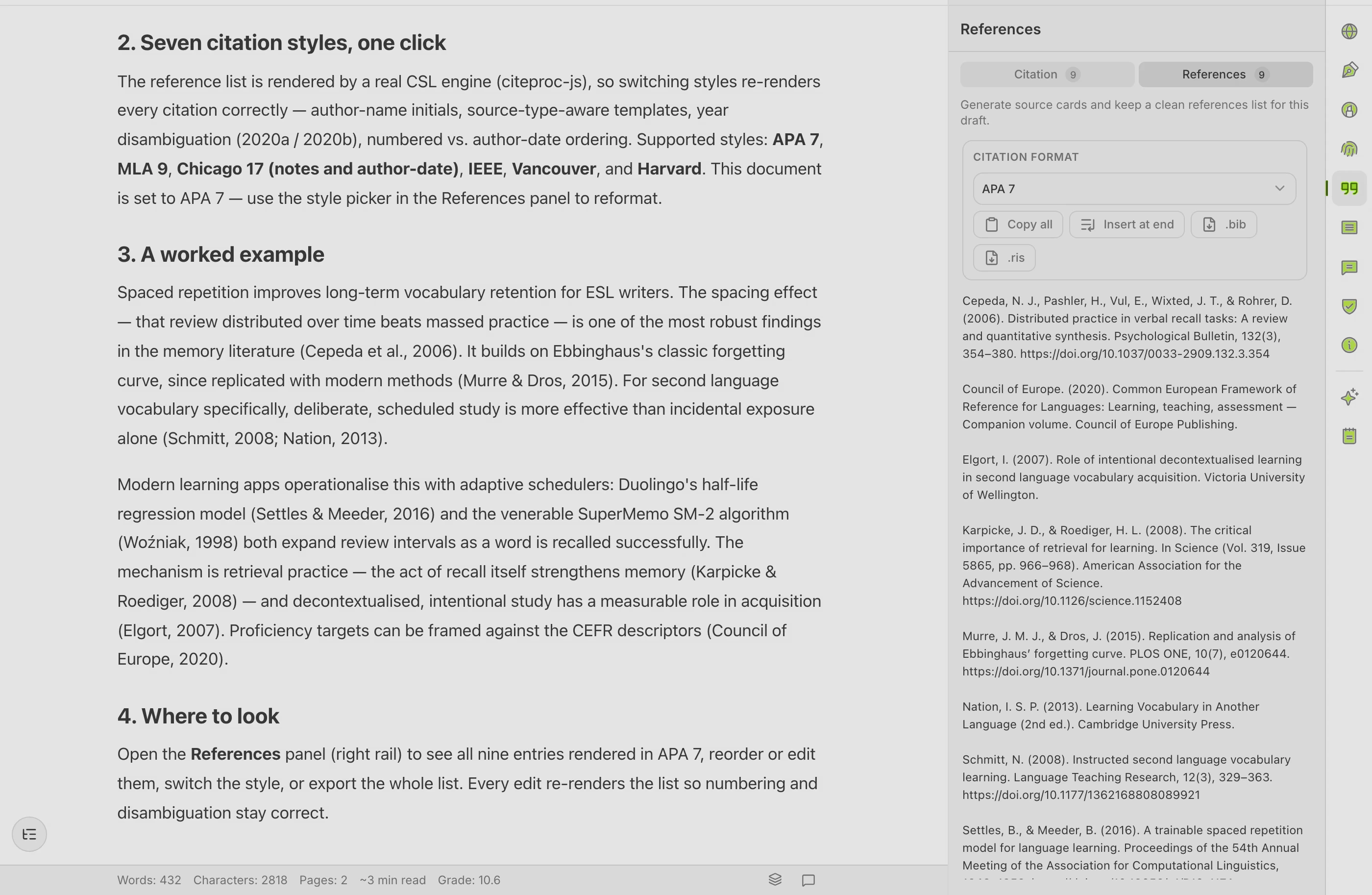
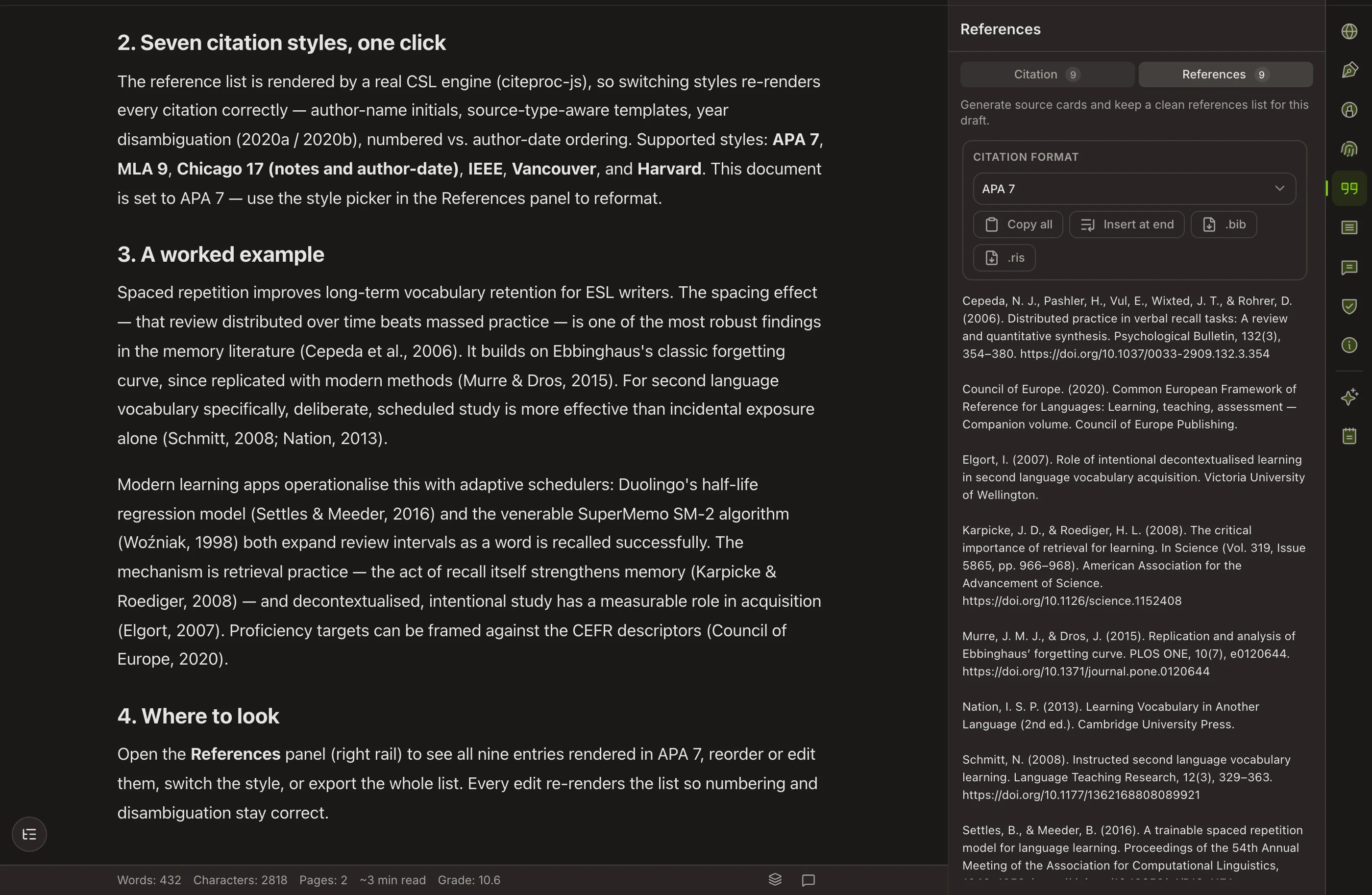
- Handle citation honestly — Bluebook and OSCOLA are not among the styles Copyeditor formats, so plan on building your footnotes manually. Where you cite secondary literature in a supported style, the bibliography builds itself.
- Proofread and submit — Grammar review and the AI-detector preview before you submit to a journal or a supervisor, then Word or PDF export. The Authorship Certificate records how the paper was written.
CITATION SHORTCUTS
Chicago formats you will need most
Questions from law writers
Does Copyeditor generate Bluebook or OSCOLA citations?
No. It formats APA, MLA, Chicago, and IEEE. Legal citation systems are not supported, and building your footnotes remains a manual job — we would rather say that than have the claim fail on your first case citation.
What structure does a case note use?
Facts and procedural history, the holding, the court’s reasoning, then your critique — and the critique is the part that earns the grade. Summary without evaluation is the most common failing.
Should legal writing use passive voice?
Sparingly. Naming the actor matters in law: “the court held” is clearer and more accurate than “it was held.” Passive is defensible when the actor is genuinely unknown or irrelevant.
How much of an article should be footnotes?
In US law reviews, a great deal — notes commonly occupy as much space as the text. Elsewhere the ratio is lower. Follow your target publication rather than a general rule.
Guides worth reading next
Turning a topic into a claim someone could argue with
One arguable sentence that tells the reader what the paper will defend, and why.
Keeping the line between your words and theirs
Avoiding plagiarism is mostly a matter of process: mark every borrowed phrase at the moment you capture it, and cite while drafting rather than afterwards.
Giving the reader a map they can follow
Signposting tells a reader where they are, where they are going, and why one paragraph follows another — using relationships, not decorative connectives.
Closing a paper without writing a second abstract
Answer the opening question, name the contribution, and say what it changes.
Neighboring fields
Academic writing in political science
The American Political Science Association style manual is built on the Chicago author–date system, with in-text parenthetical citations and a references list. Drafting in Chicago author–date puts you close to compliant before any journal-specific pass.
Academic writing in history
Citations go in footnotes, with the full form at first use and a shortened form thereafter, and a separate bibliography at the end. Author–date is rare in history because a note can carry commentary alongside the reference.
Academic writing in business and management
Management journals reject well-executed studies that only confirm what is already known. The introduction has to name the gap in the theory and say what your paper adds to it, which is a different claim from saying your data are new.
Built for the paper
you are actually writing
Structured drafting, citations that build their own reference list, and an Authorship Certificate that records how the document came together. Copyeditor is in beta — apply and we’ll reach out as spots open.