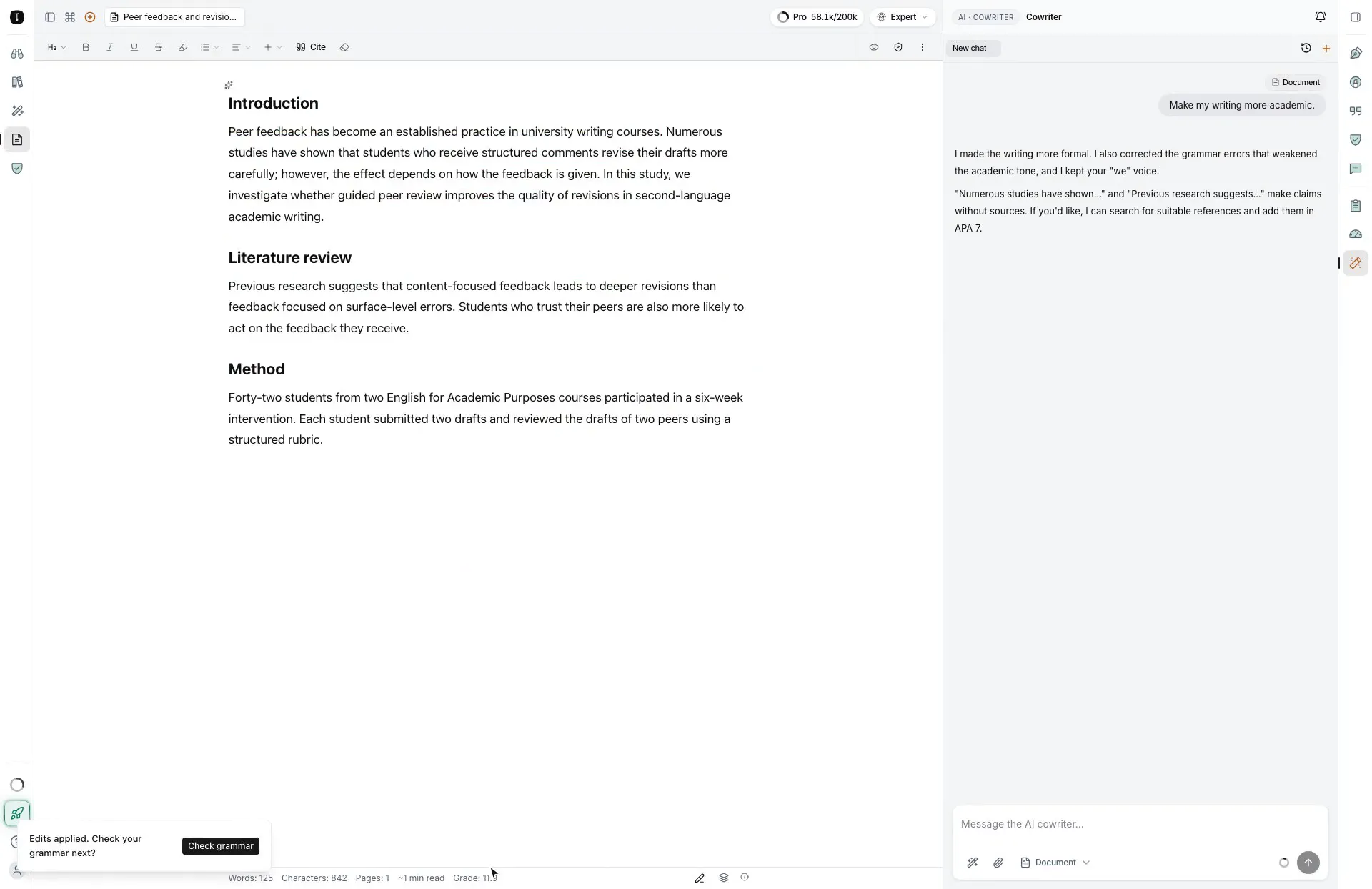
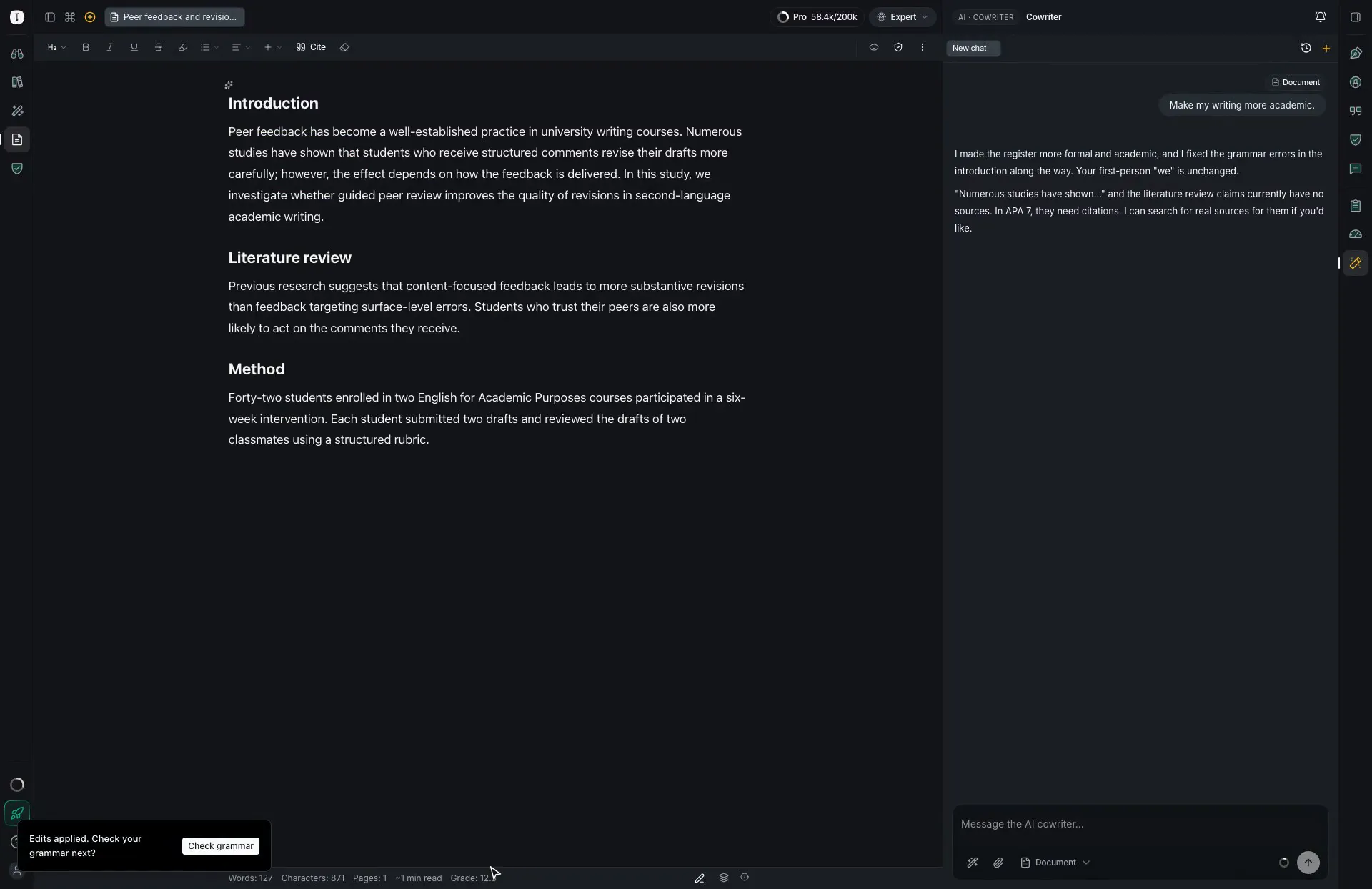
Business and Management
Writing management research: contribution, hypotheses, practice
Theoretical contribution, formal hypotheses, managerial implications, and Harvard referencing — the conventions management writing is assessed against.
- Usual citation style
- Harvard referencing — not one of the styles Copyeditor formats automatically today.
- What you will be writing
- Empirical management journal articles · MBA capstone projects and consulting-style reports · Teaching case studies with instructor notes · Market and industry analyses · Strategy memos with an executive summary · Dissertations in organizational behavior or strategy
FIELD CONVENTIONS
What business and management expects of a manuscript
Generic writing advice stops here. These are the conventions reviewers in this field actually apply.
- The gatekeeping question is “what is the theoretical contribution?”
- Management journals reject well-executed studies that only confirm what is already known. The introduction has to name the gap in the theory and say what your paper adds to it, which is a different claim from saying your data are new.
- Hypotheses are stated formally and numbered
- Quantitative papers develop each hypothesis in prose and then state it in a labeled sentence — H1, H2, H2a — with the direction of the predicted effect. Results and discussion then refer back by number, so a reader can track support hypothesis by hypothesis.
- Practitioner implications are a required, separate section
- Business research answers to managers as well as scholars, so the discussion splits into theoretical and managerial implications. The managerial half names the decision the finding should change, not just the topic it touches.
- The teaching case and the research case are different genres
- A teaching case narrates a decision point, withholds the outcome, and ships with instructor notes. A research case study builds theory from evidence and states its analytical method. Writing one in the shape of the other is a common and costly mistake.
- Reports invert the structure a journal article uses
- A consulting report or strategy memo leads with the recommendation in an executive summary, then supports it. An article builds to its conclusion. Reusing an article’s shape in a report buries the answer past the point where an executive reader stops.
- Harvard referencing dominates outside the US
- Most UK and European business schools require Harvard, though the variants differ by institution — check your school’s guide, since “Harvard” is a family rather than a single manual. Copyeditor formats APA, which is close in shape, but not Harvard itself.
THE FRICTION
Where the writing actually slows down
What gets in the way
- Framing a solid empirical study as a theoretical contribution rather than a description
- Harvard variants that differ between your university guide and your target journal
- Group-written capstone reports where four voices have to sound like one
- Confidential company data that has to be anonymized without gutting the analysis
- Fitting a full analysis into a one-page executive summary
How the workflow runs in Copyeditor
- Frame the contribution before the data — Plan mode structures the introduction around the gap and the claim, and lays out the hypothesis development section in order.
- Draft the two implication sets — Ask mode helps you write theoretical and managerial implications in the different registers each needs, without one collapsing into the other.
- Keep references consistent — Citations and the bibliography build in APA, MLA, Chicago, or IEEE. Harvard is not formatted automatically, so if your school mandates it, budget time for a conversion pass.
- Unify voice, then export — Grammar review and paraphrase help a multi-author report read as one document. Export to Word or PDF, with the Authorship Certificate recording how the draft was produced.
CITATION SHORTCUTS
Harvard formats you will need most
Questions from business and management writers
Is Harvard referencing supported?
Not automatically. Copyeditor formats APA, MLA, Chicago, and IEEE. APA is structurally close to most Harvard variants, so drafting in APA and converting is the practical route.
How long should an executive summary be?
One page for most reports, and it must stand alone — recommendation first, then the reasoning and the main numbers. A reader who stops there should still know what you want them to do.
Can I use company data in a capstone project?
Usually with permission and anonymization. Agree the disclosure boundary with the organization in writing before you draft, so you are not rewriting the analysis after a legal review.
What makes a management paper get desk-rejected?
Most often, no clear theoretical contribution, or a contribution claimed in the abstract that the paper never delivers. Fit with the journal’s conversation is checked before method quality is.
Guides worth reading next
Compressing a whole paper into 250 useful words
Four moves — background, method, result, implication — with the result sentence doing most of the work.
Closing a paper without writing a second abstract
Answer the opening question, name the contribution, and say what it changes.
Building a literature review that argues instead of lists
Organize by theme, say what the sources mean together, and end on the gap your study addresses.
Giving the reader a map they can follow
Signposting tells a reader where they are, where they are going, and why one paragraph follows another — using relationships, not decorative connectives.
Neighboring fields
Academic writing in economics
Economics introductions run four to six pages and tell the reader the question, the data, the identification, the headline estimate, and the contribution — in that order, before any suspense can build. Withholding the finding for effect is read as a sign the finding is weak.
Academic writing in sociology
Sociology reviews are organized by theoretical position — what a perspective predicts, where it fails, what your work adds. A chronological march through recent papers reads as a coursework summary rather than a contribution.
Academic writing in law
US legal writing uses the Bluebook; the UK and much of the Commonwealth use OSCOLA, and other jurisdictions have their own guides. Copyeditor formats APA, MLA, Chicago, and IEEE only — legal citation stays a manual job, so treat this page as guidance on the writing, not a promise about the footnotes.
Free Writing Tools for Business and Management
Word Counter
Counts the words, characters, sentences, and paragraphs in any text you paste, and updates the totals as you edit.
Readability Checker
Computes Flesch Reading Ease and Flesch–Kincaid grade level for your text, along with average sentence length and the sentences that score worst.
Passive Voice Detector
Highlights sentences that appear to use the passive voice and reports the share of your sentences that contain one.
Wordiness Checker
Flags wordy phrases, filler adverbs, and nominalizations in your text and offers a shorter alternative for each one.
Academic Phrase Bank
A searchable list of academic sentence starters, grouped by paper section and by the rhetorical move you are trying to make.
Reference List Sorter
Sorts a pasted reference list into alphabetical order by first author and flags entries that look like duplicates.
Title Case Converter
Converts a title between title case and sentence case following the capitalization rules of APA, MLA, or Chicago.
Abstract Length Checker
Counts your abstract and shows the room left or the overage against the word caps journals most often set.
ChatGPT Words Checker
Flags overused AI buzzwords, repetitive formulaic markers, and stylistic cliches that trigger peer-review suspicion.
Academic Tone Checker
Highlights conversational colloquialisms, contractions, vague idioms, and informal phrasing to ensure rigorous scholarly tone.
Run-On Sentence Checker
Detects comma splices, fused independent clauses, and excessively stacked sentences that obscure academic meaning.
Why Flagged as AI? Analyzer
Explains why authentic research drafts get falsely flagged by Turnitin or GPTZero and highlights low-burstiness sentence patterns.
Thesis Statement Generator
Builds strong, arguable thesis statements across four scholarly formulas based on your topic, claim, evidence, and concessions.
Transition Words Checker
Maps cohesive linking devices across four rhetorical categories to ensure smooth logical transitions between academic arguments.
Academic Hedging Detector
Detects epistemic hedging language and flags over-claiming absolutes to help you strike the ideal scientific balance.
Syllable Counter
Counts syllables across words and sentences, highlighting polysyllabic vocabulary and rhythmic sentence weight.
Words to Pages Calculator
Converts word count to exact page count based on font, line spacing, margins, and academic formatting standards.
Reading & Speech Time Calculator
Estimates silent reading duration and conference presentation speaking time with pacing controls.
Journal Abstract Limit Checker
Validates abstract length and structural requirements against official guidelines of major academic journals.
Built for the paper
you are actually writing
Structured drafting, citations that build their own reference list, and an Authorship Certificate that records how the document came together. Copyeditor is in beta — apply and we’ll reach out as spots open.