Harvard referencing
How to cite a dataset in Harvard referencing
Datasets have versions. Citing one without its version number or DOI makes your analysis impossible for anyone else to reproduce.
THE FORMAT
A dataset in Harvard, at a glance
Creator, A. (Year) Title of dataset (Version 0.0) [Dataset]. Repository. Available at: https://doi.org/… (Accessed: Day Month Year).
Lindqvist, P. and Okonkwo, A. (2022) Delta rice salinity survey, 2015–2021 (Version 2.1) [Dataset]. Calder Data Archive. Available at: https://doi.org/10.7910/DVN/4KQ2XB (Accessed: 3 March 2024).
(Lindqvist and Okonkwo, 2022)
In prose: Lindqvist and Okonkwo (2022) sampled forty-one sites twice a year for six years.
Lindqvist, P. (2019) Awash Basin household water use survey [Dataset]. Calder Data Archive. Available at: https://data.calder.edu/collections/awash-household-survey (Accessed: 3 March 2024).
In text: (Lindqvist, 2019)
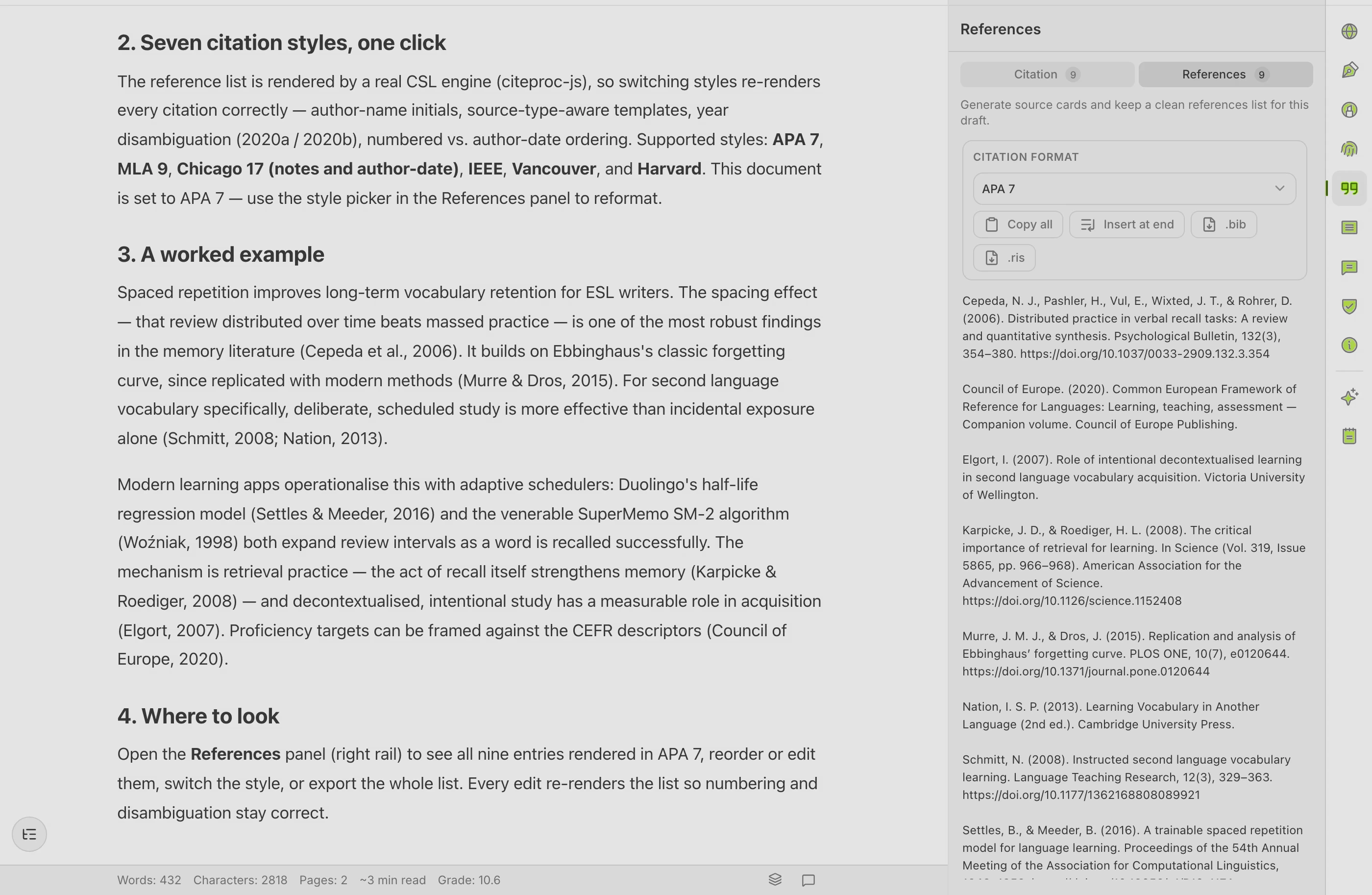
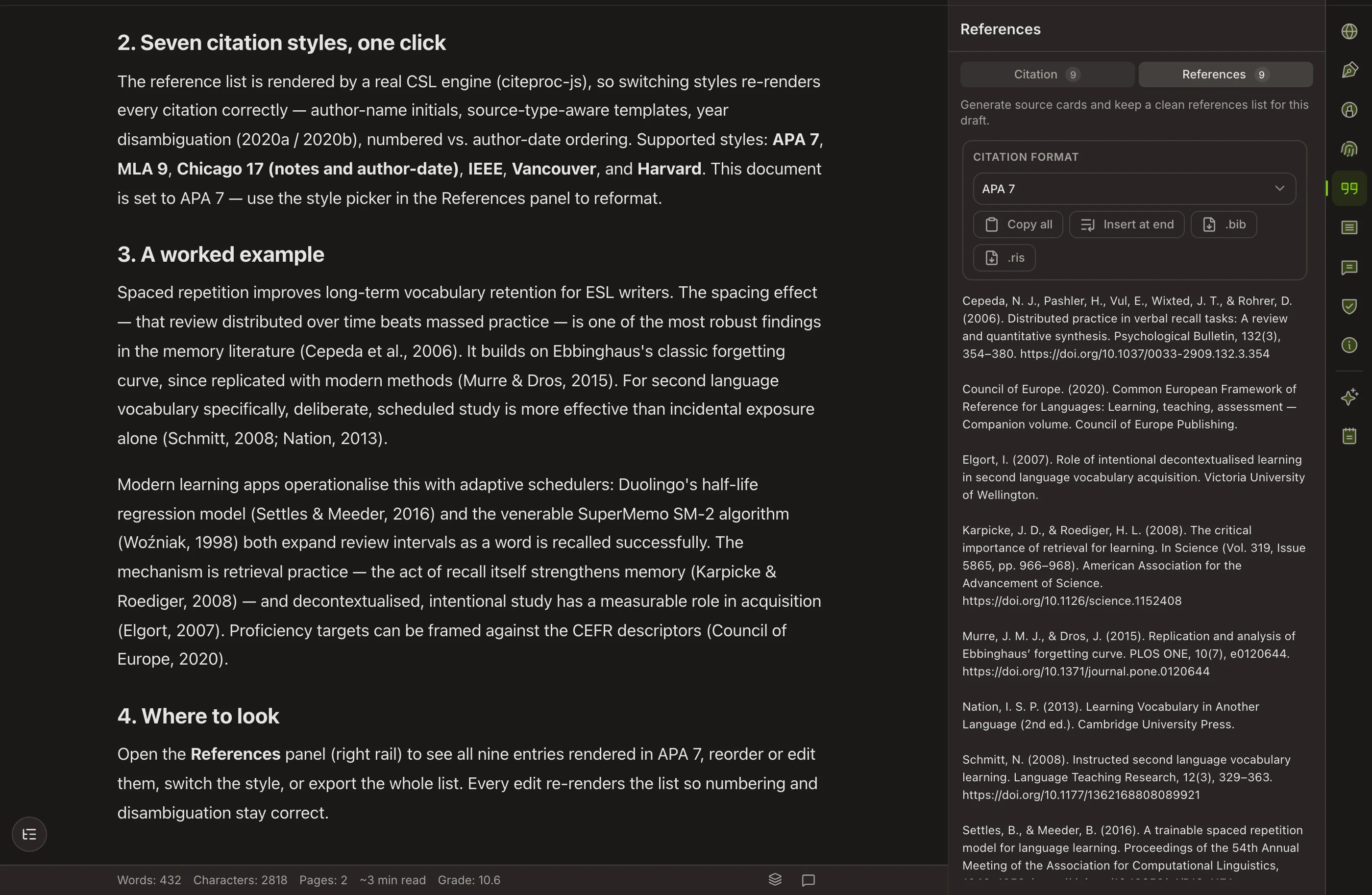
Copyeditor formats APA, MLA, Chicago and IEEE automatically — cite a source once and the reference list builds itself. See how citations work .
BEFORE YOU FORMAT
What Harvard needs from a dataset
Elements to collect
- Creator or creators of the dataset
- Year the version you used was published
- Title of the dataset
- Version number
- Repository that hosts it
- DOI or persistent identifier
- Description of the format, when the style asks for one
Rules specific to this entry
- Few Harvard guides cover datasets explicitly. The conservative approach is the pattern above — creators, year, italic title, version, medium marker, repository, DOI — which borrows the elements every repository already publishes and punctuates them in Harvard form. If your guide is silent, say in a note which convention you followed.
- The version number is the point of the citation. Without it, nobody can tell which snapshot produced your numbers, which is the reason to cite data at all.
- Most Harvard guides use “and” between authors in both the text and the reference list, where APA would use “&” in one place and “and” in the other.
- Repositories publish a recommended citation of their own. Keep its elements and re-punctuate them rather than pasting it in unchanged — a pasted citation is usually APA or a house style, and it will not match the rest of your list.
Building the entry, step by step
Collect the details
Before you format anything, gather every element Harvard needs for a dataset: Creator or creators of the dataset; Year the version you used was published; Title of the dataset; Version number.
Build the reference list entry
Arrange those details in the Harvard order: Creator, A. (Year) Title of dataset (Version 0.0) [Dataset]. Repository. Available at: https://doi.org/… (Accessed: Day Month Year).
Add the in-text citation
In the body of your paper, cite it as (Lindqvist and Okonkwo, 2022) — or work the same reference into your sentence as Lindqvist and Okonkwo (2022) sampled forty-one sites twice a year for six years..
Check it against the exceptions
Few Harvard guides cover datasets explicitly. The conservative approach is the pattern above — creators, year, italic title, version, medium marker, repository, DOI — which borrows the elements every repository already publishes and punctuates them in Harvard form. If your guide is silent, say in a note which convention you followed.
Harvard RULES
The conventions behind every Harvard entry
your institution’s Harvard style guide — Harvard has no single governing manual is the authority. Where a journal or department publishes its own house rules, those win — check your submission guidelines before the reference list is final.
The rules that apply across every source — author order, capitalization, how the reference list is sorted, and where Harvard entries most often go wrong — are collected on the Harvard referencing guide.
The same dataset in another style
Switching styles late in a draft is normal. Here is the same source formatted five other ways.
Questions about Harvard and datasets
What if the dataset has no author?
Move the title into the author position and alphabetize by the first significant word of that title — ignoring an initial “A”, “An” or “The”. In the text, use a shortened form of the title where the author name would go.
What do I need before I can cite a dataset?
Creator or creators of the dataset, Year the version you used was published, Title of the dataset, and the rest of the elements listed above. Datasets have versions. Citing one without its version number or DOI makes your analysis impossible for anyone else to reproduce.
Is there anything unusual about a dataset in Harvard?
Few Harvard guides cover datasets explicitly. The conservative approach is the pattern above — creators, year, italic title, version, medium marker, repository, DOI — which borrows the elements every repository already publishes and punctuates them in Harvard form. If your guide is silent, say in a note which convention you followed.
What else catches people out here?
The version number is the point of the citation. Without it, nobody can tell which snapshot produced your numbers, which is the reason to cite data at all.
Can I reformat this dataset in another style later?
By hand, you would retype the entry — the element order, punctuation and italics all differ between styles. In Copyeditor, sources are stored as structured data, so switching between APA, MLA, Chicago and IEEE reformats every citation and the whole reference list at once.
Cite it once
and never reformat it again
Copyeditor keeps sources as structured data, so switching between APA, MLA, Chicago and IEEE reformats every citation and the whole reference list at once.