Economics
How economics papers are built: identification, tables, and prose
Long introductions that state the result, identification strategy sections, numbered equations, and Chicago author–date — how economics papers are written.
- Usual citation style
- Chicago 17th edition (notes–bibliography)
- What you will be writing
- Empirical papers with an explicit identification strategy · Theory papers built around a formal model · Working papers circulated before journal submission · Policy reports for central banks and agencies · Referee reports on other economists’ manuscripts · Job market papers
FIELD CONVENTIONS
What economics expects of a manuscript
Generic writing advice stops here. These are the conventions reviewers in this field actually apply.
- The introduction gives away the result immediately
- Economics introductions run four to six pages and tell the reader the question, the data, the identification, the headline estimate, and the contribution — in that order, before any suspense can build. Withholding the finding for effect is read as a sign the finding is weak.
- There is usually no standalone literature review
- Related work is folded into the introduction as a short, pointed passage explaining what three or four specific papers did and what yours does differently. A separate chapter-length review is a dissertation convention, not a journal one.
- The identification strategy is the paper
- Empirical work lives or dies on why the variation you exploit can be treated as exogenous. That argument gets its own section, states the assumptions in plain language alongside the notation, and is followed by the tests that would fail if it were wrong.
- Equations are numbered and referenced by number
- Models are set out in displayed, numbered equations with every symbol defined at first use, and the text refers back as “equation (3).” Notation is expected to stay consistent from the model section through the estimating equation.
- Tables carry the results; prose interprets magnitudes
- The main table is often the first thing a reader looks at, so it has to be self-contained — variable definitions, standard errors, clustering, and sample size in the notes. The text explains what a coefficient means in units people care about rather than restating it.
- Robustness lives in the paper; detail lives in the appendix
- A results section is followed by robustness checks that anticipate the referee’s objections, with fuller specifications pushed to an online appendix. Long review cycles mean papers circulate as working papers for years, so the draft has to be readable in isolation.
THE FRICTION
Where the writing actually slows down
What gets in the way
- Writing an introduction that summarizes the entire paper without becoming a second abstract
- Keeping notation consistent between the model and the empirical sections after months of edits
- Table notes that drift out of sync with the specification actually estimated
- Referee reports arriving a year apart, requiring you to rebuild your own argument from memory
- Journal templates that assume LaTeX when your draft lives in a word processor
How the workflow runs in Copyeditor
- Draft the introduction as the paper’s spine — Plan mode structures the introduction around question, data, identification, result, and contribution, so the rest of the paper has something to hang from.
- Write the strategy in plain language — Ask mode helps you state identifying assumptions clearly next to the notation — the part referees read hardest and authors write fastest.
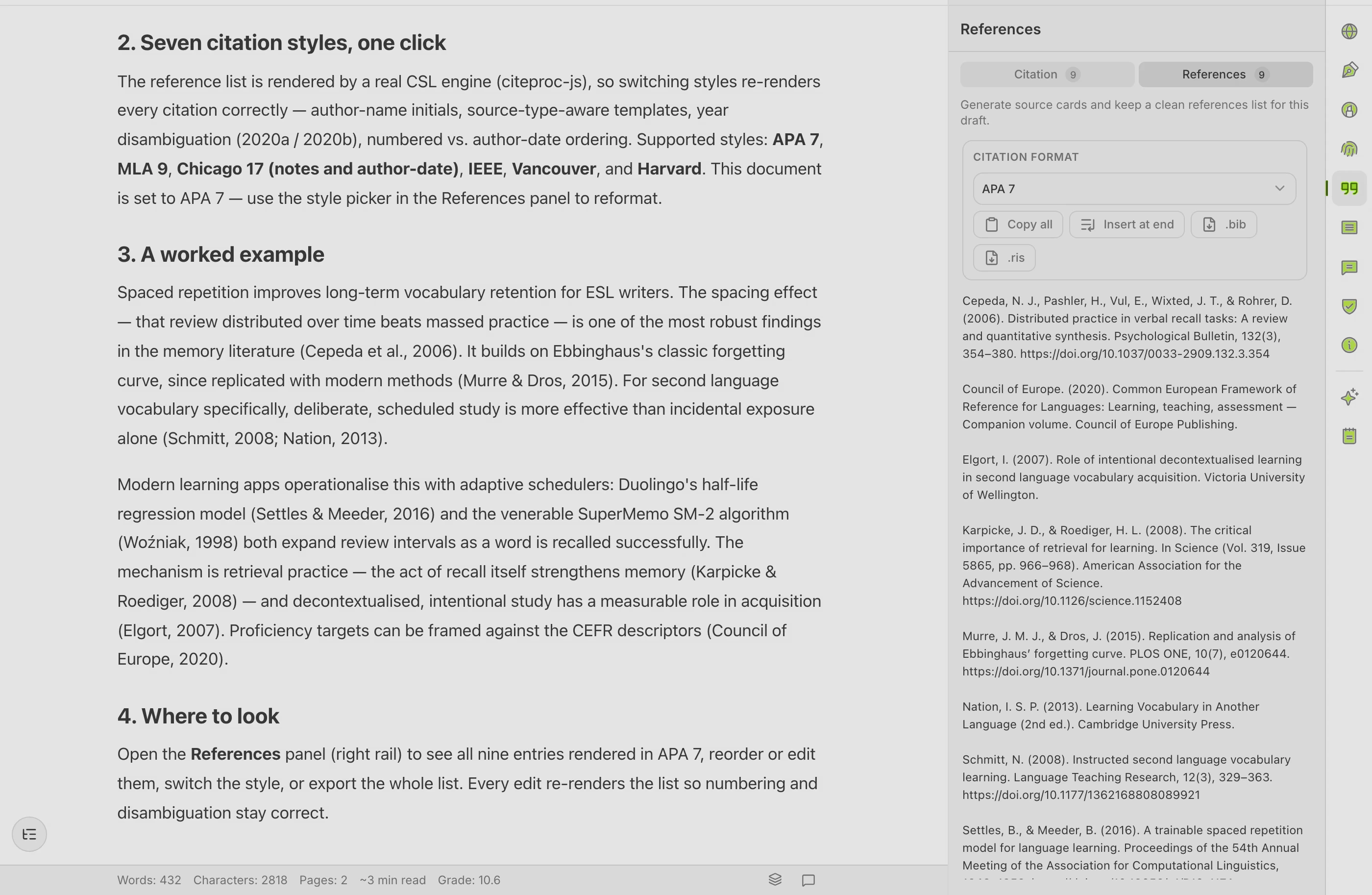
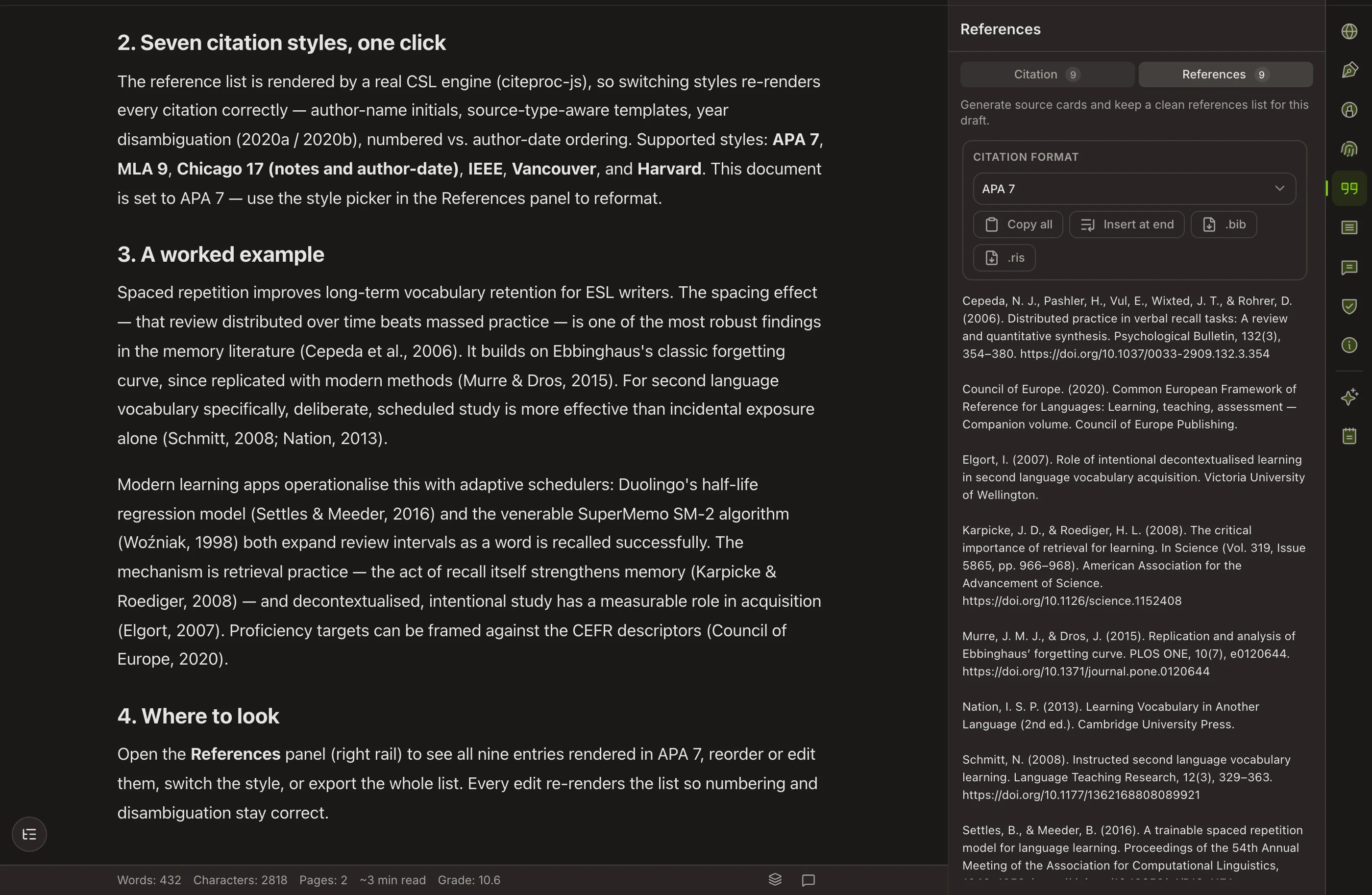
- Cite as you write — Citations and the bibliography build in Chicago author–date, the closest supported system to most economics journals, and rebuild if you switch styles.
- Revise for referees, then export — Edit mode reworks paragraphs a referee flagged; grammar review and the AI-detector preview run before resubmission. Export to Word or PDF — there is no LaTeX export.
CITATION SHORTCUTS
Chicago formats you will need most
Questions from economics writers
Does Copyeditor export to LaTeX or Overleaf?
No. Word and PDF export are what ship today. If your journal requires a LaTeX submission, Copyeditor is a drafting environment rather than a typesetting one.
Which citation style do economics journals use?
Author–date variants close to Chicago dominate, though individual journals impose their own reference formatting. Copyeditor formats Chicago automatically, which gets you most of the way.
How long should an economics introduction be?
Longer than in most fields — four to six pages is normal for a full-length paper, because it carries the literature positioning that other disciplines put in a separate review section.
Can it help with a referee report response?
Yes. Draft point-by-point replies with Plan mode for the structure and Edit mode for tone, so a response reads as considered rather than defensive.
Guides worth reading next
From the wide field to your specific question, in about a page
Establish the territory, name the gap, state the question — and stop before it becomes a review.
Reporting findings so the text and the tables each do their own job
Data in the tables, pattern in the prose, every planned result reported — including the null ones.
Describing your method so another researcher could repeat it
Enough detail to reproduce the study, plus a reason for every design decision you made.
Writing a revision letter that gets your paper accepted
Answer every comment, show where each change landed, and disagree with reasons rather than irritation.
Neighboring fields
Academic writing in business and management
Management journals reject well-executed studies that only confirm what is already known. The introduction has to name the gap in the theory and say what your paper adds to it, which is a different claim from saying your data are new.
Academic writing in political science
The American Political Science Association style manual is built on the Chicago author–date system, with in-text parenthetical citations and a references list. Drafting in Chicago author–date puts you close to compliant before any journal-specific pass.
Academic writing in computer science
Top computer science conferences are peer-reviewed with acceptance decisions that count for careers, and journals often come second. This shapes the writing: a fixed deadline, a fixed page count, and a paper that must be self-contained because there is no revise-and-resubmit in most cycles.
Built for the paper
you are actually writing
Structured drafting, citations that build their own reference list, and an Authorship Certificate that records how the document came together. Copyeditor is in beta — apply and we’ll reach out as spots open.