Roundup
Paraphrasing tools that hold up in academic writing
Paraphrasing in academic writing is not word substitution — it is restating someone else’s finding in your own terms while keeping the meaning and the citation intact. Tools vary enormously in how well they respect that, and a rewriter that changes your terminology can quietly change your claim. Disclosure: we build Copyeditor; it is listed third, not first.
HOW THESE WERE JUDGED
The criteria, stated up front
- Does it preserve technical terminology instead of swapping it for a looser synonym?
- Does the rewritten sentence still support the citation attached to it?
- How much control do you have over how far the text moves from the original?
- Can you use it on a paragraph in context, or only on pasted fragments?
- Is there a free way to test it on your own writing first?
Copyeditor publishes this list and also appears on it. We rank ourselves where we genuinely land rather than at the top of every category, and we say plainly when another tool is the better answer. Verify current features and pricing on each vendor’s own site.
7 TOOLS
The list
1. Best for Everyday rewriting, with control over how far the text moves
QuillBot
Still the benchmark for paraphrasing as a task. Several rewrite modes plus a synonym control mean you decide whether you want a light touch or a full restatement, and the free tier is enough to judge it on your own writing. Check the output against your field’s terminology — that is where any paraphraser is weakest.
- Rewrite modes and a synonym control give you genuine command over the result
- Free tier does real work without a card
- Browser extension and Word add-in mean it goes where you write
- Rewriting is the whole product — the surrounding paper is still your problem
- Field-specific terminology needs checking after every pass
2. Best for Rewriting where you can explain what you want changed
ChatGPT
A general assistant paraphrases well when you tell it what to preserve — the hedging, the technical terms, the tense of a methods section. That instruction-following is a real advantage over a fixed set of modes. The cost is that it works on pasted text, so your citation context does not travel with it.
- You can specify constraints — keep the terminology, keep the hedging, tighten by a third
- Handles a full paragraph in context, not just a sentence
- Free tier available
- Nothing carries the citation across, so attribution is on you
- Results vary with how carefully you phrase the request
3. Best for Paraphrasing inside the draft, with the citation still attached
Copyeditor
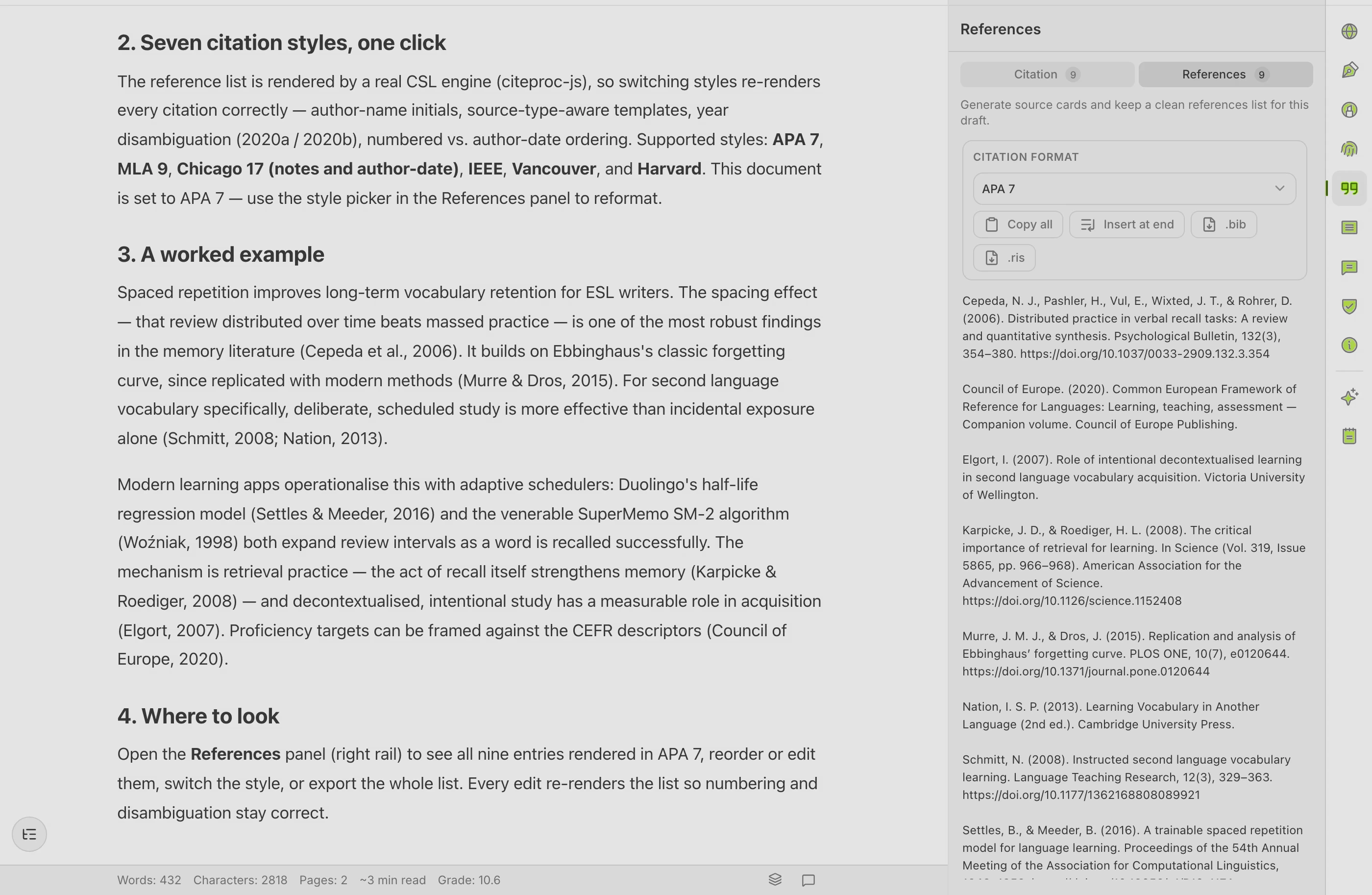
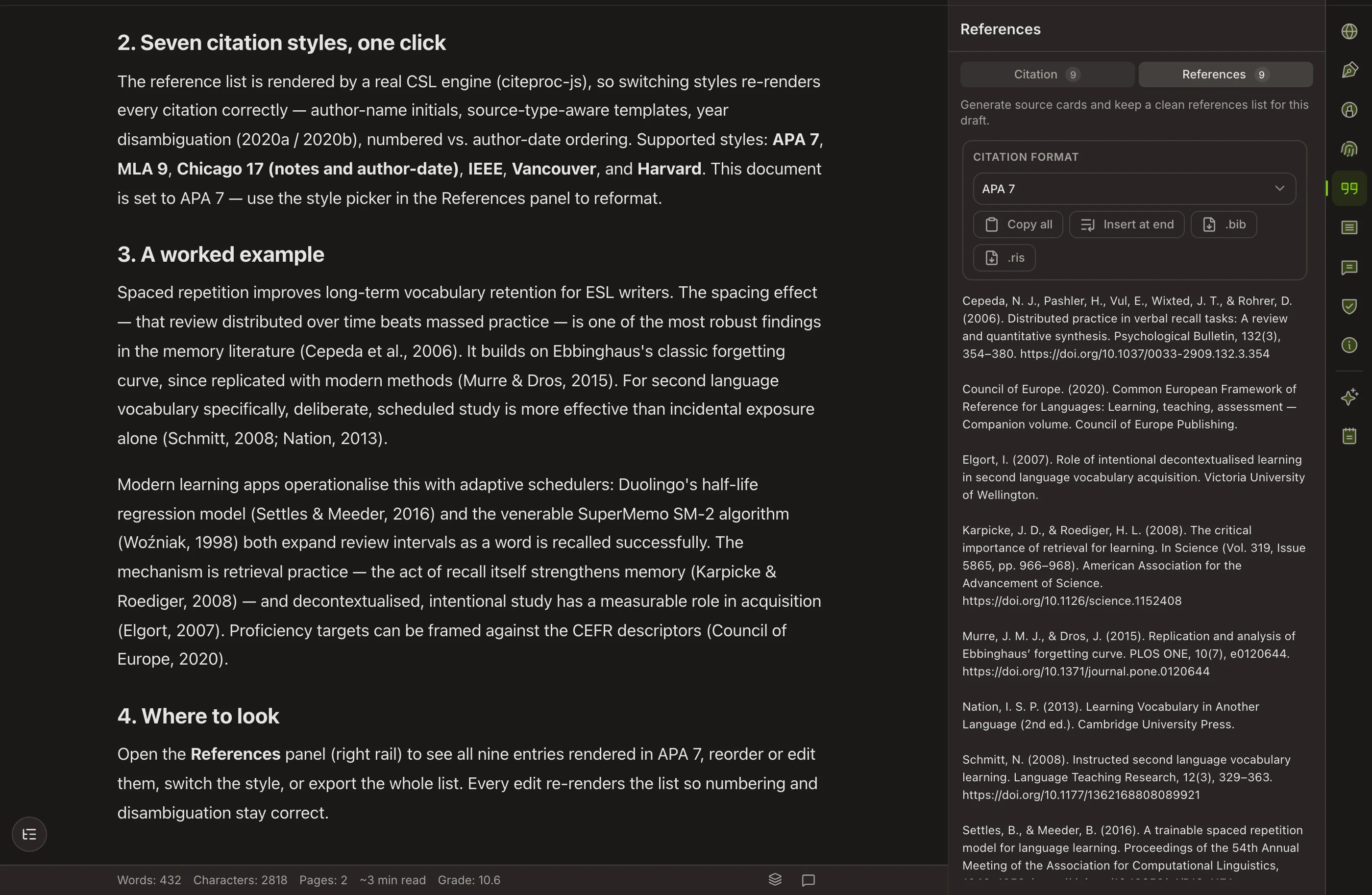
The paraphrase targets academic register and runs on the passage where it sits, so the source you cited stays attached to the sentence you just rewrote. That is a narrower offering than a standalone paraphraser and a more useful one in a paper. It is in closed beta, so you cannot try it this minute.
- Rewrites in place, with the citation and reference list intact
- Grammar review and drafting in the same document, so there is no round trip
- Closed beta — not available on demand
- Not a standalone paraphrasing utility for pasted text from elsewhere
4. Best for Rewriting toward journal-ready academic language
Paperpal
Rewriting suggestions come from a tool built around research manuscripts, which shows in how it treats register and convention. If the goal is prose a journal editor will not stumble over, that focus is worth more than a longer feature list.
- Suggestions shaped by academic and journal conventions
- Sits alongside the rest of a submission-oriented toolkit
- Less flexible than a dedicated paraphraser when you want an aggressive rewrite
5. Best for Rewriting technical and scientific sentences
Trinka
Trinka’s value in this list comes from what it will leave alone. A tool built on academic and technical writing is less likely to simplify the precise term your discipline requires. Rewriting is one part of a product mostly aimed at correction and submission readiness.
- Tuned to academic and technical register across many subject areas
- Pairs rewriting with consistency and submission-readiness checks
- Free tier to test on your own text
- Paraphrasing is a secondary feature rather than the center of the product
6. Best for A free paraphraser from a source students already trust
Scribbr
Scribbr’s free tools are widely used for a reason: they work, they are free, and they sit next to citation generators and clear writing guidance. For occasional rewriting it may be all you need, and the surrounding explanations are unusually good.
- Free and immediately usable
- Sits beside citation generators and well-written academic guidance
- Built for the occasional rewrite rather than sustained manuscript work
7. Best for A free first pass before deciding whether to pay a human
Wordvice AI
The free AI tools are a light way to test the water with a company whose real strength is human editing. If the automated pass leaves you unsure about an important manuscript, you are already in the right place to commission an editor.
- Free tools with no commitment
- A direct route to human editing when automation is not enough
- The substantial offering is the paid human service, not the free rewriter
Questions about this category
Is using a paraphrasing tool plagiarism?
Running someone else’s text through a rewriter and presenting it as yours is plagiarism regardless of the tool. Paraphrasing legitimately means restating an idea in your own words with the source cited. The tool does not change that distinction; only the citation does.
Will a paraphrasing tool help me pass an AI detector?
Do not plan around that. Detection tools change constantly, results are probabilistic, and institutions treat deliberate evasion as an integrity matter in its own right. Write the work, cite the sources, and be able to describe your process.
Why does paraphrasing keep breaking my technical terms?
General rewriters optimize for different wording, and a discipline-specific term looks to them like a synonym opportunity. Tools trained on academic and technical writing are more conservative here, but you still have to read the output.
Do I still need to cite a paraphrased source?
Yes. Paraphrasing changes the wording, not the ownership of the idea. Every restated finding keeps its citation.
Are these rankings stable?
No — features and plans change on every one of these products. Confirm what is included on each vendor’s own site before you subscribe.
Related roundups
The AI writing tools worth using on an academic paper
Almost every tool in this category claims to be built for academic writing, and most of them are general writing tools with a citation feature attached.
Grammar checkers that understand academic writing
Academic prose breaks the rules that general grammar checkers enforce: the passive voice is often correct, hedging is not weak writing, and the long sentence is carrying a qualified claim.
Writing tools that help when English is not your first language
When you write research in a second language, the problem is rarely grammar you could look up — it is register: which phrasing sounds like a published paper in your field, how strongly to state a finding, when a hedge is expected.
Fewer tools
one document
Copyeditor puts drafting, citations, paraphrase and export in one place, with a verifiable record of how the paper was written. In beta — apply and we’ll reach out as spots open.