Comparison
Trinka or Copyeditor: correcting a draft against writing one
Trinka is a grammar and language-correction tool built specifically for academic and technical writing, rather than a general-purpose writing assistant pointed at papers.
SIDE BY SIDE
Feature by feature
Where the other tool is stronger, the table says so. Verify anything decision-critical on both vendors’ own sites — features move on both sides.
| Feature | Copyeditor | Trinka |
|---|---|---|
| Academic grammar and register | Grammar review with academic paraphrase | Subject-aware corrections built for research writing |
| Structured drafting | Ask, Edit and Plan modes | Not a drafting tool |
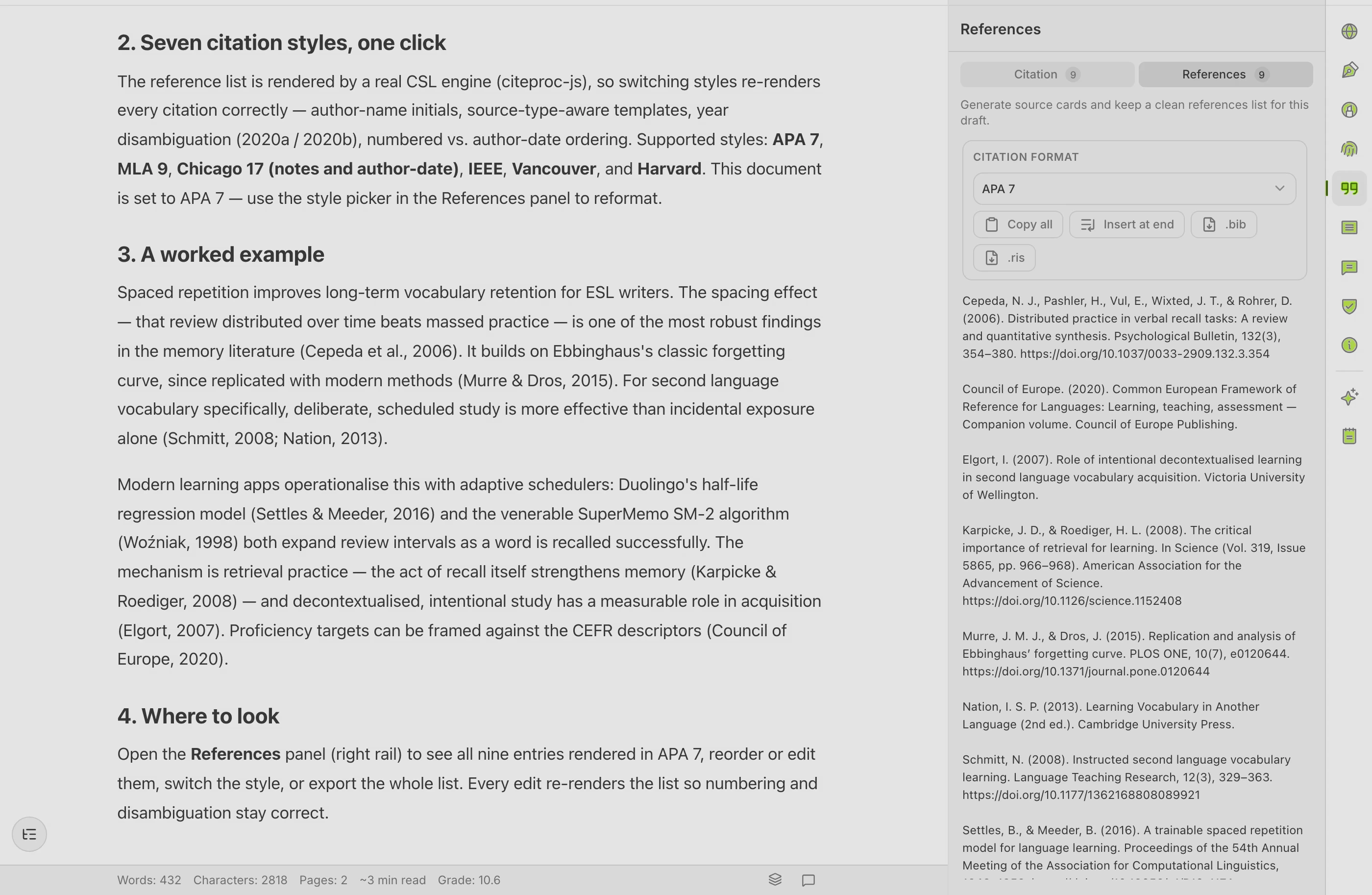
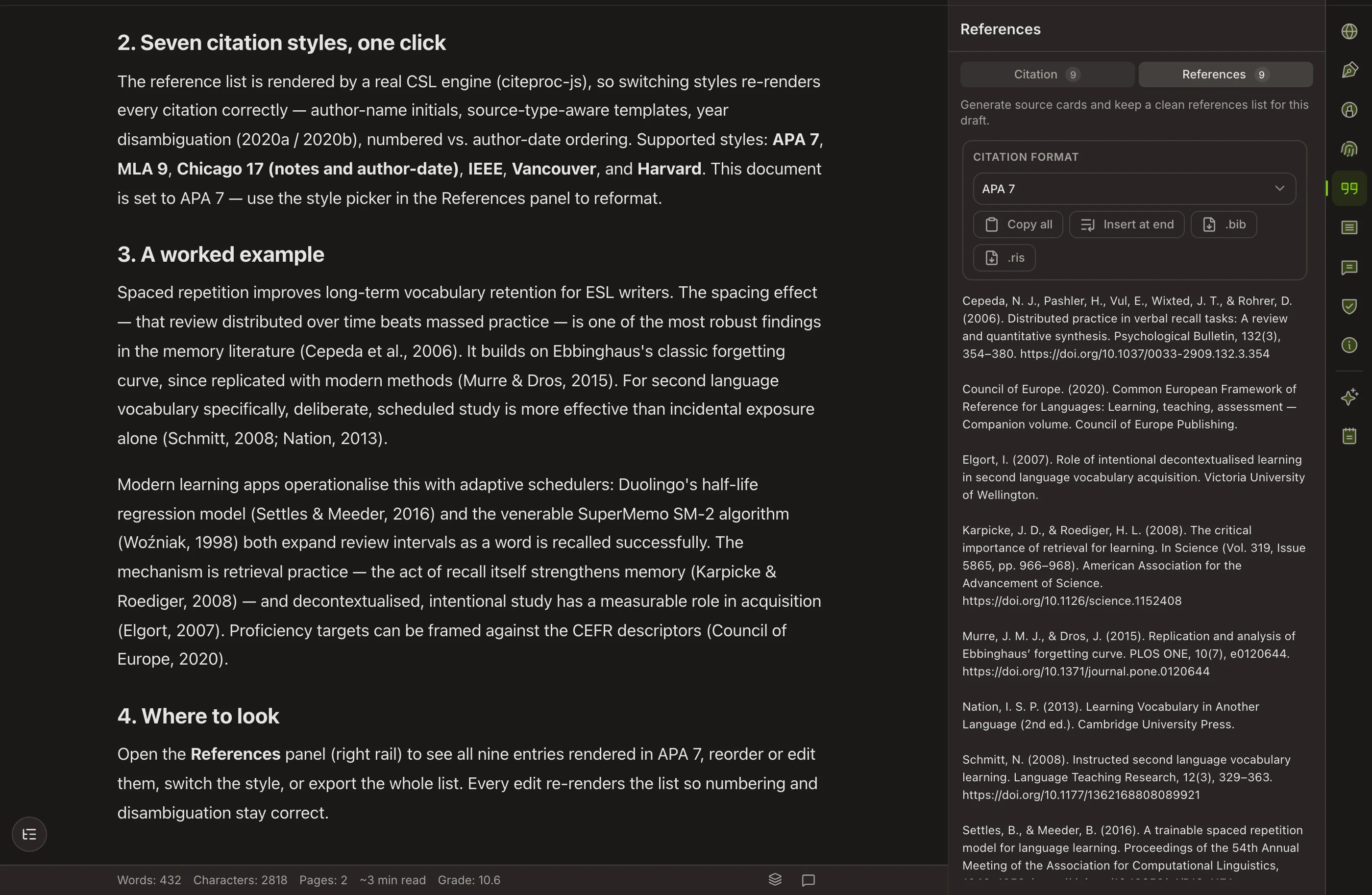
| Citations and bibliography | Self-building — APA, MLA, Chicago, IEEE | Not a bibliography builder |
| Journal submission checks | No submission-readiness report | Yes — a core part of the product |
| Consistency and style checks | Grammar review only | Yes, across a manuscript |
| Works inside Word | Export to Word and PDF | Word add-in |
| Free tier | Closed beta — no public free tier yet | Free tier available |
| AI-detector view | Preview only — not a database check | Check current tooling on their site |
| Record of authorship | Authorship Certificate anyone can verify | No equivalent |
AN HONEST READ
What Trinka does well, and where it stops
Trinka is genuinely good at
- The corrections are tuned to academic and technical register across a wide range of subject areas, so it flags things a general checker leaves alone — hedging, tense in a methods section, technical phrasing.
- It goes past grammar into the mechanics editors care about: consistency, style conventions, and submission-readiness checks aimed at journal manuscripts.
- The Word add-in and browser tooling let you work where your manuscript already lives.
- A free tier lets you test it on your own text before committing, which matters for a tool whose value depends on your field.
- It is built by a team working in the research-publishing world, and the feature choices show it.
Where it leaves an academic writer short
- It improves text that exists — it does not help you decide what the section should say or produce a first draft.
- It does not build and format a reference list for you, so citations remain a separate job.
- There is no record of how the document was written, only of what it now says.
- Because it works on finished prose, the copy-paste loop between draft, checker and reference tool remains.
WHICH ONE
Pick the right tool for your case
Choose Trinka when
- You have a finished manuscript and the remaining work is language. Trinka is built for exactly that moment and does it well.
- You are preparing a journal submission and want consistency and readiness checks against the conventions of research publishing.
- You write in Word with co-authors and need corrections to land in the file everyone is already editing.
- Your field uses technical phrasing that general-purpose checkers keep trying to simplify.
Choose Copyeditor when
- The hard part is not the grammar — it is getting a defensible structure and a first draft onto the page.
- You want citations and the reference list handled in the same document as the prose.
- You want to be able to show how the piece was written, not only how it reads.
- You would rather work in one place than move a file between a drafting tool, a checker and a citation generator.
Trinka offers a free tier plus paid plans billed monthly or annually, with add-ons for some publishing-oriented checks and separate institutional licensing. Copyeditor is one subscription for the workspace and is in closed beta. Confirm current plans on trinka.ai — both products change what is included.
Questions about Trinka and Copyeditor
Is Trinka better than a general grammar checker for research writing?
For academic manuscripts, a checker built on research writing will usually make suggestions that fit the register better than a general one. Whether that difference is worth a subscription depends on how much finished prose you produce.
Can Copyeditor replace Trinka?
Not for submission-readiness work. Copyeditor reviews grammar and rewrites for academic register inside the draft, but it does not produce the manuscript consistency and readiness reports Trinka is built around.
Do I need both?
Some people will want both: draft and cite in Copyeditor, then run the finished manuscript through Trinka before submission. That is a reasonable workflow and we would rather say so than pretend otherwise.
Does Trinka handle references?
It is a language tool, not a reference manager. If your reference list is the pain point, a manager like Zotero or EndNote — or a drafting tool that builds the bibliography as you cite — is the thing to look at.
How reliable is this comparison?
It reflects what both tools do at the time of writing. Features move on both sides, so check trinka.ai for the current feature list before making a decision on it.
Other comparisons
Copyeditor vs Writefull
Writefull is a language-feedback tool whose suggestions are grounded in how published research papers are actually written, delivered inside the tools researchers already use.
Copyeditor vs Wordvice
Wordvice is primarily a human editing and proofreading service for academic and admissions documents, with a set of free AI writing tools alongside it.
Copyeditor vs QuillBot
QuillBot is a paraphrasing-first writing suite that has grown outward into grammar checking, summarizing, translation and a citation generator.
One document
instead of six tabs
Structured drafting, citations that build their own bibliography, and a signed record of how the paper was written. Copyeditor is in beta — apply and we’ll reach out as spots open.