Comparison
ChatGPT or Copyeditor for academic writing?
ChatGPT is a general-purpose AI assistant that happens to be very good at writing, and for most researchers it is already the default first stop.
SIDE BY SIDE
Feature by feature
Where the other tool is stronger, the table says so. Verify anything decision-critical on both vendors’ own sites — features move on both sides.
| Feature | Copyeditor | ChatGPT |
|---|---|---|
| Range beyond writing | Academic writing only | Code, data, translation, analysis, images |
| Writing in a real document | Yes — the draft is the workspace | Chat, then copy into your document |
| Structured drafting | Ask, Edit and Plan modes over the draft | As good as your prompting |
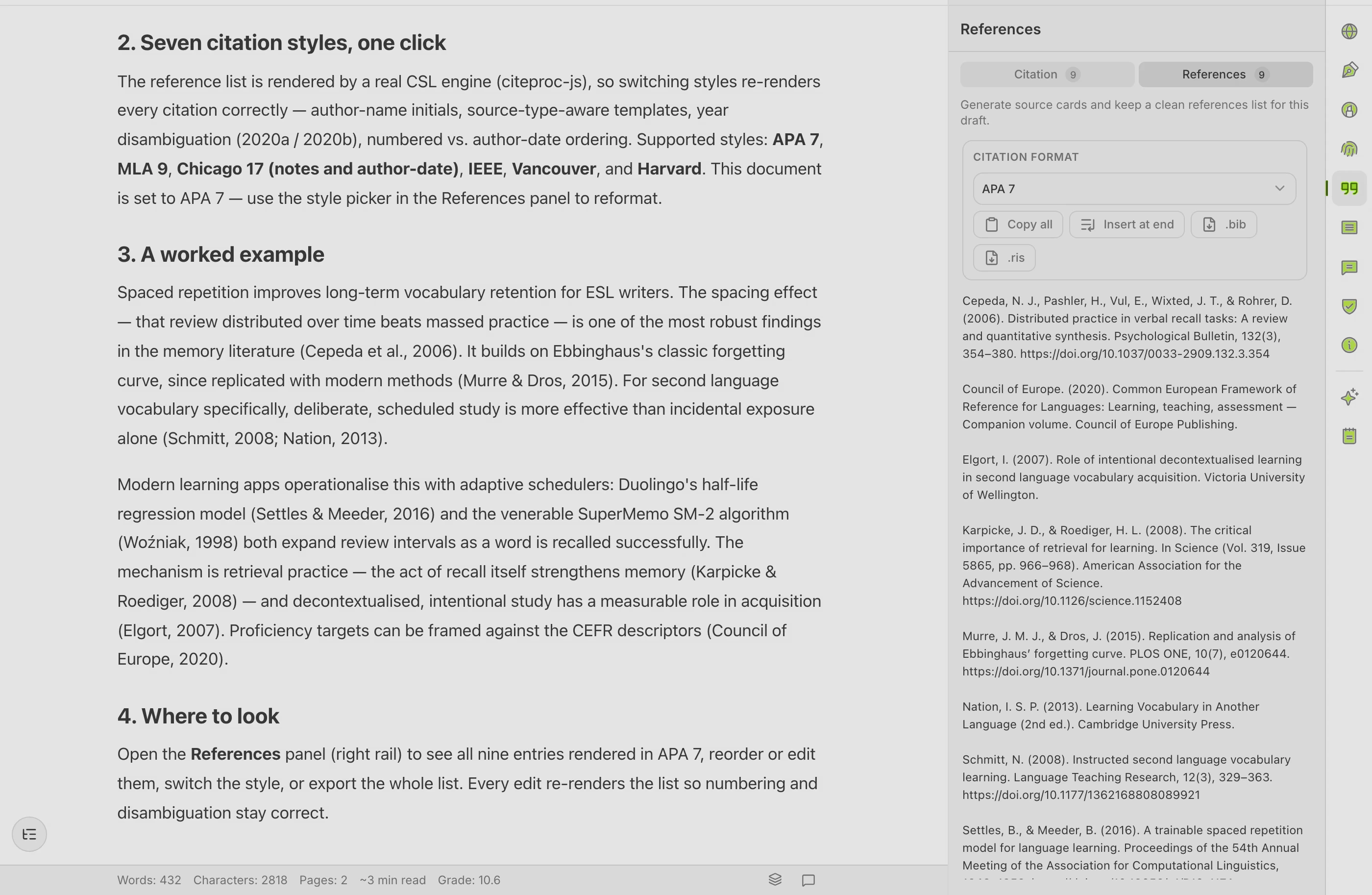
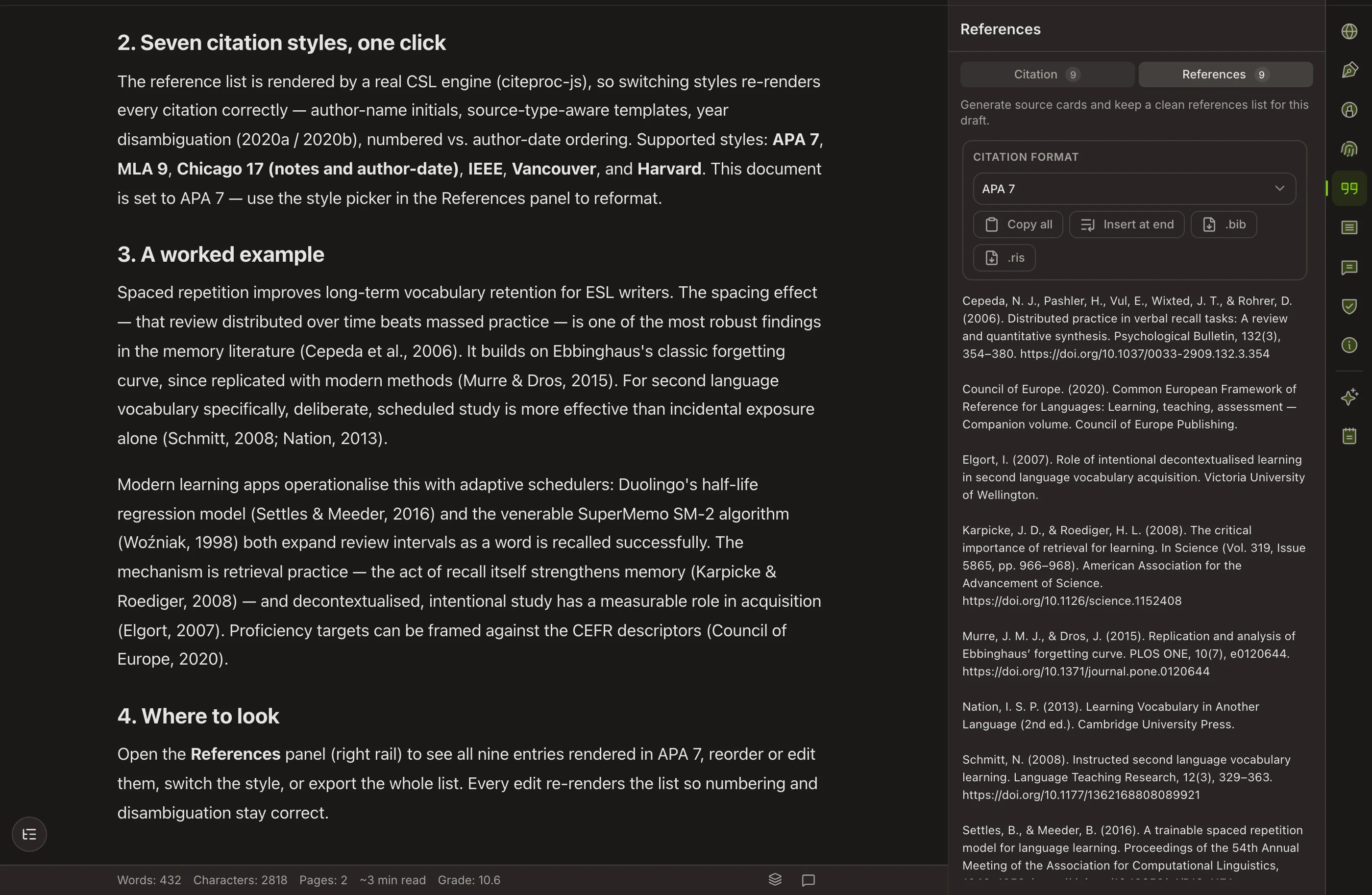
| Citations and bibliography | Self-building — APA, MLA, Chicago, IEEE | Generated text you must verify yourself |
| Adding sources | By DOI, URL, BibTeX or RIS | Paste or upload; no reference list is maintained |
| Reference reliability | Built from the record you added | Verify every citation before you trust it |
| Export | Word and PDF | Copy out and format yourself |
| Cost of a free option | Closed beta — no public free tier yet | Usable free tier |
| AI-detector view | Preview only — not a database check | No |
| Record of authorship | Authorship Certificate anyone can verify | No equivalent |
AN HONEST READ
What ChatGPT does well, and where it stops
ChatGPT is genuinely good at
- Range. In one thread you can brainstorm a research question, argue with your own framing, rewrite a paragraph, debug an R script and translate an abstract.
- Speed and availability — it is open in a tab already, it costs nothing to ask, and there is no workflow to set up.
- It is genuinely good at hard thinking: pressure-testing an argument, spotting a weak inference, suggesting a counter-example your reviewer will raise.
- File upload lets you paste in a paper, a dataset or a draft and work over it directly.
- One subscription covers work far outside writing, which is hard for a specialized tool to match on value.
Where it leaves an academic writer short
- It is a chat window, not a document. The paper still lives somewhere else, and you spend real time moving text between the two.
- References must be verified one by one — invented or subtly wrong citations are a known failure mode, and a plausible-looking DOI is not evidence.
- There is no bibliography attached to your paper, so style changes mean redoing the formatting work by hand.
- Nothing records how the document was written, which is awkward precisely when a reader suspects AI involvement.
- Formatting and export are your problem — what comes out of a chat is not a submission-ready document.
WHICH ONE
Pick the right tool for your case
Choose ChatGPT when
- Your needs run well past writing — analysis, code, translation, teaching material — and you want one subscription that covers all of it.
- You are thinking rather than drafting. For interrogating an idea before you commit to it, a general assistant is hard to beat.
- The task is a one-off and odd. General tools handle unusual requests that a specialized product has never been shaped for.
- You want something free right now, and Copyeditor is in closed beta.
Choose Copyeditor when
- The output is a paper with a reference list, and you are tired of rebuilding the bibliography by hand.
- You want every source to trace back to a record you added by DOI, URL, BibTeX or RIS rather than to a generated string.
- You want to stop shuttling paragraphs between a chat window and a document.
- You want a verifiable account of how the draft was written, which a chat transcript does not give you.
ChatGPT has a free tier plus paid consumer and team plans, and the boundary between them moves frequently. Copyeditor is one subscription for the workspace and is in closed beta. Check openai.com for current plans rather than relying on any figure quoted elsewhere, including here.
Questions about ChatGPT and Copyeditor
Can I just use ChatGPT for my whole paper?
Many people do, and it works up to a point. The friction shows up in the assembly: verifying citations, keeping a reference list consistent, formatting for submission and being able to account for your process later.
Why do AI tools invent citations?
A language model produces text that looks like a citation, which is not the same as retrieving one. That is why it matters whether a reference came from a record you added — a DOI, a BibTeX entry — or from generated prose. Verify either way.
Is using ChatGPT for academic writing allowed?
It depends on your institution and, for publication, on the journal. Many now permit assistance with disclosure. Read the policy that applies to you, and keep a record of what you did — that is the practical protection.
Does Copyeditor use the same underlying models?
Copyeditor is built on large language models, like most tools in this category. The difference is not the model — it is that the model is working inside a document with your sources attached and a record of what changed.
Should I keep both?
Probably. A general assistant for thinking and for everything that is not the paper, a writing workspace for the paper itself. Verify current capabilities on both sides — this space changes month to month.
Other comparisons
Copyeditor vs Jenni AI
Jenni AI is an AI writing assistant aimed squarely at academic drafting, best known for inline autocomplete that continues your sentence and can attach a citation as it does.
Copyeditor vs SciSpace
SciSpace is a literature discovery and paper-reading assistant — search across research papers, ask questions about a PDF, and pull findings out of many papers at once.
Copyeditor vs Turnitin
Turnitin is an institutional academic-integrity platform bought by universities and schools, not by students — an adjacent system rather than a competitor, and Copyeditor is not an alternative to it.
One document
instead of six tabs
Structured drafting, citations that build their own bibliography, and a signed record of how the paper was written. Copyeditor is in beta — apply and we’ll reach out as spots open.