Comparison
SciSpace or Copyeditor: reading the literature against writing the paper
SciSpace is a literature discovery and paper-reading assistant — search across research papers, ask questions about a PDF, and pull findings out of many papers at once.
SIDE BY SIDE
Feature by feature
Where the other tool is stronger, the table says so. Verify anything decision-critical on both vendors’ own sites — features move on both sides.
| Feature | Copyeditor | SciSpace |
|---|---|---|
| Searching the literature | No paper search | Yes — a core feature |
| Asking questions about a PDF | No paper reading assistant | Yes, with page-level references |
| Literature-review extraction table | No | Yes — findings across many papers |
| Structured drafting | Ask, Edit and Plan modes over the draft | Writing tools, but reading comes first |
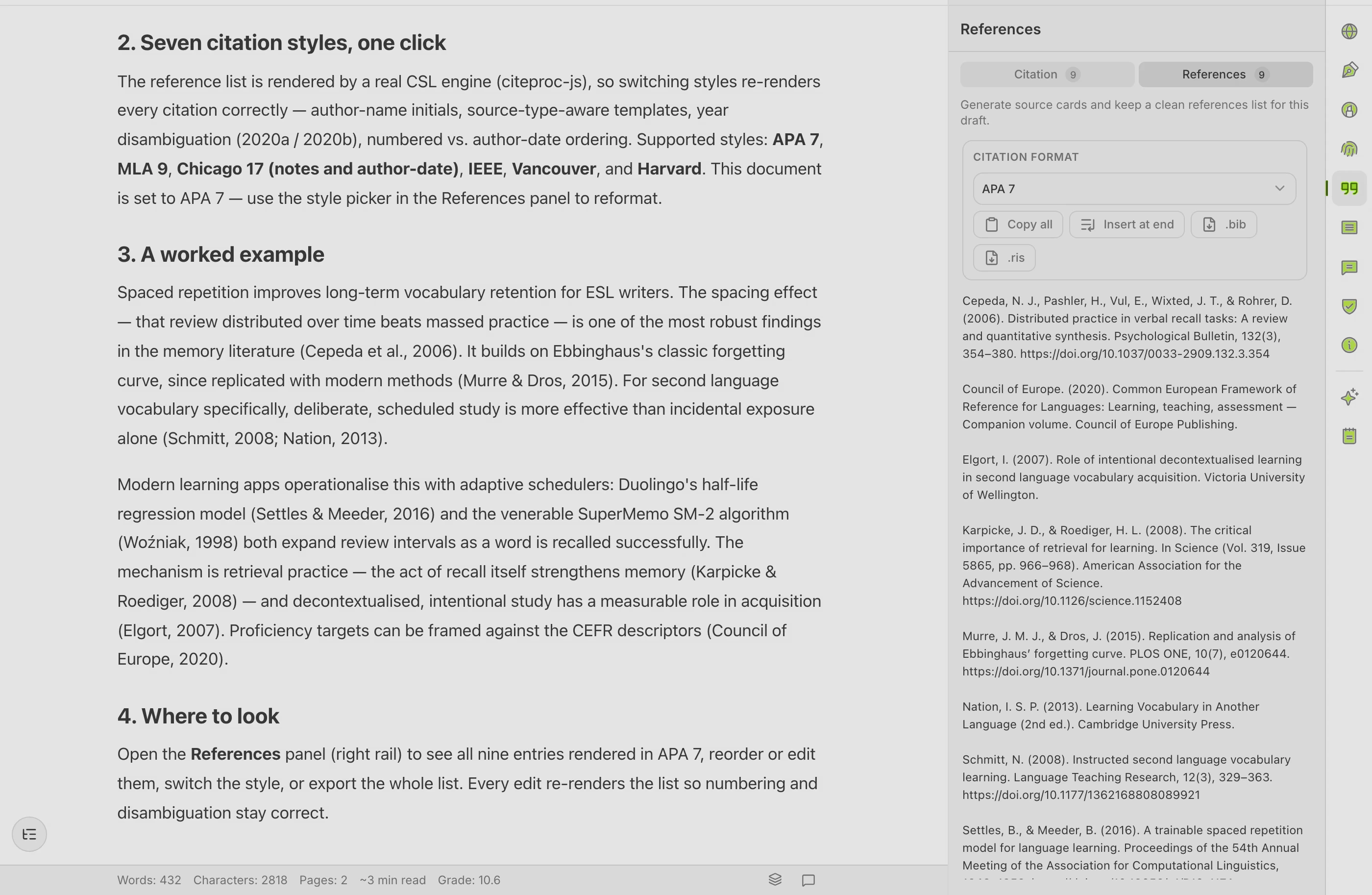
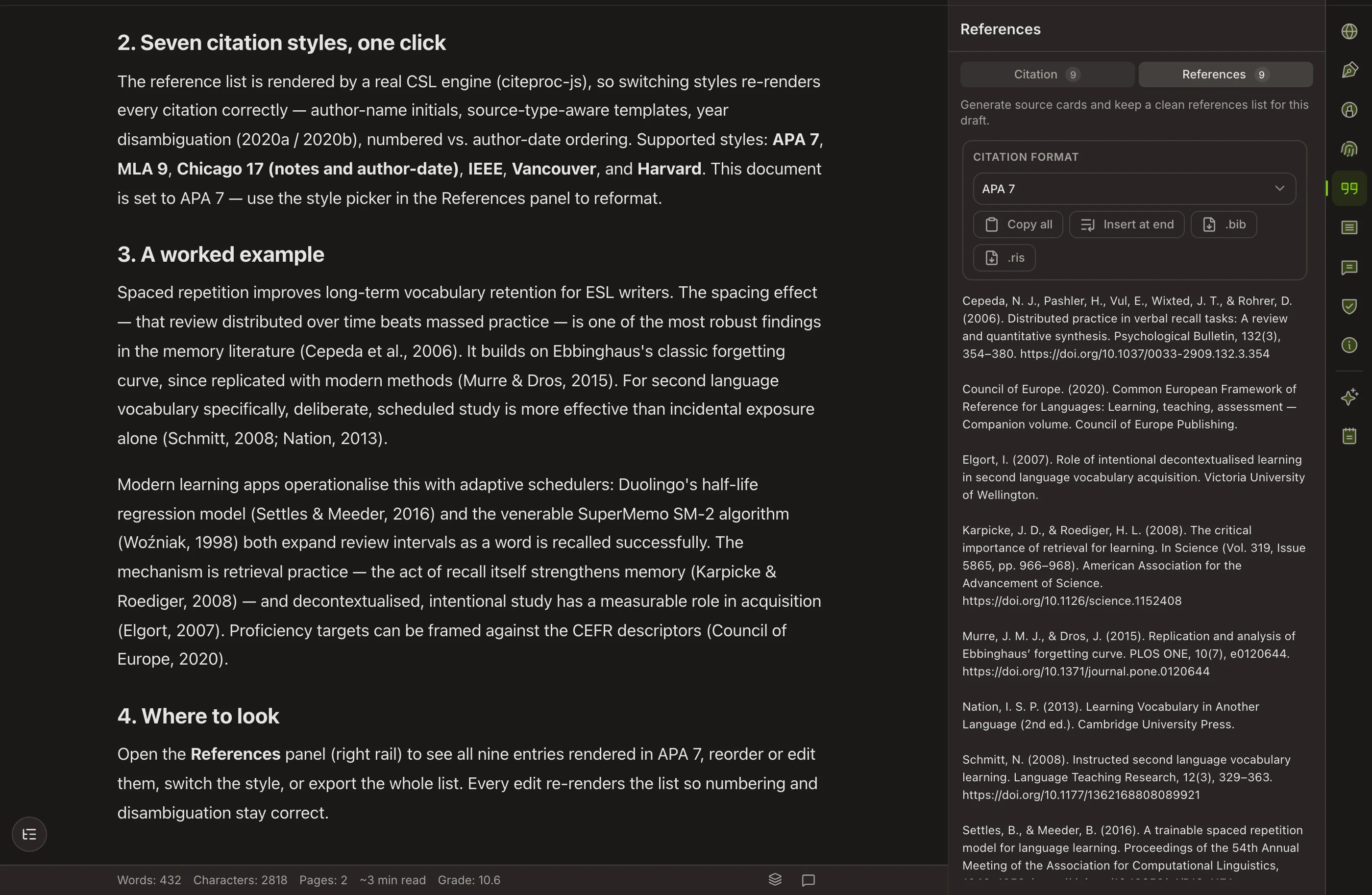
| Citations and bibliography | Self-building — APA, MLA, Chicago, IEEE | Check current citation support on their site |
| Academic paraphrase and grammar | Yes | Yes |
| Free tier | Closed beta — no public free tier yet | Free tier with usage limits |
| Export | Word and PDF | Check current export options on their site |
| Record of authorship | Authorship Certificate anyone can verify | No equivalent |
AN HONEST READ
What SciSpace does well, and where it stops
SciSpace is genuinely good at
- Search across a large body of research with AI summaries is a real time-saver at the start of a project, when you do not yet know the shape of the literature.
- The reading assistant explains dense passages, notation and methods and points back to the page it drew from, which makes its answers checkable.
- Extracting columns across many papers into a comparison table is genuinely useful literature-review work that would otherwise take days.
- It handles the reading you do outside its own site through a browser extension over PDFs.
- Explanations in multiple languages help when you are reading in a second language and the paper is already hard enough.
Where it leaves an academic writer short
- Discovery is the strength; the drafting side is lighter than a dedicated writing workspace.
- Summaries and extracted answers still need checking against the paper — a page reference makes that easy, but it does not make it optional.
- It does not produce a signed record of how your own document was written.
- The reference list of your manuscript is not its job, so the writing-side citation work remains.
WHICH ONE
Pick the right tool for your case
Choose SciSpace when
- You are at the reading stage. Finding, triaging and understanding papers is the work in front of you, and SciSpace is built for exactly that.
- You are building a literature review and want findings extracted across dozens of papers into something you can compare.
- You are reading outside your specialism and want dense passages explained with a pointer back to the page.
- You read in a second language and want explanations in your own.
Choose Copyeditor when
- The reading is done and the manuscript has to get written.
- You want the bibliography to build itself as you cite, in APA, MLA, Chicago or IEEE.
- You want a verifiable record of how the document was written.
- You want drafting, paraphrase and grammar review in the same document rather than across tools.
SciSpace has a free tier with usage limits and paid plans billed monthly or annually, with the annual rate lower per month. Copyeditor is one subscription and is in closed beta. Check scispace.com for current limits and prices — this category revises plans often.
Questions about SciSpace and Copyeditor
Do SciSpace and Copyeditor compete?
Only at the edges. SciSpace is strongest before you write; Copyeditor is built for while you write. Using both — read there, draft here — is a coherent workflow rather than a compromise.
Can I trust an AI summary of a paper?
Treat it as a fast route to the relevant page, not as the paper. SciSpace linking back to the source makes checking easy, and anything you intend to cite should be read at the passage you are citing.
Does SciSpace manage references?
It is oriented around discovery and reading rather than maintaining a curated library. If you keep one, a reference manager like Zotero remains the right home for it.
Which one helps with a literature review?
Both, at different stages. SciSpace helps you gather and compare what the literature says; Copyeditor helps you turn that into a synthesized chapter with citations attached.
How current is this comparison?
SciSpace ships changes frequently and so do we. Verify their current feature set and plans on scispace.com before relying on anything here.
Other comparisons
Copyeditor vs Jenni AI
Jenni AI is an AI writing assistant aimed squarely at academic drafting, best known for inline autocomplete that continues your sentence and can attach a citation as it does.
Copyeditor vs ChatGPT
ChatGPT is a general-purpose AI assistant that happens to be very good at writing, and for most researchers it is already the default first stop.
Copyeditor vs Zotero
Zotero is a free, open-source reference manager — an adjacent tool rather than a competitor. It is where a great many researchers keep their library, and it is the strongest thing in this list at the job it does.
One document
instead of six tabs
Structured drafting, citations that build their own bibliography, and a signed record of how the paper was written. Copyeditor is in beta — apply and we’ll reach out as spots open.