Comparison
Turnitin and Copyeditor: a similarity check and a record of writing
Turnitin is an institutional academic-integrity platform bought by universities and schools, not by students — an adjacent system rather than a competitor, and Copyeditor is not an alternative to it.
SIDE BY SIDE
Feature by feature
Where the other tool is stronger, the table says so. Verify anything decision-critical on both vendors’ own sites — features move on both sides.
| Feature | Copyeditor | Turnitin |
|---|---|---|
| Plagiarism-database check | No — not a database check | Yes — the largest comparison corpus in the category |
| Who buys it | The writer | The institution |
| AI-detector view | Preview of how a draft reads — advisory only | Institution-facing AI indicators in the report |
| Available before you submit | Yes — while you write | Only if your institution enables a draft check |
| Structured drafting | Ask, Edit and Plan modes | Not a writing tool |
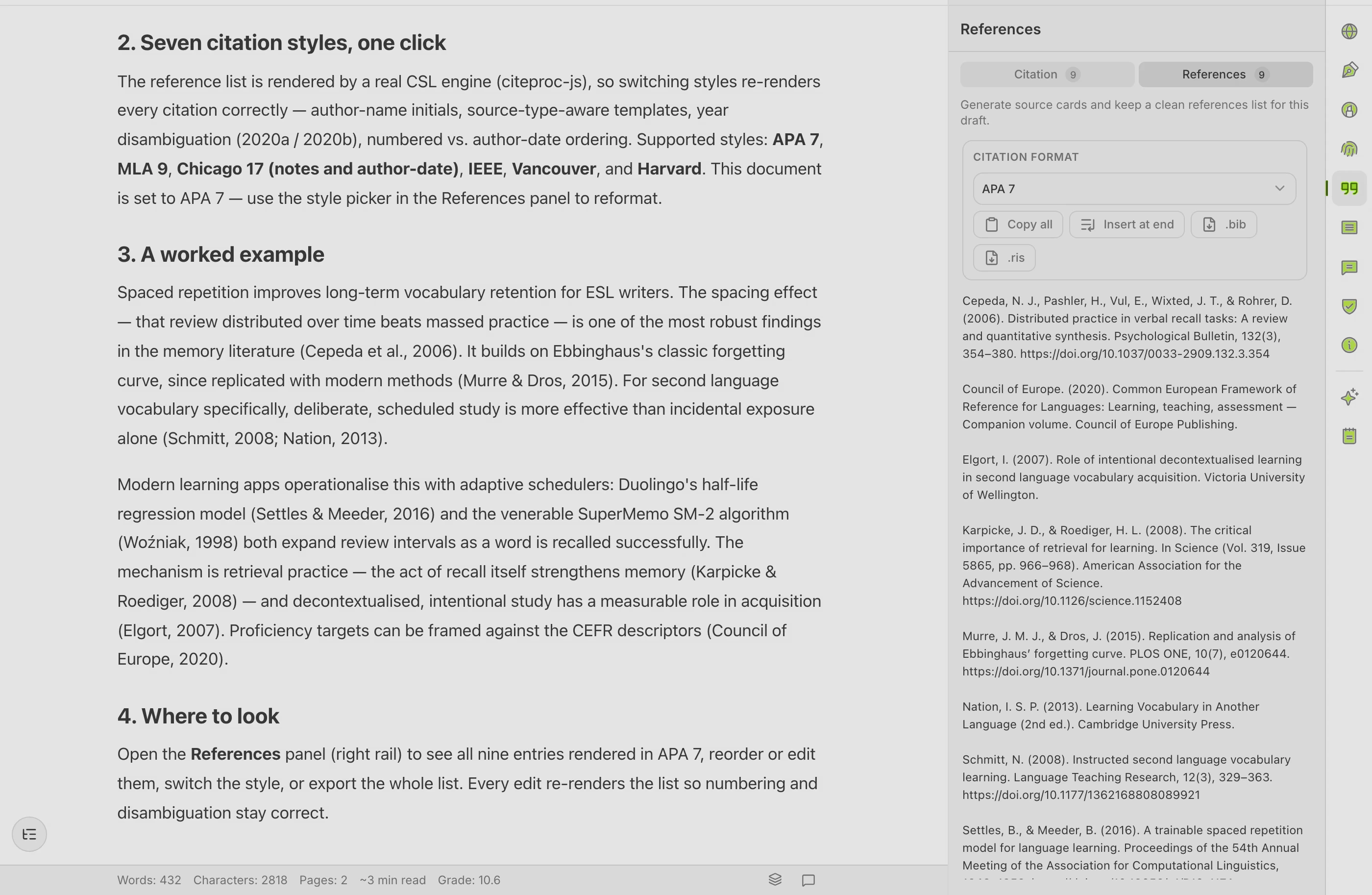
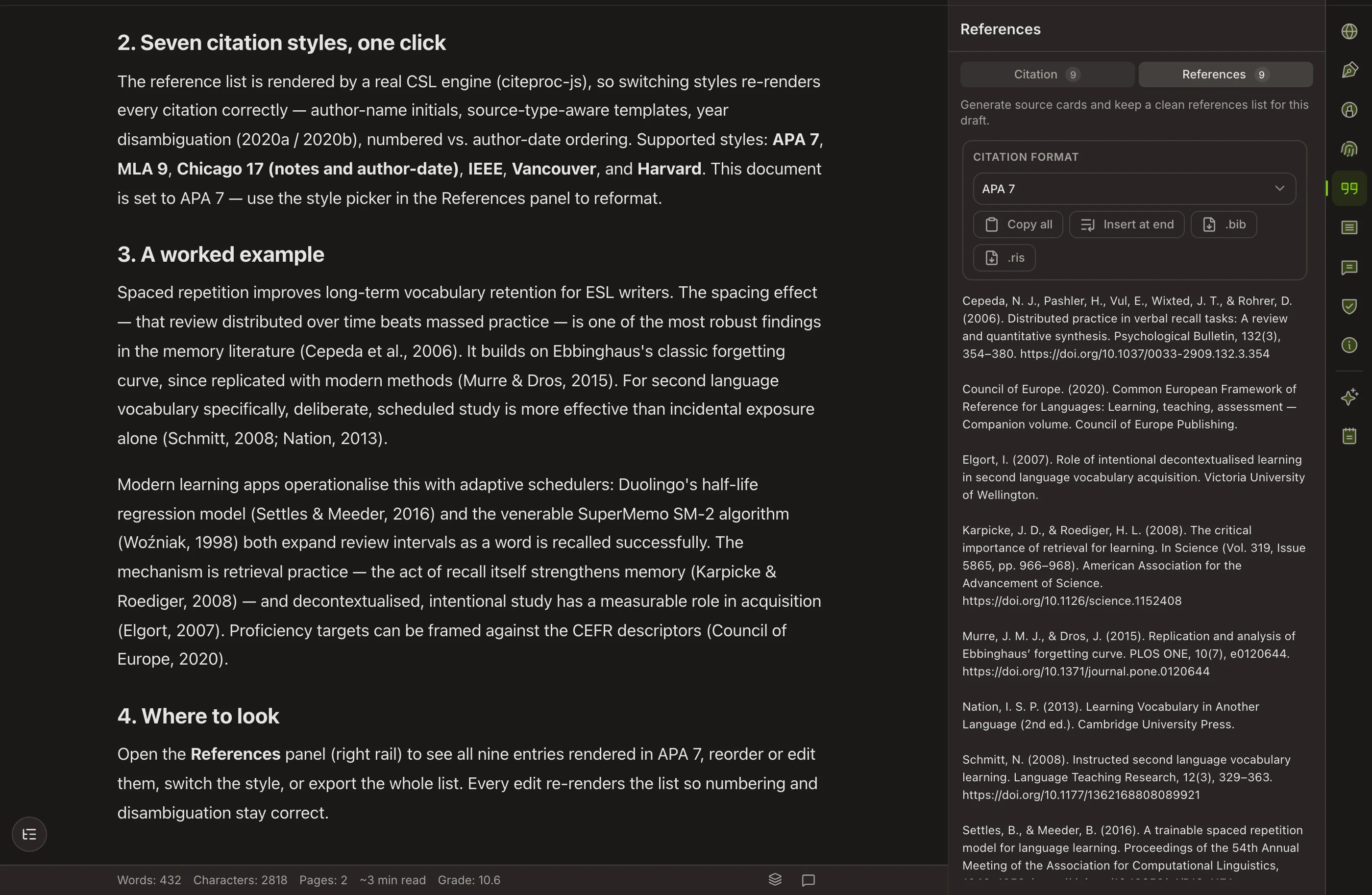
| Citations and bibliography | Self-building — APA, MLA, Chicago, IEEE | No |
| Grading and feedback tools | No | Yes — rubrics and instructor feedback |
| Evidence of process | Authorship Certificate anyone can verify | Evidence about the finished text, not the process |
AN HONEST READ
What Turnitin does well, and where it stops
Turnitin is genuinely good at
- The comparison corpus is the largest in the category, covering published work, web content and a very large archive of previously submitted student papers. Nothing a student can buy comes close.
- It is embedded in how institutions actually work — assignments, learning management systems and grading flow through it, so instructors get consistent evidence in one place.
- The marking tools around it, including rubrics and reusable feedback, make it a grading environment rather than only a checker.
- Reports are designed for an experienced reader to interpret, with matched passages linked to their sources rather than reduced to a single verdict.
- Institution-wide deployment means the same standard applies to every submission in a cohort.
Where it leaves an academic writer short
- You generally cannot buy it as an individual, and you do not control when or whether your work is submitted to it.
- A similarity score is a measurement, not a judgment — correctly quoted and cited material counts as matching text, and a human still has to read the report.
- It tells you nothing about how a document was written, only how much of the final text resembles other text.
- It arrives at the end. By the time a report exists, the writing decisions that caused the problem were made weeks ago.
WHICH ONE
Pick the right tool for your case
Choose Turnitin when
- You are an institution and you need a similarity check across every submission with consistent evidence and an audit trail. That is the job Turnitin exists to do.
- You need a genuine plagiarism-database comparison. Copyeditor does not do this, and its AI-detector view is not a substitute.
- You are teaching, and rubrics, feedback and grading in the same place as the check are worth more than any single feature.
- Your department already runs on it and consistency across markers matters.
Choose Copyeditor when
- You are writing, not marking, and you want help while the document is still being made.
- You want to be able to show how a piece was written if the question ever comes up — which a similarity report cannot tell anyone.
- You want citations and the reference list built as you write, so quoted material is properly attributed before anything is checked.
- You want an advisory read on how your draft looks to detectors before submission, understanding that it is a preview and not a verdict.
Turnitin is sold to institutions under licenses negotiated per organization; there is no meaningful individual price to quote, and students normally access it through their school. Copyeditor is an individual subscription and is in closed beta. For institutional terms, contact Turnitin directly.
Questions about Turnitin and Copyeditor
Is Copyeditor a Turnitin alternative?
No. Turnitin compares your finished text against a very large database; Copyeditor does not do that at all. Anyone selling you a cheap Turnitin replacement is describing something else.
What is the AI-detector preview, exactly?
It is a preview of how your draft reads to detection tools — an advisory signal you can act on before you submit. It is not a plagiarism check, it does not query any submission database, and it cannot tell you what your institution’s system will report.
Will the Authorship Certificate protect me from an integrity case?
It documents how a document was written and can be verified by anyone without an account, which is supporting evidence about your process. It is not a verdict, it does not prove legal innocence, and no institution is obliged to accept it. We describe it this way deliberately.
Can I check my own work in Turnitin before submitting?
Only if your institution offers a draft-check option — many do, through the assignment itself. Ask your department rather than paying a third-party site claiming to run Turnitin for you.
Does a high similarity score mean plagiarism?
No. It means matching text, which includes correctly quoted and cited passages, reference lists and standard method descriptions. The report is read by a person who decides what it means.
Other comparisons
Copyeditor vs ChatGPT
ChatGPT is a general-purpose AI assistant that happens to be very good at writing, and for most researchers it is already the default first stop.
Copyeditor vs Wordvice
Wordvice is primarily a human editing and proofreading service for academic and admissions documents, with a set of free AI writing tools alongside it.
Copyeditor vs SciSpace
SciSpace is a literature discovery and paper-reading assistant — search across research papers, ask questions about a PDF, and pull findings out of many papers at once.
One document
instead of six tabs
Structured drafting, citations that build their own bibliography, and a signed record of how the paper was written. Copyeditor is in beta — apply and we’ll reach out as spots open.