IEEE style
How to cite a chapter in an edited book in IEEE style
A chapter has two sets of names — the chapter authors and the book editors — and getting the two the wrong way round is the single most common reference-list error.
THE FORMAT
A chapter in an edited book in IEEE, at a glance
[#] A. B. Author, “Title of the chapter,” in Title of the Book, C. D. Editor, Ed. City, State, Country: Publisher, Year, pp. ##–##.
[4] T. Nakamura, “Fault ride-through requirements for offshore converters,” in Handbook of Grid-Scale Storage, R. Alvarado and M. Sundqvist, Eds. Cham, Switzerland: Springer, 2022, pp. 173–198.
The ride-through envelope has tightened twice since the 2016 grid code [4].
In prose: Nakamura [4] traces the envelope back to the first offshore interconnection studies.
[5] A. Barzegar, “Battery second-life economics,” in Energy Systems in Transition, K. Duarte, Ed. London, U.K.: IET, 2021, pp. 55–79, doi: 10.1049/PBPO189E_ch3.
In text: Second-life valuation remains highly sensitive to cycle count [5].
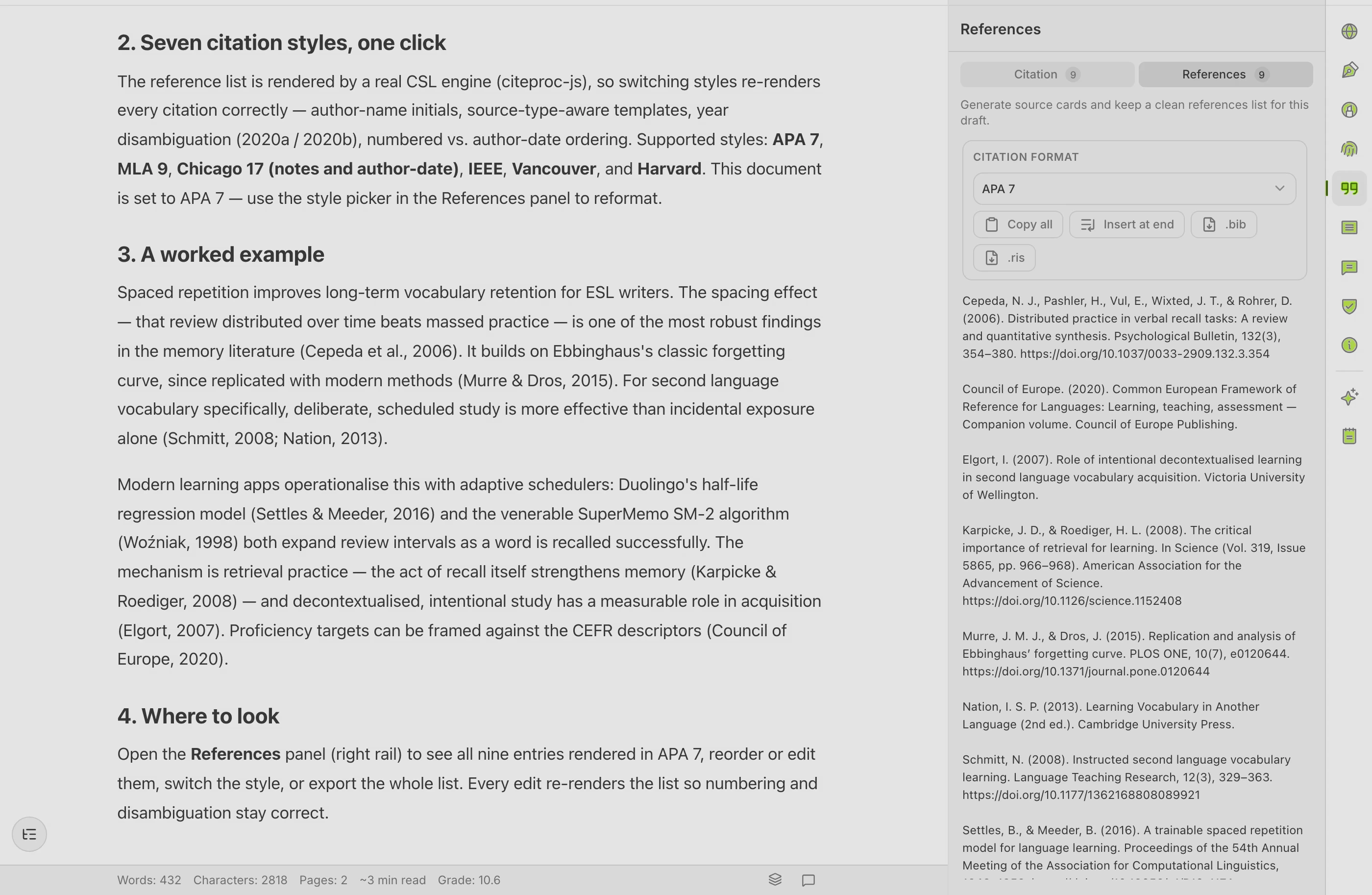
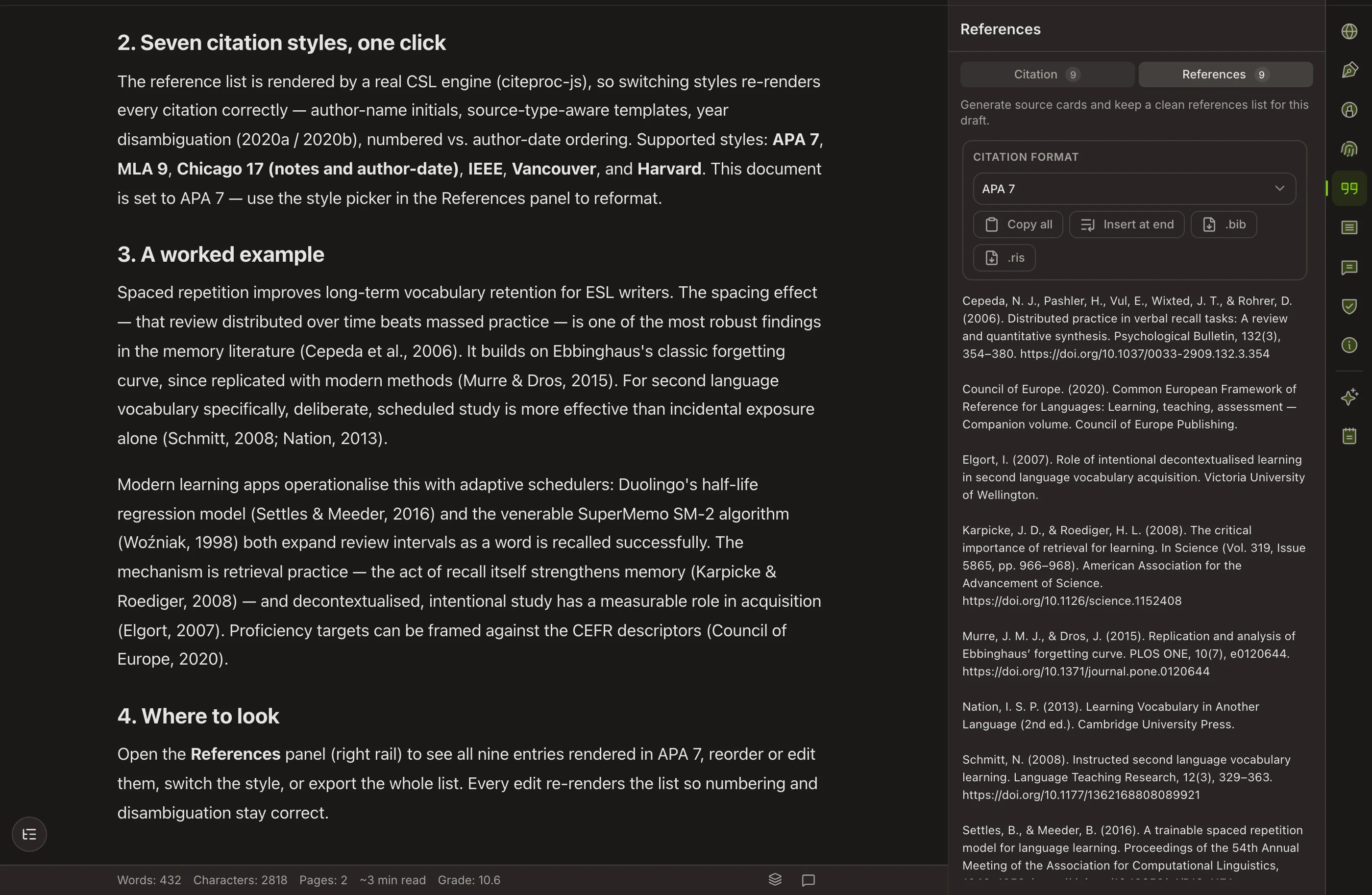
Copyeditor formats APA, MLA, Chicago and IEEE automatically — cite a source once and the references builds itself. See how citations work .
BEFORE YOU FORMAT
What IEEE needs from a chapter in an edited book
Elements to collect
- Chapter author or authors
- Year of publication
- Chapter title
- Editor or editors of the whole book
- Book title
- Page range of the chapter
- Publisher
Rules specific to this entry
- The chapter author leads and the editors follow the book title, still initials-first, closed by “Ed.” for one editor and “Eds.” for two or more. Reversing the two name sets is the most common IEEE chapter error and the easiest for a reviewer to spot.
- Unlike a whole book, a chapter does carry its page range in the entry — “pp. 173–198” — because the range is what identifies the chapter within the volume.
- The word “in” before the italicized book title is lowercase and unitalicized. It is the hinge that tells a reader the quoted title is a part and the italic title is the container.
- If the whole book already has its own numbered entry, you can point at a chapter from the bracket instead of creating a second entry: [2, ch. 7]. Use one approach or the other, not both.
Building the entry, step by step
Collect the details
Before you format anything, gather every element IEEE needs for a chapter in an edited book: Chapter author or authors; Year of publication; Chapter title; Editor or editors of the whole book.
Build the references entry
Arrange those details in the IEEE order: [#] A. B. Author, “Title of the chapter,” in Title of the Book, C. D. Editor, Ed. City, State, Country: Publisher, Year, pp. ##–##.
Add the in-text citation
In the body of your paper, cite it as The ride-through envelope has tightened twice since the 2016 grid code [4]. — or work the same reference into your sentence as Nakamura [4] traces the envelope back to the first offshore interconnection studies..
Check it against the exceptions
The chapter author leads and the editors follow the book title, still initials-first, closed by “Ed.” for one editor and “Eds.” for two or more. Reversing the two name sets is the most common IEEE chapter error and the easiest for a reviewer to spot.
IEEE RULES
The conventions behind every IEEE entry
IEEE Reference Guide is the authority. Where a journal or department publishes its own house rules, those win — check your submission guidelines before the references is final.
The rules that apply across every source — author order, capitalization, how the references is sorted, and where IEEE entries most often go wrong — are collected on the IEEE style guide.
The same chapter in an edited book in another style
Switching styles late in a draft is normal. Here is the same source formatted five other ways.
Questions about IEEE and book chapters
What if the chapter in an edited book has no author?
Start the entry with the title and keep the number you already assigned it. A numeric references never re-sorts for a missing author, so the entry stays exactly where it is.
What do I need before I can cite a chapter in an edited book?
Chapter author or authors, Year of publication, Chapter title, and the rest of the elements listed above. A chapter has two sets of names — the chapter authors and the book editors — and getting the two the wrong way round is the single most common reference-list error.
Is there anything unusual about a chapter in an edited book in IEEE?
The chapter author leads and the editors follow the book title, still initials-first, closed by “Ed.” for one editor and “Eds.” for two or more. Reversing the two name sets is the most common IEEE chapter error and the easiest for a reviewer to spot.
What else catches people out here?
Unlike a whole book, a chapter does carry its page range in the entry — “pp. 173–198” — because the range is what identifies the chapter within the volume.
Can I reformat this chapter in an edited book in another style later?
By hand, you would retype the entry — the element order, punctuation and italics all differ between styles. In Copyeditor, sources are stored as structured data, so switching between APA, MLA, Chicago and IEEE reformats every citation and the whole reference list at once.
Cite it once
and never reformat it again
Copyeditor keeps sources as structured data, so switching between APA, MLA, Chicago and IEEE reformats every citation and the whole references at once.