IEEE style
How to cite a report in IEEE style
Reports from governments, NGOs, and think tanks usually have a corporate author rather than a person, and often a report number that has to be preserved exactly.
THE FORMAT
A report in IEEE, at a glance
[#] A. B. Author, “Title of the report,” Issuing Organization, City, State, Country, Rep. XXX-##, Mon. Year.
[4] M. Grüneberg and A. Solano, “Interconnection cost trends for utility-scale solar,” Nat. Renewable Energy Lab., Golden, CO, USA, Tech. Rep. NREL/TP-6A20-88412, Sep. 2023.
Interconnection now accounts for roughly a fifth of installed cost [4].
In prose: A recent laboratory report [4] puts interconnection at 18 % of installed cost for the median project.
[5] Standard for Interconnection and Interoperability of Distributed Energy Resources with Associated Electric Power Systems Interfaces, IEEE Standard 1547-2018, Apr. 2018.
In text: Ride-through behavior is fixed by the interconnection standard [5].
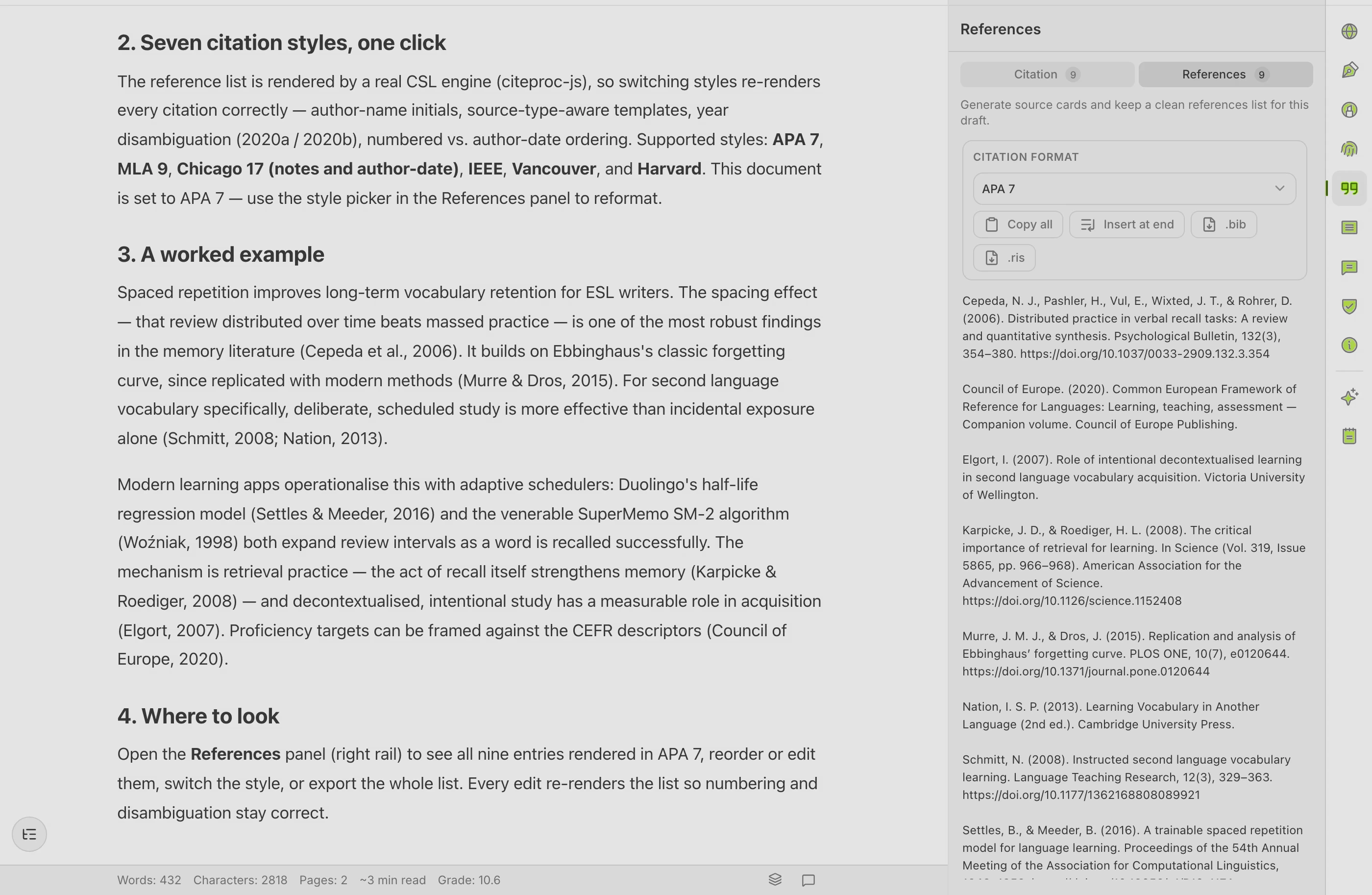
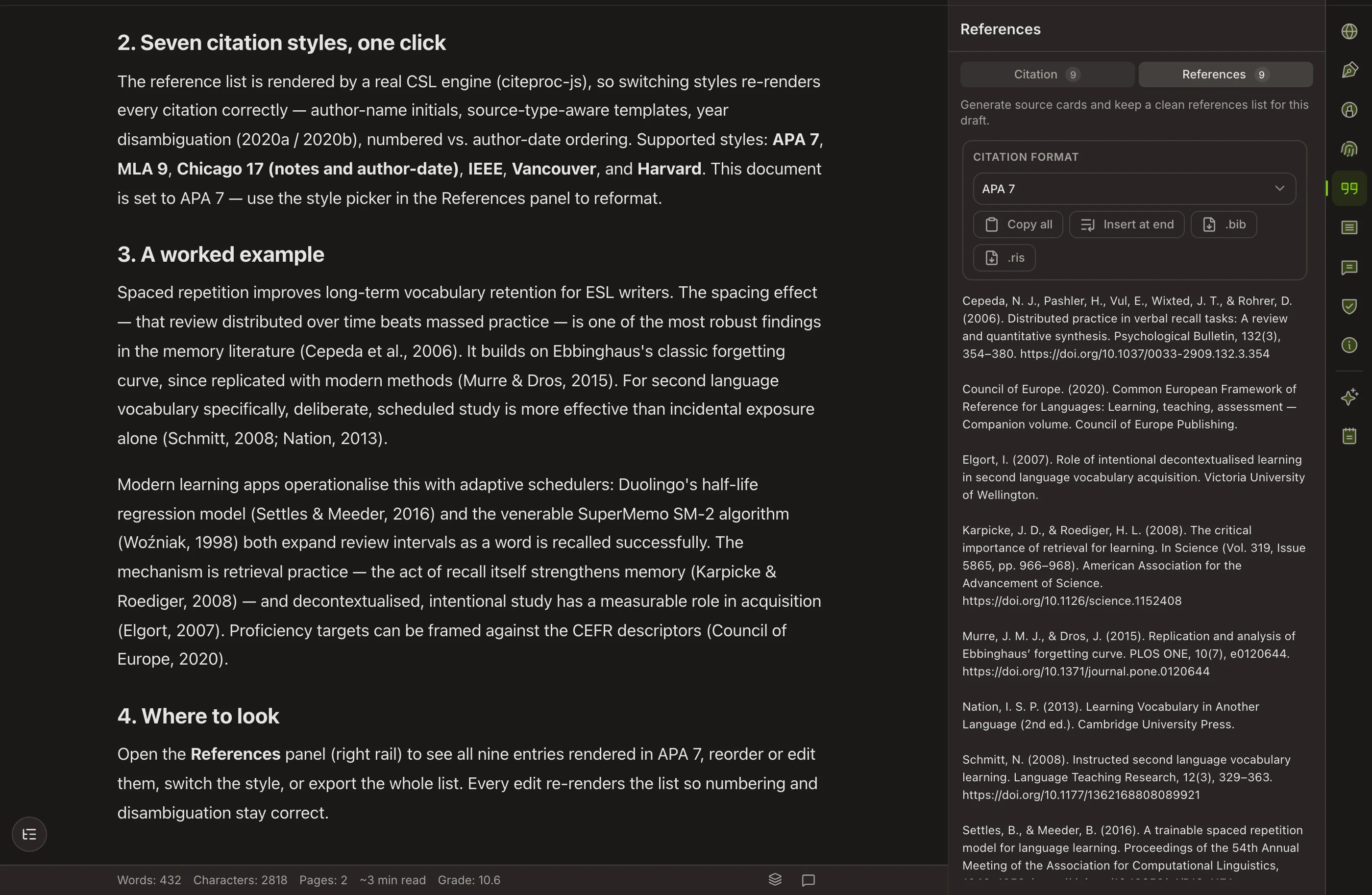
Copyeditor formats APA, MLA, Chicago and IEEE automatically — cite a source once and the references builds itself. See how citations work .
BEFORE YOU FORMAT
What IEEE needs from a report
Elements to collect
- Issuing organization, used as the author when no individual is named
- Year of publication
- Full title of the report
- Report or publication number, when there is one
- Publisher, when it differs from the author
- URL
Rules specific to this entry
- The report number is not decoration and is not reformatted. Reproduce “NREL/TP-6A20-88412” character for character after “Tech. Rep.” or “Rep.” — it is how a reader finds the document after the agency reorganizes its website.
- With a corporate author and no named person, the organization moves into the author slot and still carries its location: “Nat. Renewable Energy Lab., Golden, CO, USA”. IEEE abbreviates organization names the same way it abbreviates journals.
- Report titles sit in quotation marks with sentence capitalization. Nothing in a report entry is italicized, which distinguishes it at a glance from a book.
- A report gets month and year when the cover shows a month. Unlike a web page, it has a real publication date, so an access date is unnecessary even when you read the PDF online.
Building the entry, step by step
Collect the details
Before you format anything, gather every element IEEE needs for a report: Issuing organization, used as the author when no individual is named; Year of publication; Full title of the report; Report or publication number, when there is one.
Build the references entry
Arrange those details in the IEEE order: [#] A. B. Author, “Title of the report,” Issuing Organization, City, State, Country, Rep. XXX-##, Mon. Year.
Add the in-text citation
In the body of your paper, cite it as Interconnection now accounts for roughly a fifth of installed cost [4]. — or work the same reference into your sentence as A recent laboratory report [4] puts interconnection at 18 % of installed cost for the median project..
Check it against the exceptions
The report number is not decoration and is not reformatted. Reproduce “NREL/TP-6A20-88412” character for character after “Tech. Rep.” or “Rep.” — it is how a reader finds the document after the agency reorganizes its website.
IEEE RULES
The conventions behind every IEEE entry
IEEE Reference Guide is the authority. Where a journal or department publishes its own house rules, those win — check your submission guidelines before the references is final.
The rules that apply across every source — author order, capitalization, how the references is sorted, and where IEEE entries most often go wrong — are collected on the IEEE style guide.
The same report in another style
Switching styles late in a draft is normal. Here is the same source formatted five other ways.
Questions about IEEE and reports
What if the report has no author?
Start the entry with the title and keep the number you already assigned it. A numeric references never re-sorts for a missing author, so the entry stays exactly where it is.
What do I need before I can cite a report?
Issuing organization, used as the author when no individual is named, Year of publication, Full title of the report, and the rest of the elements listed above. Reports from governments, NGOs, and think tanks usually have a corporate author rather than a person, and often a report number that has to be preserved exactly.
Is there anything unusual about a report in IEEE?
The report number is not decoration and is not reformatted. Reproduce “NREL/TP-6A20-88412” character for character after “Tech. Rep.” or “Rep.” — it is how a reader finds the document after the agency reorganizes its website.
What else catches people out here?
With a corporate author and no named person, the organization moves into the author slot and still carries its location: “Nat. Renewable Energy Lab., Golden, CO, USA”. IEEE abbreviates organization names the same way it abbreviates journals.
Can I reformat this report in another style later?
By hand, you would retype the entry — the element order, punctuation and italics all differ between styles. In Copyeditor, sources are stored as structured data, so switching between APA, MLA, Chicago and IEEE reformats every citation and the whole reference list at once.
Cite it once
and never reformat it again
Copyeditor keeps sources as structured data, so switching between APA, MLA, Chicago and IEEE reformats every citation and the whole references at once.