IEEE style
How to cite a conference paper in IEEE style
Conference output splits three ways — a paper published in proceedings, a paper presented but never published, and a poster — and the styles treat them differently.
THE FORMAT
A conference paper in IEEE, at a glance
[#] A. B. Author and C. D. Author, “Title of the paper,” in Proc. Abbrev. Conf. Name (ACRONYM), City, Country, Year, pp. ##–##, doi: 10.xxxx/xxxxx.
[4] J. Halloran and W. Zhu, “Online calibration of lidar–camera extrinsics on rough terrain,” in Proc. IEEE Int. Conf. Robot. Autom. (ICRA), London, U.K., 2023, pp. 4188–4195, doi: 10.1109/ICRA.2023.1017732.
Extrinsic drift can be corrected online without a target board [4].
In prose: Halloran and Zhu [4] recalibrate continuously from scene geometry rather than from a checkerboard.
[5] S. Iqbal, “Thermal derating of dc fast chargers in desert climates,” presented at the IEEE Transp. Electrific. Conf. Expo (ITEC), Anaheim, CA, USA, Jun. 19–21, 2024.
In text: Derating above 45 °C ambient was reported informally at ITEC [5].
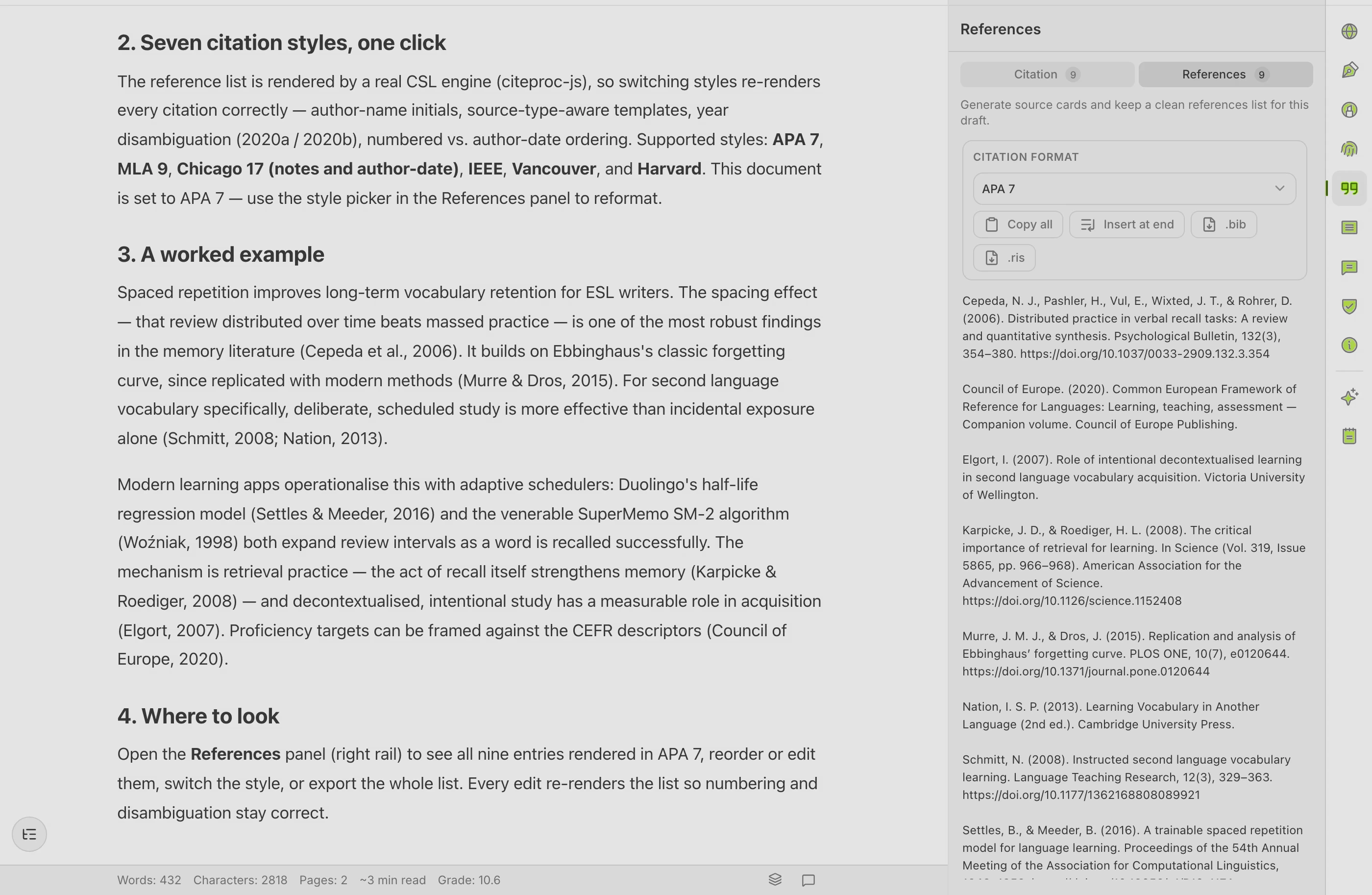
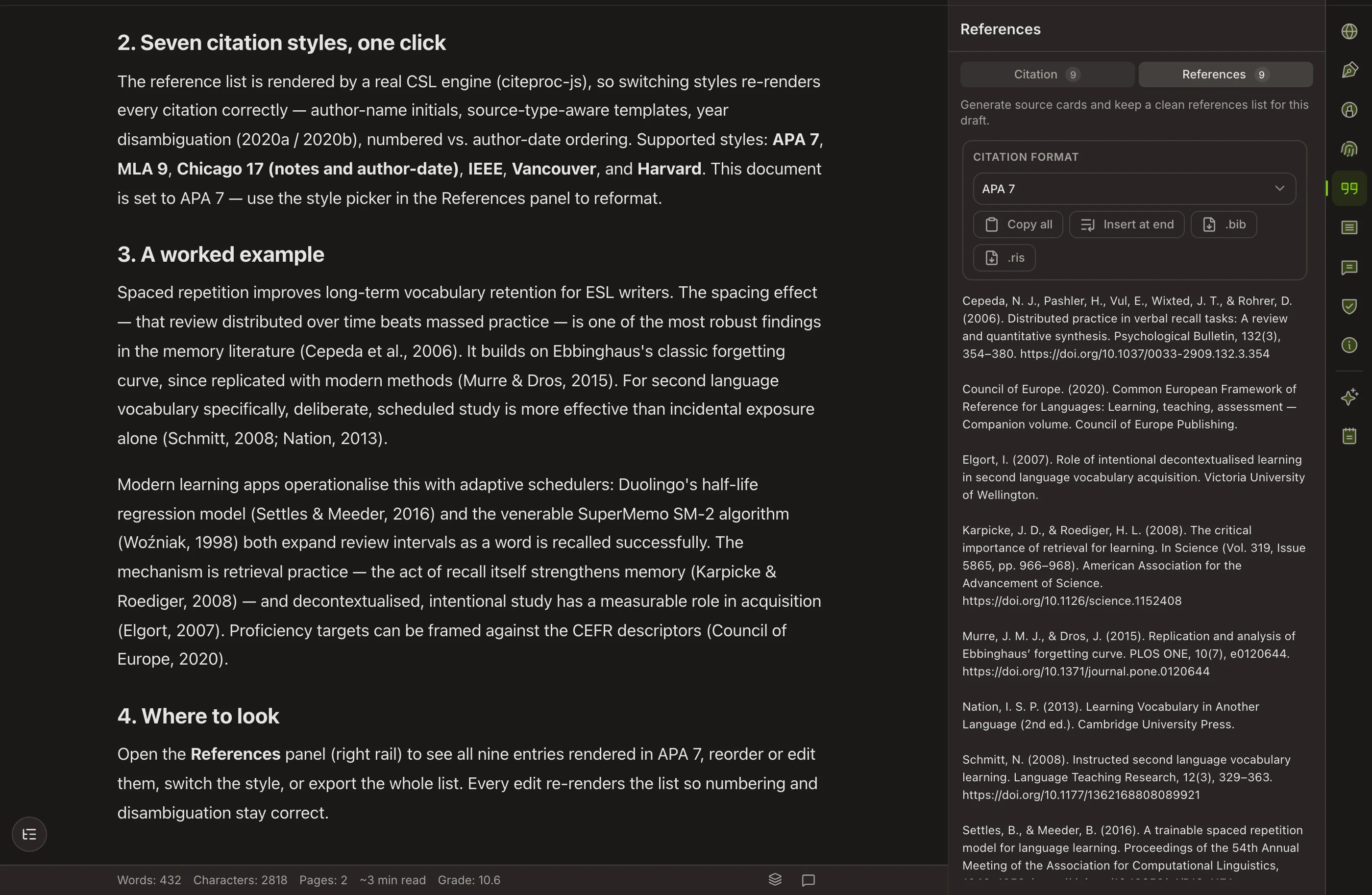
Copyeditor formats APA, MLA, Chicago and IEEE automatically — cite a source once and the references builds itself. See how citations work .
BEFORE YOU FORMAT
What IEEE needs from a conference paper
Elements to collect
- Presenter or author names
- Date or date range of the conference
- Title of the paper or poster
- Type of contribution — paper presentation, poster session, keynote
- Conference name
- Location of the conference
- Proceedings title, pages, and DOI when it was published
Rules specific to this entry
- A paper published in proceedings is an “in <em>Proc. …</em>” entry with page numbers. A paper you only heard delivered is a “presented at” entry with the full conference dates and no pages. Do not give a presented paper a page range it never had.
- Conference names are abbreviated the way journals are — “Int. Conf. Robot. Autom.” — with the community’s acronym in parentheses so the reader can find the venue.
- The city, state or province, and country of the conference follow the venue name, and the year given is the year the conference took place. That is not always the year the proceedings volume was issued.
- Preprints of conference papers are cited as preprints, not as proceedings. Once the paper appears in the proceedings, update the entry — a reviewer who finds the published version will assume you did not read it.
Building the entry, step by step
Collect the details
Before you format anything, gather every element IEEE needs for a conference paper: Presenter or author names; Date or date range of the conference; Title of the paper or poster; Type of contribution — paper presentation, poster session, keynote.
Build the references entry
Arrange those details in the IEEE order: [#] A. B. Author and C. D. Author, “Title of the paper,” in Proc. Abbrev. Conf. Name (ACRONYM), City, Country, Year, pp. ##–##, doi: 10.xxxx/xxxxx.
Add the in-text citation
In the body of your paper, cite it as Extrinsic drift can be corrected online without a target board [4]. — or work the same reference into your sentence as Halloran and Zhu [4] recalibrate continuously from scene geometry rather than from a checkerboard..
Check it against the exceptions
A paper published in proceedings is an “in <em>Proc. …</em>” entry with page numbers. A paper you only heard delivered is a “presented at” entry with the full conference dates and no pages. Do not give a presented paper a page range it never had.
IEEE RULES
The conventions behind every IEEE entry
IEEE Reference Guide is the authority. Where a journal or department publishes its own house rules, those win — check your submission guidelines before the references is final.
The rules that apply across every source — author order, capitalization, how the references is sorted, and where IEEE entries most often go wrong — are collected on the IEEE style guide.
The same conference paper in another style
Switching styles late in a draft is normal. Here is the same source formatted five other ways.
Questions about IEEE and conference papers
What if the conference paper has no author?
Start the entry with the title and keep the number you already assigned it. A numeric references never re-sorts for a missing author, so the entry stays exactly where it is.
What do I need before I can cite a conference paper?
Presenter or author names, Date or date range of the conference, Title of the paper or poster, and the rest of the elements listed above. Conference output splits three ways — a paper published in proceedings, a paper presented but never published, and a poster — and the styles treat them differently.
Is there anything unusual about a conference paper in IEEE?
A paper published in proceedings is an “in <em>Proc. …</em>” entry with page numbers. A paper you only heard delivered is a “presented at” entry with the full conference dates and no pages. Do not give a presented paper a page range it never had.
What else catches people out here?
Conference names are abbreviated the way journals are — “Int. Conf. Robot. Autom.” — with the community’s acronym in parentheses so the reader can find the venue.
Can I reformat this conference paper in another style later?
By hand, you would retype the entry — the element order, punctuation and italics all differ between styles. In Copyeditor, sources are stored as structured data, so switching between APA, MLA, Chicago and IEEE reformats every citation and the whole reference list at once.
Cite it once
and never reformat it again
Copyeditor keeps sources as structured data, so switching between APA, MLA, Chicago and IEEE reformats every citation and the whole references at once.