IEEE style
How to cite a journal article in IEEE style
Journal articles carry the most metadata of any source — volume, issue, page range, and a DOI — and each style orders and punctuates them differently.
THE FORMAT
A journal article in IEEE, at a glance
[#] A. B. Author, C. D. Author, and E. F. Author, “Title of the article,” Abbrev. Journal Title, vol. #, no. #, pp. ##–##, Mon. Year, doi: 10.xxxx/xxxxx.
[4] R. M. Delacroix, H. Ito, and P. Venkataraman, “Thermal drift compensation in low-cost MEMS gyroscopes,” IEEE Sens. J., vol. 21, no. 14, pp. 942–953, Jul. 2021, doi: 10.1109/JSEN.2021.3099471.
A one-point thermal calibration removes most of the low-frequency drift [4].
In prose: Delacroix et al. [4] measured residual drift across a 40 °C range and found it bounded below 0.3°/h.
[5] S. Kaur et al., “A 28 nm all-digital phase-locked loop for automotive radar,” IEEE J. Solid-State Circuits, vol. 58, no. 2, pp. 401–412, Feb. 2023, doi: 10.1109/JSSC.2022.3211840.
In text: Fractional-N synthesis at this node is now routine [5].
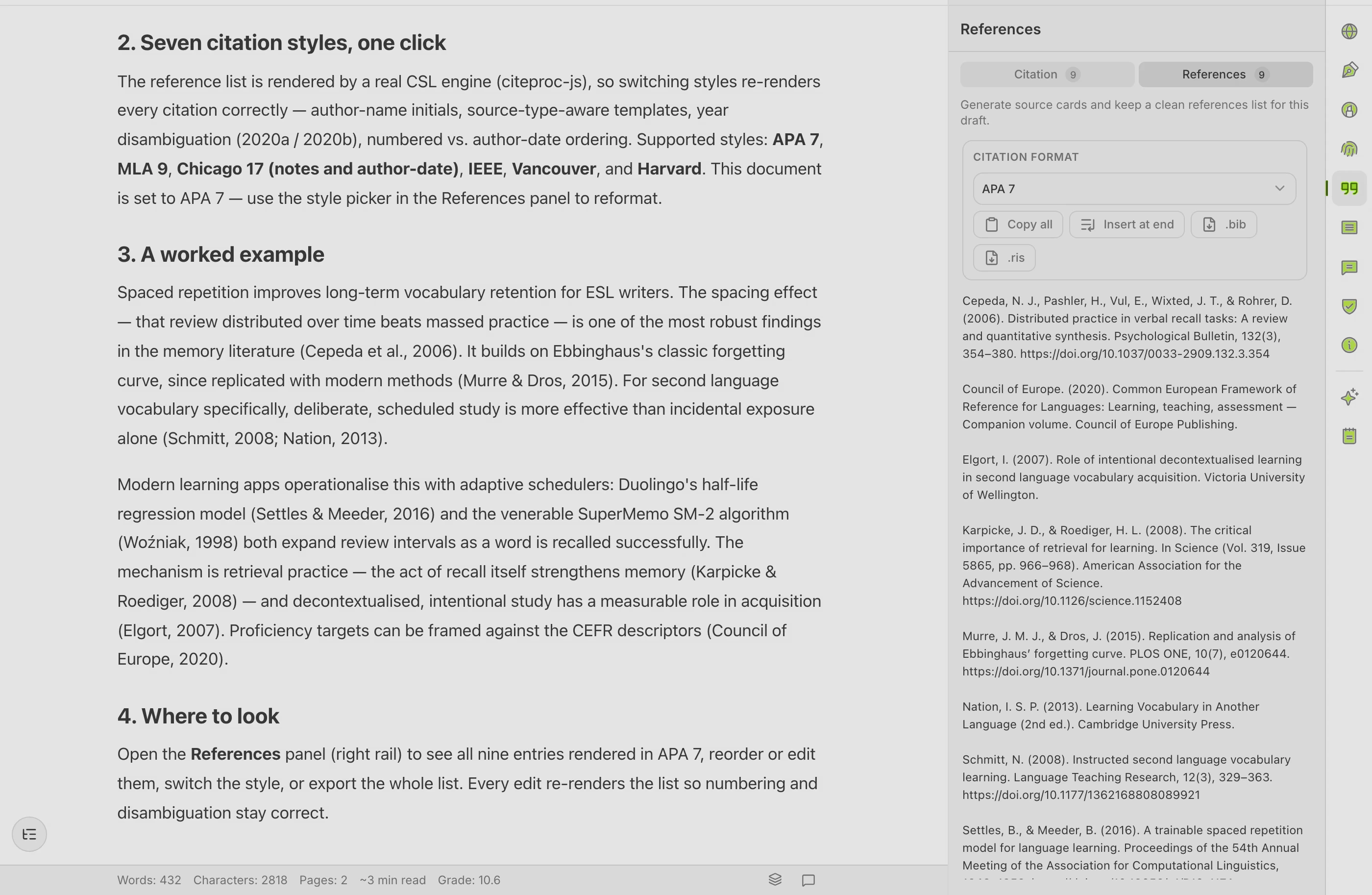
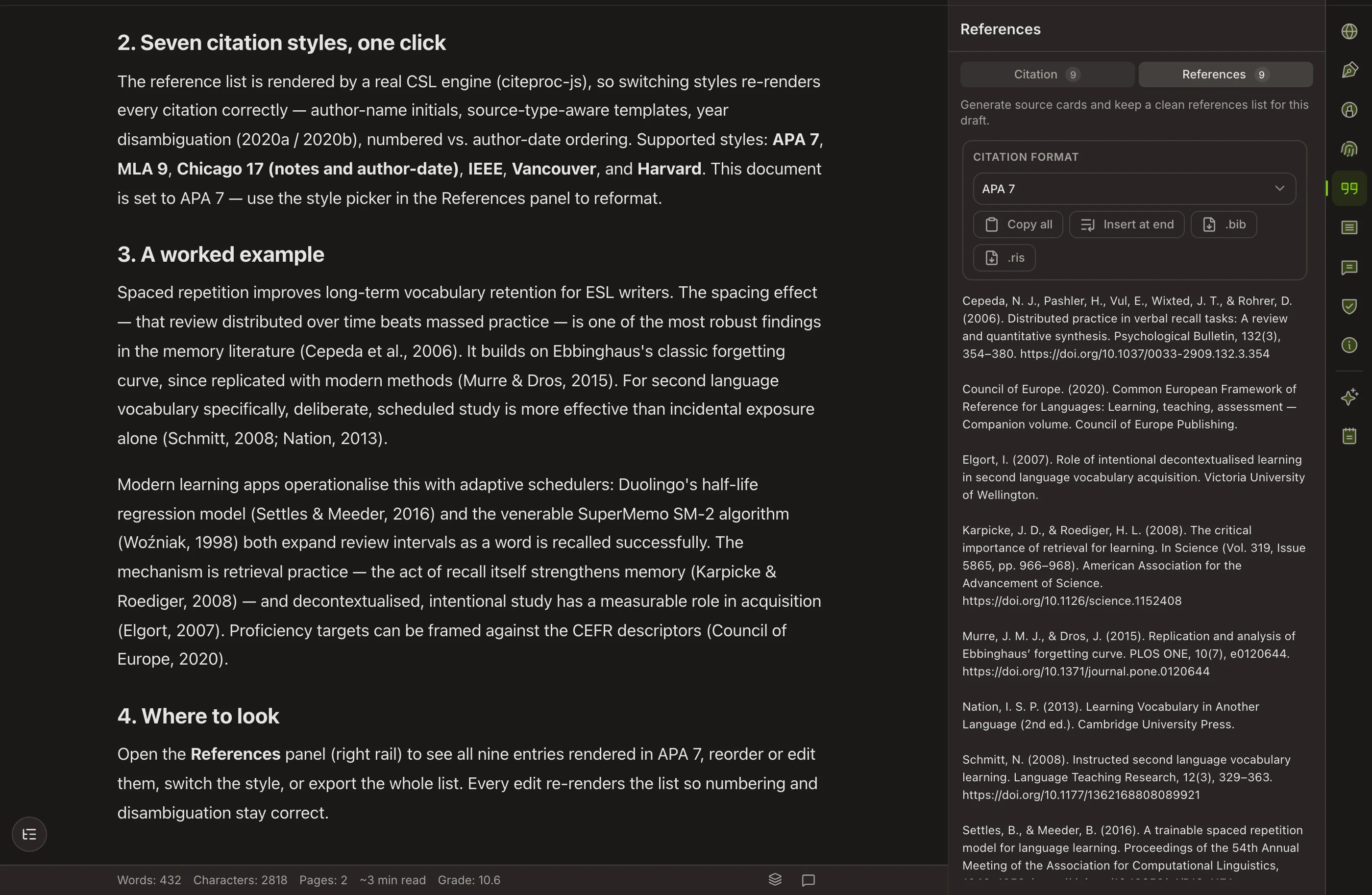
Copyeditor formats APA, MLA, Chicago and IEEE automatically — cite a source once and the references builds itself. See how citations work .
BEFORE YOU FORMAT
What IEEE needs from a journal article
Elements to collect
- All author names, in the order printed on the article
- Year of publication
- Article title
- Journal name (in full, not the abbreviation, unless the style asks for it)
- Volume and issue number
- Page range
- DOI, or a stable URL when there is no DOI
Rules specific to this entry
- The volume, issue, and page cluster is spelled out with abbreviations and commas — “vol. 21, no. 14, pp. 942–953” — not compressed the way Vancouver compresses it. Page ranges use an en dash and are written out in full: 942–953, never 942–53.
- The date is month and year only, with the month abbreviated. A journal article never takes a day, and it never takes just a bare year the way an APA entry does.
- The DOI closes the entry after a comma, lowercase and unpunctuated: “doi: 10.1109/JSEN.2021.3099471.” Do not wrap it in “https://doi.org/” unless your target journal’s template shows that form.
- The journal name is italicized and abbreviated per IEEE’s periodical title list. If you cannot find an official abbreviation, give the full title rather than inventing one.
Building the entry, step by step
Collect the details
Before you format anything, gather every element IEEE needs for a journal article: All author names, in the order printed on the article; Year of publication; Article title; Journal name (in full, not the abbreviation, unless the style asks for it).
Build the references entry
Arrange those details in the IEEE order: [#] A. B. Author, C. D. Author, and E. F. Author, “Title of the article,” Abbrev. Journal Title, vol. #, no. #, pp. ##–##, Mon. Year, doi: 10.xxxx/xxxxx.
Add the in-text citation
In the body of your paper, cite it as A one-point thermal calibration removes most of the low-frequency drift [4]. — or work the same reference into your sentence as Delacroix et al. [4] measured residual drift across a 40 °C range and found it bounded below 0.3°/h..
Check it against the exceptions
The volume, issue, and page cluster is spelled out with abbreviations and commas — “vol. 21, no. 14, pp. 942–953” — not compressed the way Vancouver compresses it. Page ranges use an en dash and are written out in full: 942–953, never 942–53.
IEEE RULES
The conventions behind every IEEE entry
IEEE Reference Guide is the authority. Where a journal or department publishes its own house rules, those win — check your submission guidelines before the references is final.
The rules that apply across every source — author order, capitalization, how the references is sorted, and where IEEE entries most often go wrong — are collected on the IEEE style guide.
The same journal article in another style
Switching styles late in a draft is normal. Here is the same source formatted five other ways.
Questions about IEEE and journal articles
What if the journal article has no author?
Start the entry with the title and keep the number you already assigned it. A numeric references never re-sorts for a missing author, so the entry stays exactly where it is.
What do I need before I can cite a journal article?
All author names, in the order printed on the article, Year of publication, Article title, and the rest of the elements listed above. Journal articles carry the most metadata of any source — volume, issue, page range, and a DOI — and each style orders and punctuates them differently.
Is there anything unusual about a journal article in IEEE?
The volume, issue, and page cluster is spelled out with abbreviations and commas — “vol. 21, no. 14, pp. 942–953” — not compressed the way Vancouver compresses it. Page ranges use an en dash and are written out in full: 942–953, never 942–53.
What else catches people out here?
The date is month and year only, with the month abbreviated. A journal article never takes a day, and it never takes just a bare year the way an APA entry does.
Can I reformat this journal article in another style later?
By hand, you would retype the entry — the element order, punctuation and italics all differ between styles. In Copyeditor, sources are stored as structured data, so switching between APA, MLA, Chicago and IEEE reformats every citation and the whole reference list at once.
Cite it once
and never reformat it again
Copyeditor keeps sources as structured data, so switching between APA, MLA, Chicago and IEEE reformats every citation and the whole references at once.