IEEE style
How to cite a interview in IEEE style
Interviews you conducted yourself are usually personal communication — cited in the text but absent from the reference list — while published interviews are cited like any other recorded source.
THE FORMAT
A interview in IEEE, at a glance
[#] A. B. Interviewee, private communication, Mon. Year.
[4] H. Lindqvist, private communication, Nov. 2024.
The manufacturer confirms that the derating curve is measured rather than modeled [4].
In prose: Lindqvist [4] confirmed that the published derating curve comes from chamber measurements, not from a thermal model.
[5] G. Nakashima, “We stopped designing for the average day,” interview by R. Pell, IEEE Spectr., vol. 61, no. 9, pp. 22–25, Sep. 2024.
In text: The chief architect has said as much publicly [5].
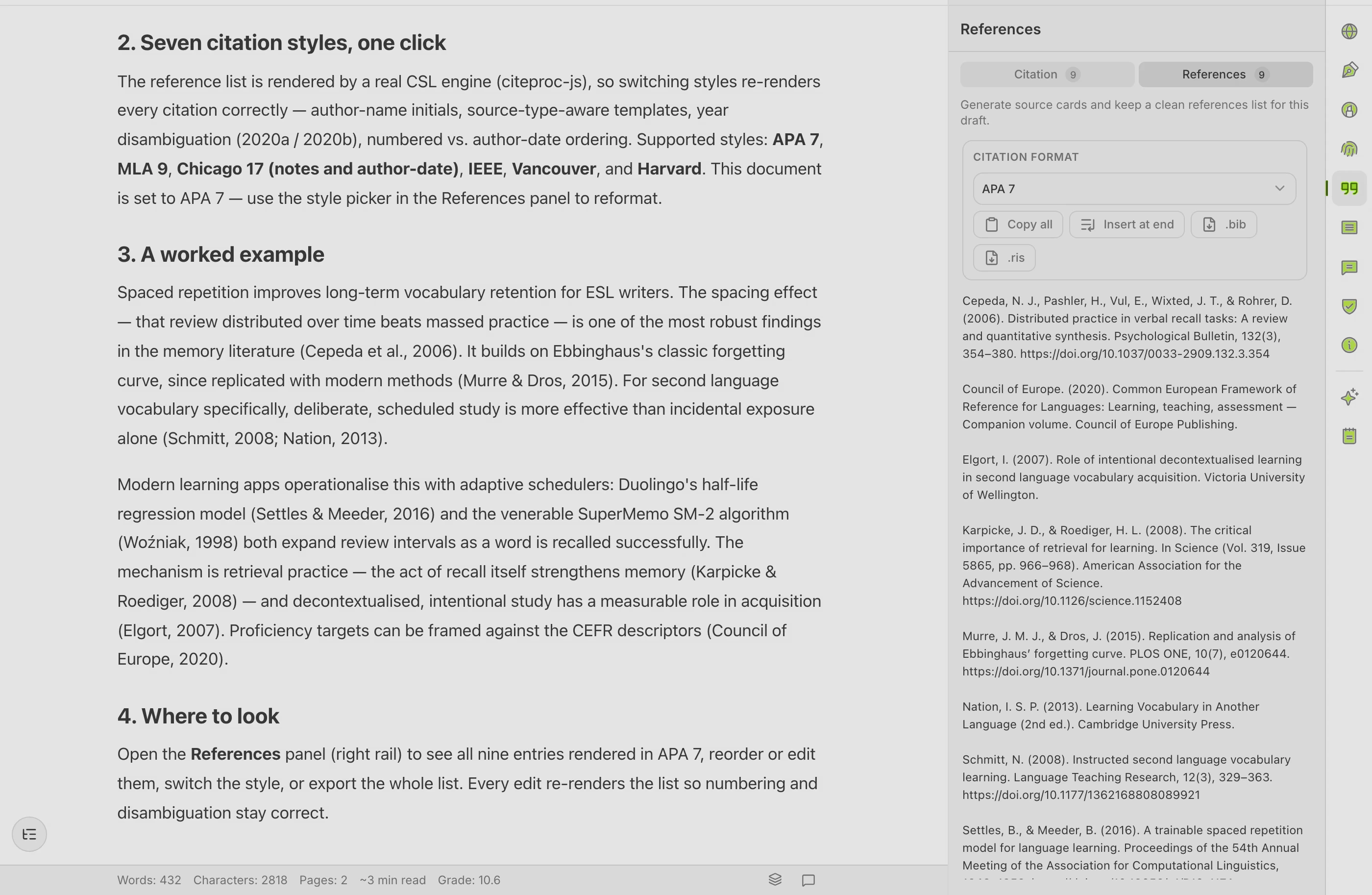
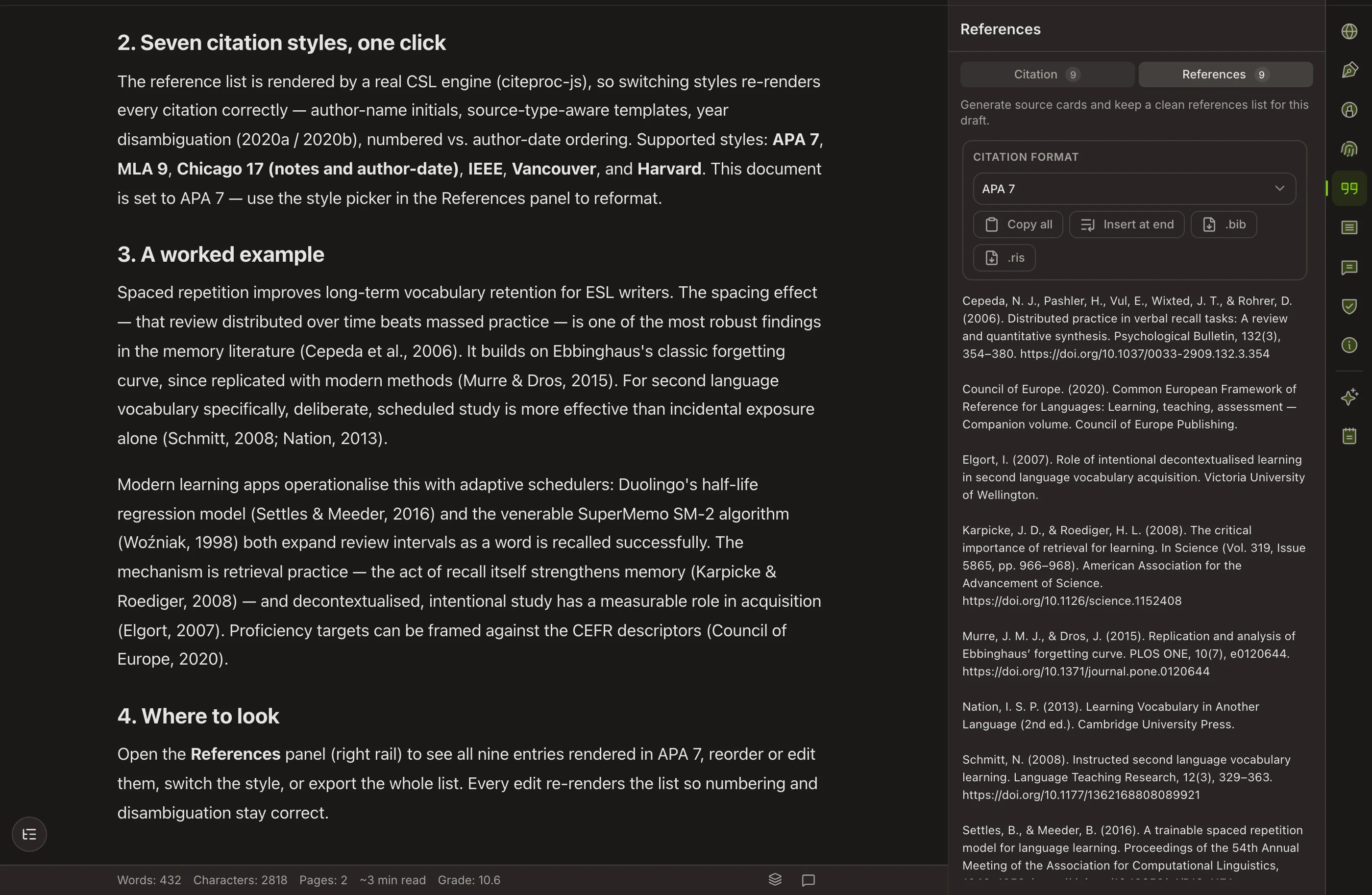
Copyeditor formats APA, MLA, Chicago and IEEE automatically — cite a source once and the references builds itself. See how citations work .
BEFORE YOU FORMAT
What IEEE needs from a interview
Elements to collect
- Name of the person interviewed
- Name of the interviewer, for a published interview
- Full date of the interview
- Where it was published or broadcast, when it was
- Format — transcript, audio recording, personal communication
Rules specific to this entry
- IEEE gives an interview you conducted yourself a numbered entry and calls it a “private communication”. This is a genuine divergence from APA and Vancouver, which keep personal communications out of the list entirely — worth knowing when you convert a manuscript between styles.
- A private-communication entry carries only the person’s name, the phrase itself, and the month and year. No title, no place, no medium, no URL. Anything more is over-specified.
- Get the person’s permission before naming them, and check whether your journal requires that permission in writing. An unverifiable private communication is the weakest citation in any reference list, so use it only for facts no published source carries.
- A published or broadcast interview is not a private communication. Cite it as whatever carried it — a magazine article, a podcast episode, a recorded video — with “interview by” and the interviewer’s name after the title.
Building the entry, step by step
Collect the details
Before you format anything, gather every element IEEE needs for a interview: Name of the person interviewed; Name of the interviewer, for a published interview; Full date of the interview; Where it was published or broadcast, when it was.
Build the references entry
Arrange those details in the IEEE order: [#] A. B. Interviewee, private communication, Mon. Year.
Add the in-text citation
In the body of your paper, cite it as The manufacturer confirms that the derating curve is measured rather than modeled [4]. — or work the same reference into your sentence as Lindqvist [4] confirmed that the published derating curve comes from chamber measurements, not from a thermal model..
Check it against the exceptions
IEEE gives an interview you conducted yourself a numbered entry and calls it a “private communication”. This is a genuine divergence from APA and Vancouver, which keep personal communications out of the list entirely — worth knowing when you convert a manuscript between styles.
IEEE RULES
The conventions behind every IEEE entry
IEEE Reference Guide is the authority. Where a journal or department publishes its own house rules, those win — check your submission guidelines before the references is final.
The rules that apply across every source — author order, capitalization, how the references is sorted, and where IEEE entries most often go wrong — are collected on the IEEE style guide.
The same interview in another style
Switching styles late in a draft is normal. Here is the same source formatted five other ways.
Questions about IEEE and interviews
What if the interview has no author?
Start the entry with the title and keep the number you already assigned it. A numeric references never re-sorts for a missing author, so the entry stays exactly where it is.
What do I need before I can cite a interview?
Name of the person interviewed, Name of the interviewer, for a published interview, Full date of the interview, and the rest of the elements listed above. Interviews you conducted yourself are usually personal communication — cited in the text but absent from the reference list — while published interviews are cited like any other recorded source.
Is there anything unusual about a interview in IEEE?
IEEE gives an interview you conducted yourself a numbered entry and calls it a “private communication”. This is a genuine divergence from APA and Vancouver, which keep personal communications out of the list entirely — worth knowing when you convert a manuscript between styles.
What else catches people out here?
A private-communication entry carries only the person’s name, the phrase itself, and the month and year. No title, no place, no medium, no URL. Anything more is over-specified.
Can I reformat this interview in another style later?
By hand, you would retype the entry — the element order, punctuation and italics all differ between styles. In Copyeditor, sources are stored as structured data, so switching between APA, MLA, Chicago and IEEE reformats every citation and the whole reference list at once.
Cite it once
and never reformat it again
Copyeditor keeps sources as structured data, so switching between APA, MLA, Chicago and IEEE reformats every citation and the whole references at once.