MLA 9th edition
How to cite a website in MLA 9th edition
Web pages often hide the author, the date, or both — and every style has a different rule for what to do when a required element simply does not exist.
THE FORMAT
A website in MLA, at a glance
Author Last, First. “Title of the Page.” Website Name, Day Month Year, url.example.org/page.
Renaud, Claire. “How Peer Review Changed after the Pandemic.” Open Science Notes, 18 Apr. 2023, opensciencenotes.org/peer-review-shift.
(Renaud)
In prose: Renaud describes editors quietly extending every deadline through 2021.
“Reading Habits of First-Year Students.” Campus Literacy Network, campusliteracy.org/reading-habits. Accessed 4 Mar. 2024.
In text: (“Reading Habits”)
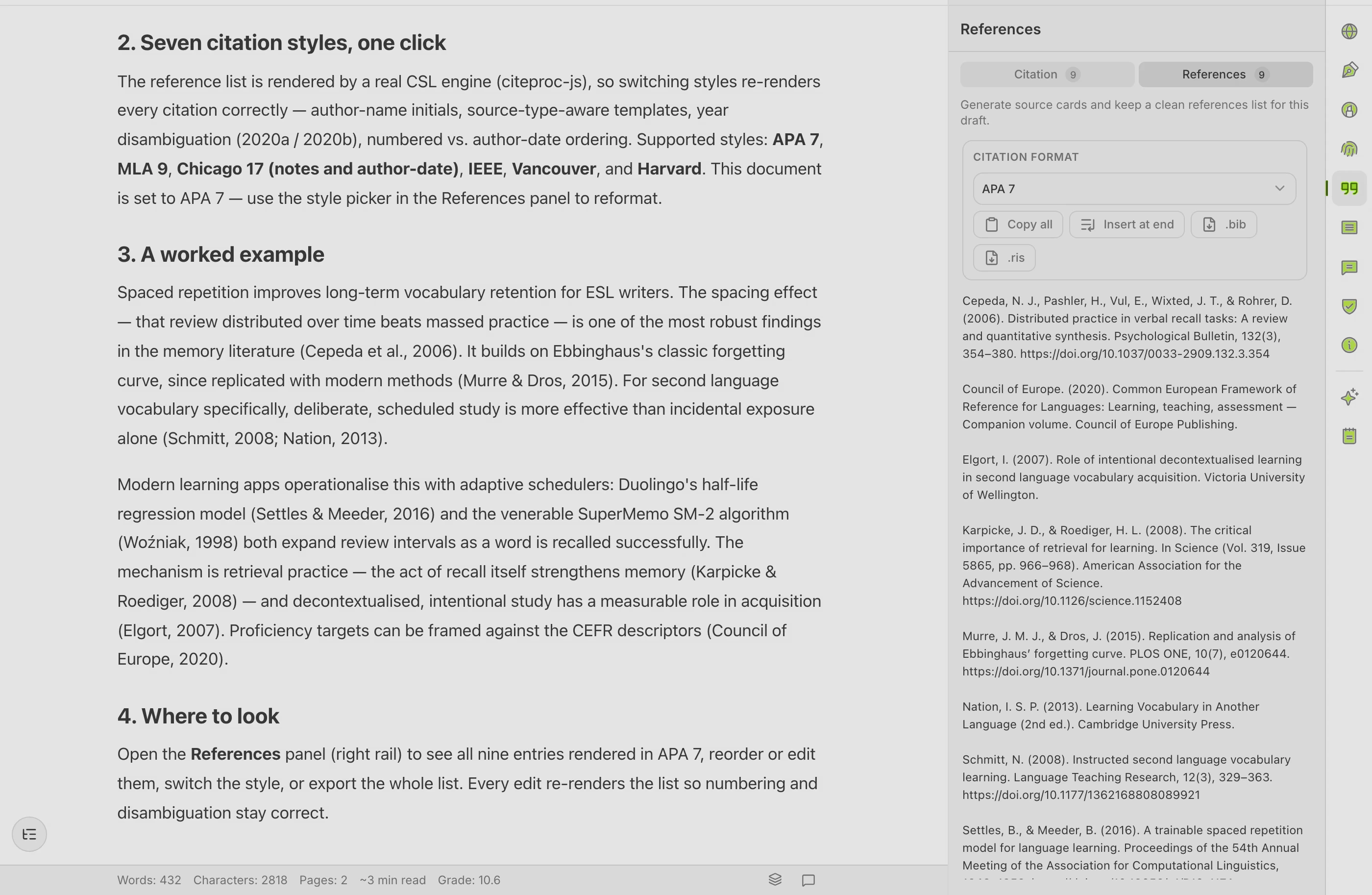
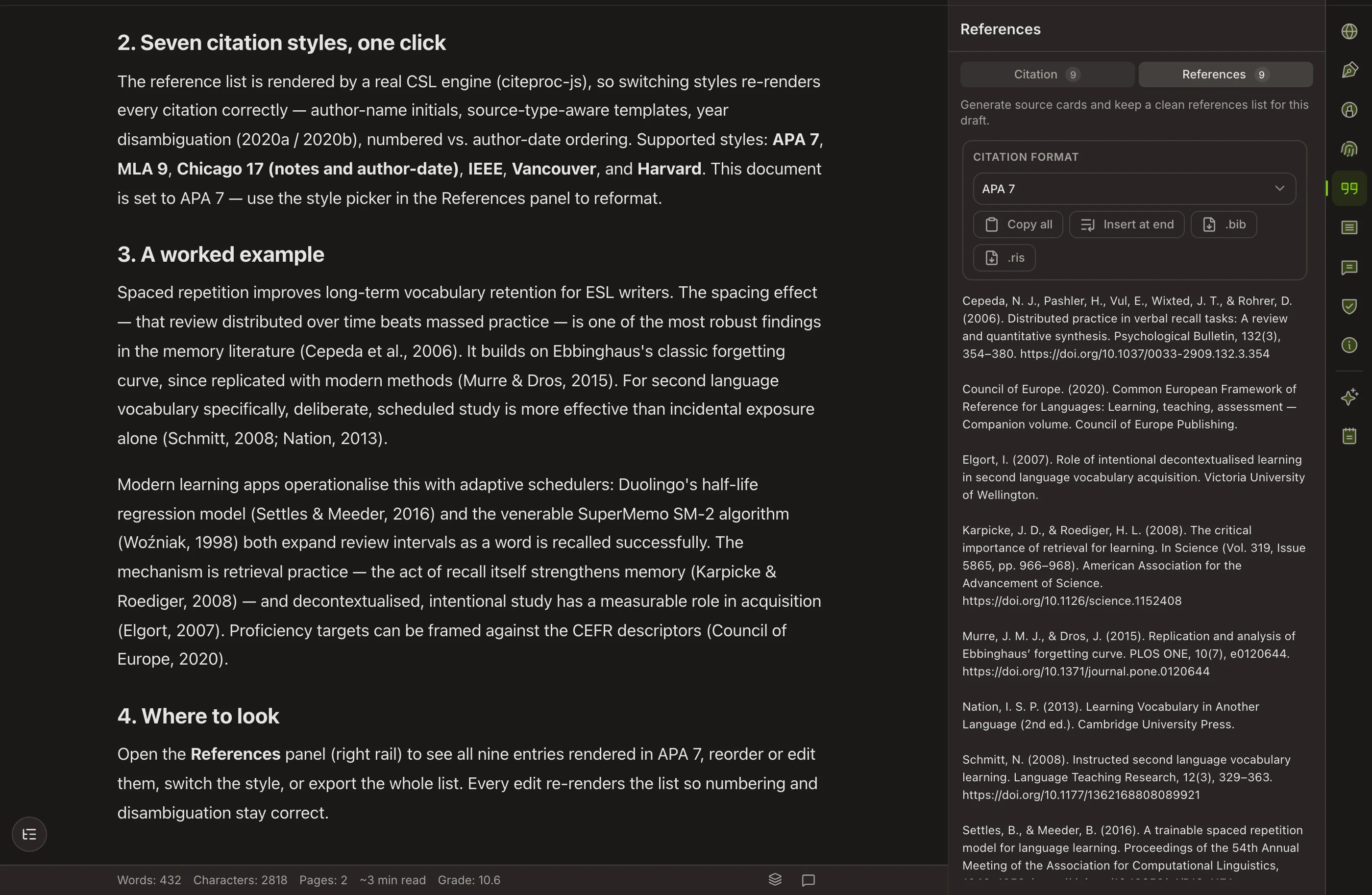
Copyeditor formats APA, MLA, Chicago and IEEE automatically — cite a source once and the works cited builds itself. See how citations work .
BEFORE YOU FORMAT
What MLA needs from a website
Elements to collect
- Author — a person if one is credited, otherwise the organization
- Date of publication or last update
- Title of the specific page (not the whole site)
- Name of the website or publishing organization
- URL
- Date you accessed it, when the style requires one
Rules specific to this entry
- A web page has no pages, so the parenthetical is the author’s surname alone — and nothing at all when the name already appears in your sentence.
- Dates run day-month-year, with months longer than four letters abbreviated: 18 Apr. 2023, 3 Sept. 2024. May, June and July are always spelled out.
- MLA 9 drops the http:// or https:// from a plain URL, so the entry ends with the bare address and a period. DOIs keep the full https://doi.org/ prefix.
- Add “Accessed 4 Mar. 2024.” at the very end when the page is undated or likely to change. It is optional, not a default.
Building the entry, step by step
Collect the details
Before you format anything, gather every element MLA needs for a website: Author — a person if one is credited, otherwise the organization; Date of publication or last update; Title of the specific page (not the whole site); Name of the website or publishing organization.
Build the works cited entry
Arrange those details in the MLA order: Author Last, First. “Title of the Page.” Website Name, Day Month Year, url.example.org/page.
Add the in-text citation
In the body of your paper, cite it as (Renaud) — or work the same reference into your sentence as Renaud describes editors quietly extending every deadline through 2021..
Check it against the exceptions
A web page has no pages, so the parenthetical is the author’s surname alone — and nothing at all when the name already appears in your sentence.
MLA RULES
The conventions behind every MLA entry
MLA Handbook (9th ed.) is the authority. Where a journal or department publishes its own house rules, those win — check your submission guidelines before the works cited is final.
The rules that apply across every source — author order, capitalization, how the works cited is sorted, and where MLA entries most often go wrong — are collected on the MLA 9th edition guide.
The same website in another style
Switching styles late in a draft is normal. Here is the same source formatted five other ways.
Questions about MLA and websites
What if the website has no author?
Move the title into the author position and alphabetize by the first significant word of that title — ignoring an initial “A”, “An” or “The”. In the text, use a shortened form of the title where the author name would go.
What do I need before I can cite a website?
Author — a person if one is credited, otherwise the organization, Date of publication or last update, Title of the specific page (not the whole site), and the rest of the elements listed above. Web pages often hide the author, the date, or both — and every style has a different rule for what to do when a required element simply does not exist.
Is there anything unusual about a website in MLA?
A web page has no pages, so the parenthetical is the author’s surname alone — and nothing at all when the name already appears in your sentence.
What else catches people out here?
Dates run day-month-year, with months longer than four letters abbreviated: 18 Apr. 2023, 3 Sept. 2024. May, June and July are always spelled out.
Can I reformat this website in another style later?
By hand, you would retype the entry — the element order, punctuation and italics all differ between styles. In Copyeditor, sources are stored as structured data, so switching between APA, MLA, Chicago and IEEE reformats every citation and the whole reference list at once.
Cite it once
and never reformat it again
Copyeditor keeps sources as structured data, so switching between APA, MLA, Chicago and IEEE reformats every citation and the whole works cited at once.