Vancouver style
How to cite a podcast episode in Vancouver style
A podcast episode is a part of a series, so it needs the same host/producer distinction as a book chapter — plus an episode number that is easy to miss.
THE FORMAT
A podcast episode in Vancouver, at a glance
#. Host AA, host. Title of the episode. Title of the Series [podcast on the Internet]. Place: Publisher; Year Mon DD [cited Year Mon DD]. Episode ##; ## min. Available from: URL
4. Almeida RT, host. Why sepsis bundles stall on the ward. The Ward Round [podcast on the Internet]. Bristol: Ward Round Media; 2025 Jan 16 [cited 2025 Mar 4]. Episode 74; 38 min. Available from: https://wardround.fm/74
Bundle compliance drops sharply once the acute team hands over.⁴
In prose: A ward pharmacist interviewed on a clinical podcast⁴ describes compliance falling sharply after handover.
5. Field notes: winter surge planning. The Ward Round [podcast on the Internet]. Bristol: Ward Round Media; 2024 Dec 5 [cited 2025 Mar 4]. Episode 61; 44 min. Available from: https://wardround.fm/61
In text: Surge planning is still largely improvised at ward level.⁵
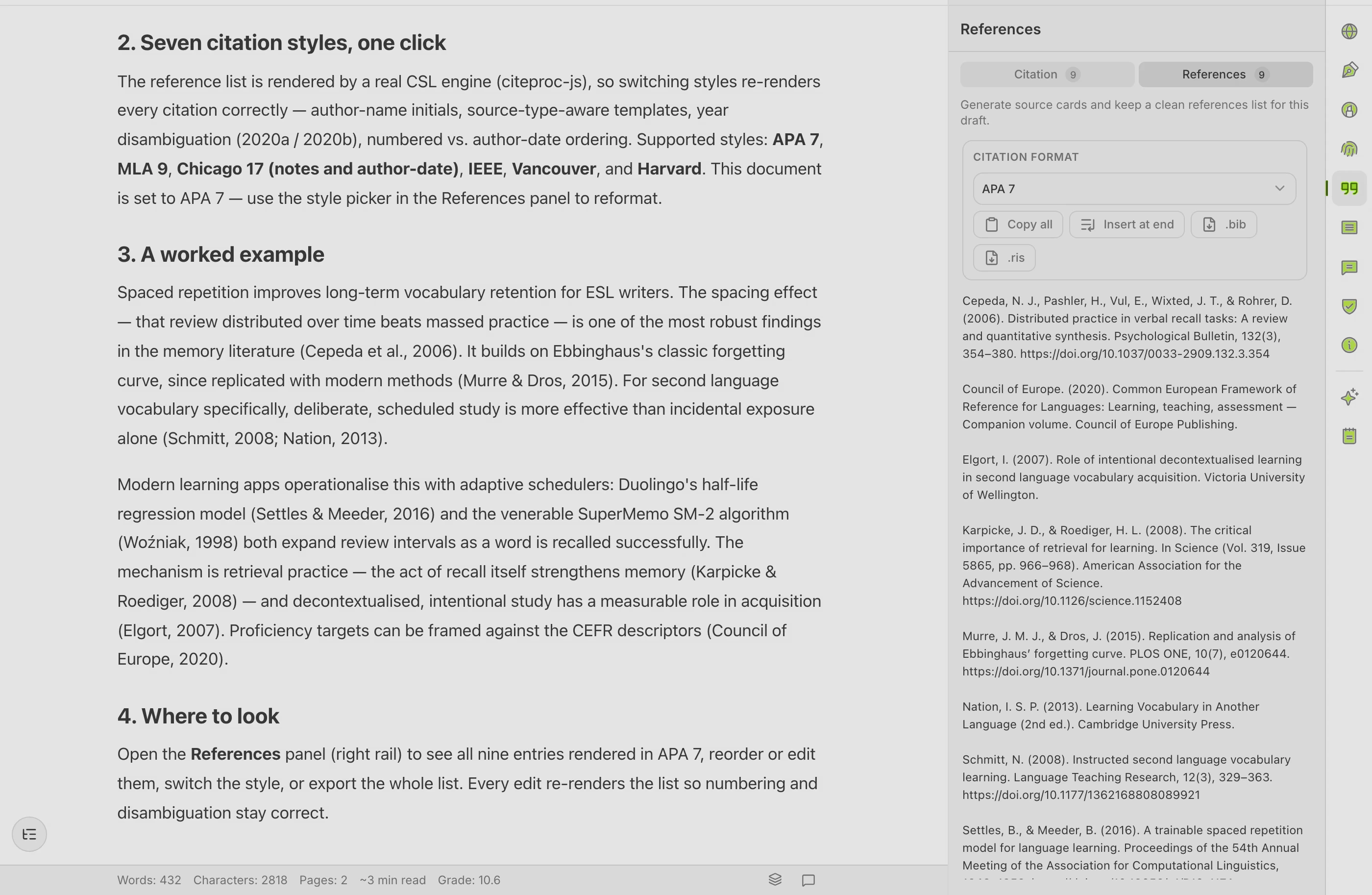
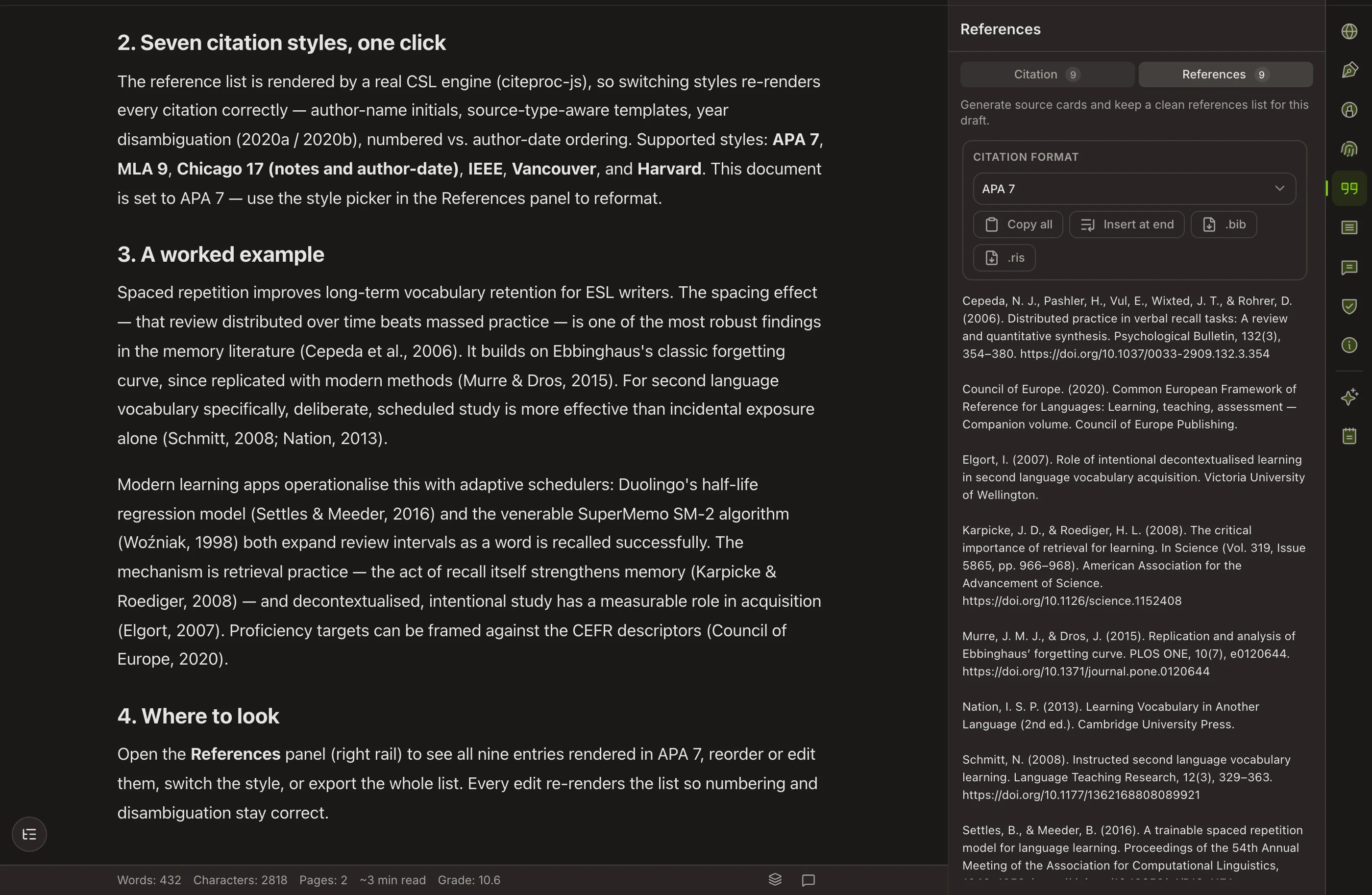
Copyeditor formats APA, MLA, Chicago and IEEE automatically — cite a source once and the references builds itself. See how citations work .
BEFORE YOU FORMAT
What Vancouver needs from a podcast episode
Elements to collect
- Host or producer, with their role in parentheses
- Date the episode was released
- Title of the individual episode
- Episode number, when the series uses them
- Title of the podcast series
- Production company or network
- URL
Rules specific to this entry
- Citing Medicine has no dedicated podcast template, so the audio-on-the-Internet pattern is the conservative construction: host with the role word “host” after the name, episode title, series title, bracketed medium, then the usual place, publisher, date, and cited-date elements.
- The role word matters in Vancouver. “Almeida RT, host.” follows the same convention as “Lindgren M, editor.” and “Interviewed by”. IEEE never labels a role; Vancouver almost always does.
- Keep the episode number. Podcast episode titles are re-edited after publication more often than any other source type, and feeds get re-hosted, so the number is the only stable locator.
- When the claim you are using comes from a guest rather than the host, name the guest in your sentence. The host stays in the author slot because the host is who the series credits.
Building the entry, step by step
Collect the details
Before you format anything, gather every element Vancouver needs for a podcast episode: Host or producer, with their role in parentheses; Date the episode was released; Title of the individual episode; Episode number, when the series uses them.
Build the references entry
Arrange those details in the Vancouver order: #. Host AA, host. Title of the episode. Title of the Series [podcast on the Internet]. Place: Publisher; Year Mon DD [cited Year Mon DD]. Episode ##; ## min. Available from: URL
Add the in-text citation
In the body of your paper, cite it as Bundle compliance drops sharply once the acute team hands over.⁴ — or work the same reference into your sentence as A ward pharmacist interviewed on a clinical podcast⁴ describes compliance falling sharply after handover..
Check it against the exceptions
Citing Medicine has no dedicated podcast template, so the audio-on-the-Internet pattern is the conservative construction: host with the role word “host” after the name, episode title, series title, bracketed medium, then the usual place, publisher, date, and cited-date elements.
Vancouver RULES
The conventions behind every Vancouver entry
Citing Medicine (NLM), 2nd ed. — the reference standard behind Vancouver is the authority. Where a journal or department publishes its own house rules, those win — check your submission guidelines before the references is final.
The rules that apply across every source — author order, capitalization, how the references is sorted, and where Vancouver entries most often go wrong — are collected on the Vancouver style guide.
The same podcast episode in another style
Switching styles late in a draft is normal. Here is the same source formatted five other ways.
Questions about Vancouver and podcast episodes
What if the podcast episode has no author?
Start the entry with the title and keep the number you already assigned it. A numeric references never re-sorts for a missing author, so the entry stays exactly where it is.
What do I need before I can cite a podcast episode?
Host or producer, with their role in parentheses, Date the episode was released, Title of the individual episode, and the rest of the elements listed above. A podcast episode is a part of a series, so it needs the same host/producer distinction as a book chapter — plus an episode number that is easy to miss.
Is there anything unusual about a podcast episode in Vancouver?
Citing Medicine has no dedicated podcast template, so the audio-on-the-Internet pattern is the conservative construction: host with the role word “host” after the name, episode title, series title, bracketed medium, then the usual place, publisher, date, and cited-date elements.
What else catches people out here?
The role word matters in Vancouver. “Almeida RT, host.” follows the same convention as “Lindgren M, editor.” and “Interviewed by”. IEEE never labels a role; Vancouver almost always does.
Can I reformat this podcast episode in another style later?
By hand, you would retype the entry — the element order, punctuation and italics all differ between styles. In Copyeditor, sources are stored as structured data, so switching between APA, MLA, Chicago and IEEE reformats every citation and the whole reference list at once.
Cite it once
and never reformat it again
Copyeditor keeps sources as structured data, so switching between APA, MLA, Chicago and IEEE reformats every citation and the whole references at once.