Vancouver style
How to cite a book in Vancouver style
Books look simple until you hit an edition number, a translator, or a publisher that has been bought three times — and the title page rarely matches the cover.
THE FORMAT
A book in Vancouver, at a glance
#. Author AA, Author BB. Title of the book: subtitle. Edition. Place: Publisher; Year. ### p.
4. Whitcombe DA, Oduya P. Perioperative fluid management: a practical guide. 3rd ed. Oxford: Oxford University Press; 2022. 318 p.
Restrictive regimens remain the default for low-risk elective procedures.⁴
In prose: Whitcombe and Oduya⁴ set out a stepwise approach to intraoperative replacement.
5. Lindgren M, Sato H, editors. Handbook of hospital-acquired infection. 2nd ed. Philadelphia: Wolters Kluwer; 2021.
In text: Surveillance definitions differ between national programs.⁵
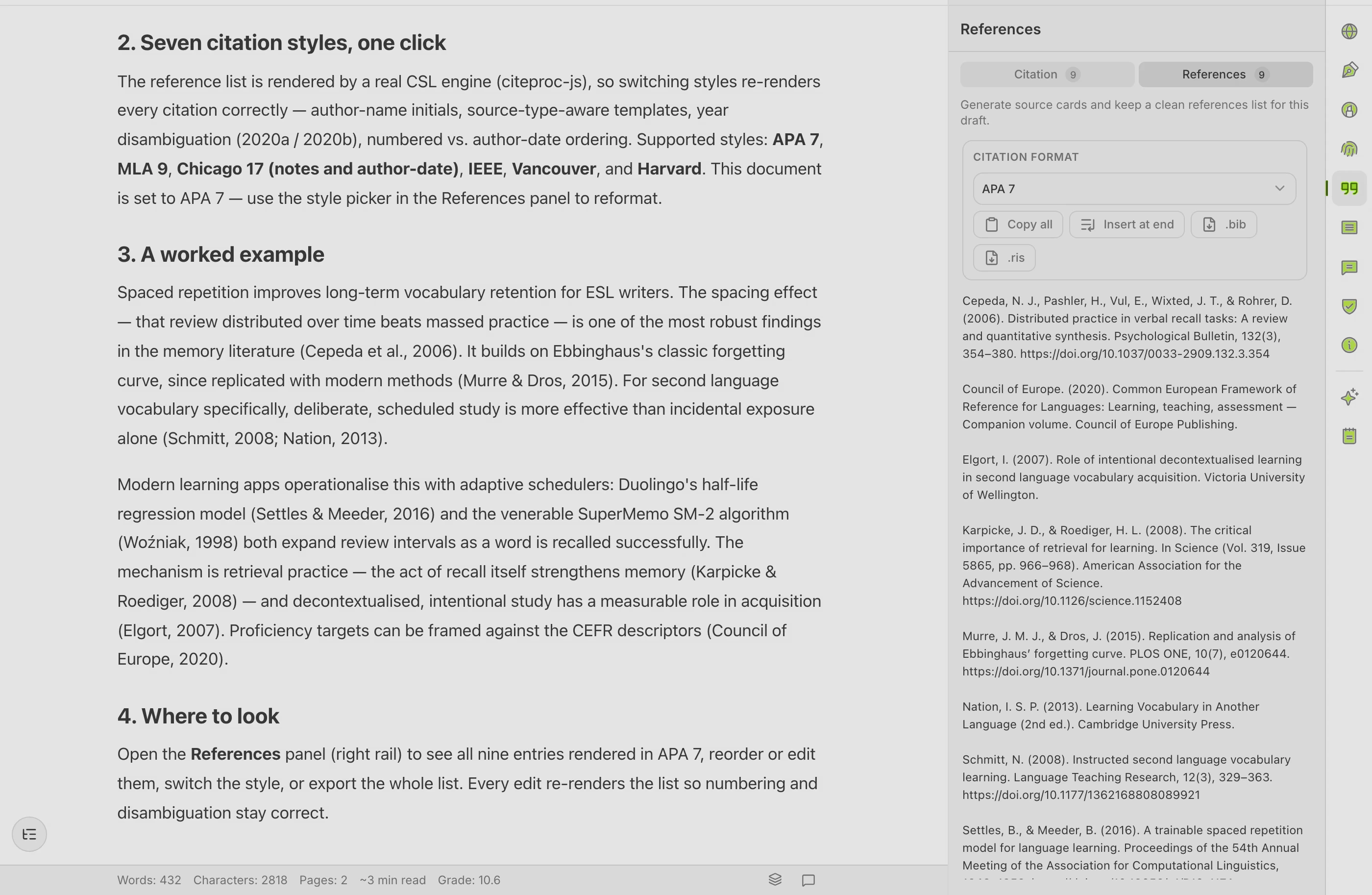
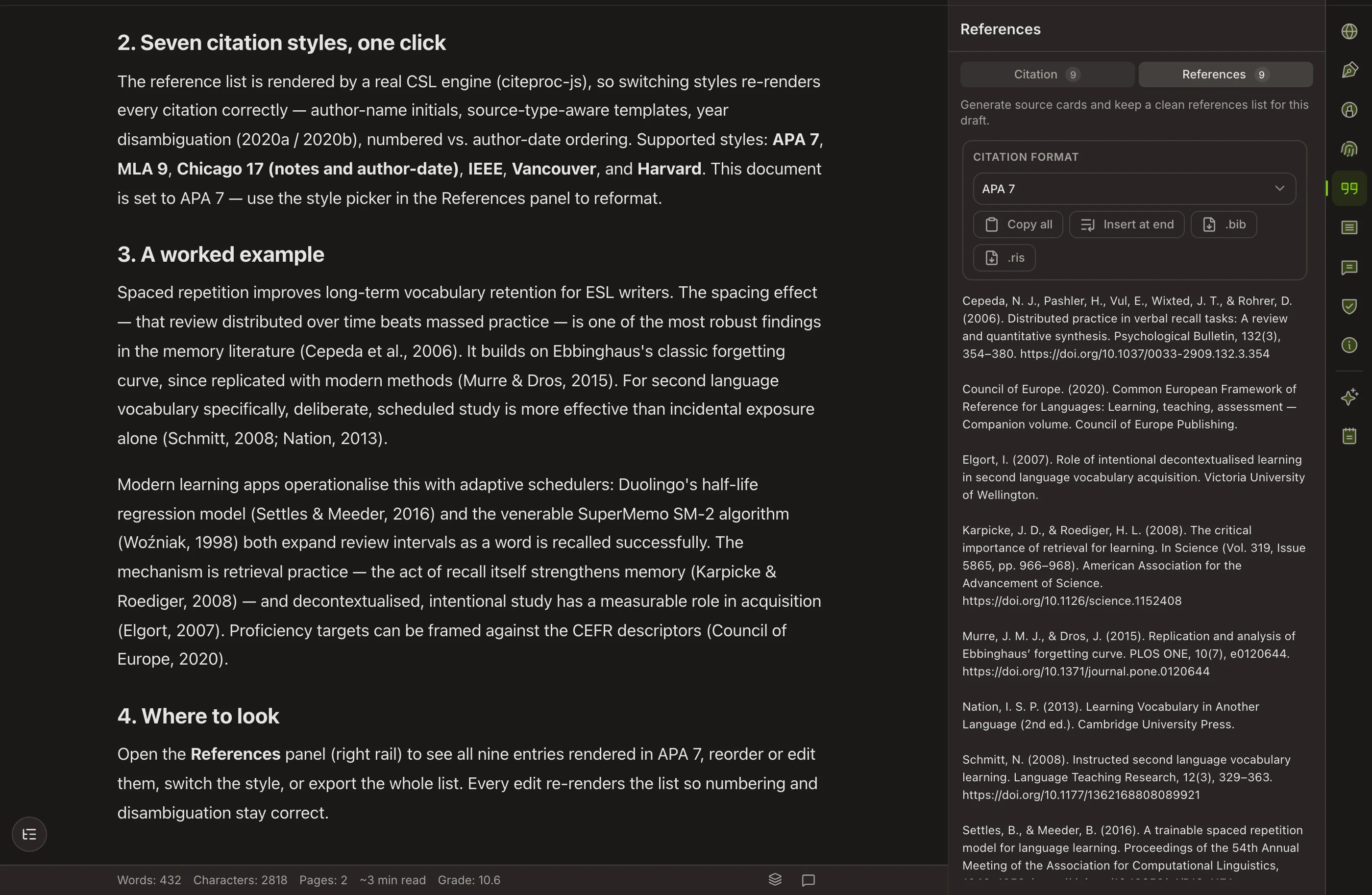
Copyeditor formats APA, MLA, Chicago and IEEE automatically — cite a source once and the references builds itself. See how citations work .
BEFORE YOU FORMAT
What Vancouver needs from a book
Elements to collect
- Author or authors (or an editor, when there is no single author)
- Year of publication of the edition you actually read
- Full title, including any subtitle after the colon
- Edition number, when it is not the first
- Publisher name
- DOI or URL for an ebook that has one
Rules specific to this entry
- Place of publication comes before the publisher, separated by a colon, and the publisher is followed by a semicolon and then the year: “Oxford: Oxford University Press; 2022.” The publisher name is given in full, not abbreviated the way IEEE abbreviates it.
- Book titles take sentence case and no italics in strict NLM style — the same treatment as an article title. The subtitle follows a colon and is not capitalized.
- Citing Medicine closes a whole-book entry with its extent, “318 p.” Most journals treat this as optional. It does no harm to keep, and it is the one place a total page count belongs.
- To point at specific pages of a book, put them in the entry — “p. 112-18” after the year — because Vancouver has no bracketed in-text locator the way IEEE does with [4, pp. 112–118].
Building the entry, step by step
Collect the details
Before you format anything, gather every element Vancouver needs for a book: Author or authors (or an editor, when there is no single author); Year of publication of the edition you actually read; Full title, including any subtitle after the colon; Edition number, when it is not the first.
Build the references entry
Arrange those details in the Vancouver order: #. Author AA, Author BB. Title of the book: subtitle. Edition. Place: Publisher; Year. ### p.
Add the in-text citation
In the body of your paper, cite it as Restrictive regimens remain the default for low-risk elective procedures.⁴ — or work the same reference into your sentence as Whitcombe and Oduya⁴ set out a stepwise approach to intraoperative replacement..
Check it against the exceptions
Place of publication comes before the publisher, separated by a colon, and the publisher is followed by a semicolon and then the year: “Oxford: Oxford University Press; 2022.” The publisher name is given in full, not abbreviated the way IEEE abbreviates it.
Vancouver RULES
The conventions behind every Vancouver entry
Citing Medicine (NLM), 2nd ed. — the reference standard behind Vancouver is the authority. Where a journal or department publishes its own house rules, those win — check your submission guidelines before the references is final.
The rules that apply across every source — author order, capitalization, how the references is sorted, and where Vancouver entries most often go wrong — are collected on the Vancouver style guide.
The same book in another style
Switching styles late in a draft is normal. Here is the same source formatted five other ways.
Questions about Vancouver and books
What if the book has no author?
Start the entry with the title and keep the number you already assigned it. A numeric references never re-sorts for a missing author, so the entry stays exactly where it is.
What do I need before I can cite a book?
Author or authors (or an editor, when there is no single author), Year of publication of the edition you actually read, Full title, including any subtitle after the colon, and the rest of the elements listed above. Books look simple until you hit an edition number, a translator, or a publisher that has been bought three times — and the title page rarely matches the cover.
Is there anything unusual about a book in Vancouver?
Place of publication comes before the publisher, separated by a colon, and the publisher is followed by a semicolon and then the year: “Oxford: Oxford University Press; 2022.” The publisher name is given in full, not abbreviated the way IEEE abbreviates it.
What else catches people out here?
Book titles take sentence case and no italics in strict NLM style — the same treatment as an article title. The subtitle follows a colon and is not capitalized.
Can I reformat this book in another style later?
By hand, you would retype the entry — the element order, punctuation and italics all differ between styles. In Copyeditor, sources are stored as structured data, so switching between APA, MLA, Chicago and IEEE reformats every citation and the whole reference list at once.
Cite it once
and never reformat it again
Copyeditor keeps sources as structured data, so switching between APA, MLA, Chicago and IEEE reformats every citation and the whole references at once.